-
Use Cases
-
Resources
-
Pricing
Barcelona, the capital of Catalonia, has a history spanning over 2,000 years. Founded as the Roman colony of Barcino, it grew into an important Mediterranean port, flourished during the medieval period as a center of the Crown of Aragon, experienced a cultural renaissance with Catalan Modernism led by Antoni Gaudí, endured the turmoil of the Spanish Civil War and Franco's dictatorship, and transformed itself through the 1992 Olympic Games into one of Europe's most dynamic and visited cities. More Less
2000 BC
% complete
The history of Barcelona stretches over 2000 years to its origins as an Iberian village named Barkeno, marking the earliest named settlement on the site of the modern city.
Image source: History of Barcelona
300 BC - 200 BC
% complete
In the 3rd and 2nd centuries BC, the area was settled by the Laietani, an Iberian people, at Barkeno on the Tàber hill (in the present-day Ciutat Vella) and at Laie (or Laiesken), believed to have been located on Montjuïc.
218 BC
% complete
Information about the period from 218 BC until the 1st century BC is scarce, but this era marks the beginning of Roman influence over the settlement later known as Barcino.
1 AD
% complete
The forum's most impressive building was the temple dedicated to Caesar Augustus, probably constructed at the start of the 1st century. Columns of this temple can still be seen today in the Gothic Quarter.
Image source: Temple of Augustus, Barcelona
100 AD
% complete
By the 2nd century, the city had the form of an oppidum and a population of 3500–5000, establishing itself as a small but significant Roman town.
250 AD - 300 AD
% complete
The Christian community in Barcino appears to have been established in the latter half of the 3rd century, laying the foundations for the city's long religious history.
250 AD - 300 AD
% complete
The first raids by the Germanic tribes started around 250, and the fortifications of the city were substantially improved in the later years of the 3rd century under Claudius II.
259 AD
% complete
The first Christian communities in the Tarraconense were founded during the 3rd century, and the diocese of Tarraco was already established by 259, when bishop Saint Fructuosus and deacons Augurius and Eulogius were burned alive under an edict of Emperor Valerian.
Image source: Fructuosus
303 AD
% complete
The persecution of Christians under Diocletian at the start of the 4th century led to at least one martyr dying in the region of Barcino: Saint Cucuphas (Sant Cugat).
Image source: Cucuphas
350 AD
% complete
The Jewish population of Barcino/Barchinona dates from the mid-4th century at the latest, contributing to the cultural diversity of the ancient city.
Image source: History of the Jews in Catalonia
400 AD
% complete
The first major Christian church in Barcino, the Basílica de la Santa Creu, was constructed around the end of the 4th century at the site where the medieval Barcelona Cathedral now stands; its baptistry can be accessed through the Museum of the History of Barcelona (MUHBA).
Image source: Barcelona Cathedral
401 AD - 500 AD
% complete
At the start of the 5th century, the Western Roman Empire suffered ever more serious attacks at the hands of various Germanic peoples, notably the Goths and the Vandals, heralding the end of Roman rule over Barcino.
897 AD - 911 AD
% complete
Wilfred II Borrell was the last of the Counts of Barcelona to pledge fidelity to the Carolingian court, although the renunciation of any claim of feudal overlordship by the French king was not confirmed until 1258 with the Treaty of Corbeil.
Image source: Wilfred II Borell
900 AD - 1100 AD
% complete
The Counts of Barcelona also repopulated their inland realms, whose population had plummeted after two centuries of war, expanding Catalan territory and influence.
1162 AD
% complete
Alfonso II of Aragon and I of Barcelona inherited the Crown of Aragon in 1162 thanks to the marriage in 1137 of Ramon Berenguer IV, Count of Barcelona, with Petronila of Aragon, though the administrations of Aragon and Catalonia remained mostly separate.
Image source: Alfonso II of Aragon
1258 AD - 1266 AD
% complete
In 1258 James I of Aragon allowed the merchant guilds of Barcelona to draw ordinances regulating maritime trade in the city's port, and in 1266 he permitted the city to appoint consuls to all the major Mediterranean ports of the period.
Image source: Consulate of the Sea
1469 AD
% complete
The marriage of Ferdinand II of Aragon and Isabella I of Castile in 1469 united the two royal lines, creating a dynastic union that would shape Spain's future.
Image source: Ferdinand II of Aragon
1700 AD - 1800 AD
% complete
During the 18th century, a fortress was built at Montjuïc overlooking the harbour, strengthening the military defences of the city and its port.
Image source: Montjuïc Castle
1701 AD - 1714 AD
% complete
The dynastic unification of the Spanish kingdoms and the riches of the New World had political repercussions across Europe, leading ultimately to the War of the Spanish Succession from 1701 to 1714.
Image source: War of the Spanish Succession
1716 AD
% complete
The Catalan institutions sided with the Habsburgs against the Bourbon Philip V, which led to the abolition of the separate status of the Principality of Catalonia with the last of the Nueva Planta decrees in 1716, diminishing Barcelona's political influence in Spain.
Image source: Nueva Planta decrees
Mar 16, 1794
% complete
On 16 March 1794, even though France and Spain were at war, French astronomer Pierre François André Méchain was given leave to enter the Montjuïc fortress to make observations used to measure the distance from Dunkirk to Barcelona, cities lying approximately on the same longitude as Paris — work foundational to defining the metre.
Image source: Pierre Méchain
Jun 22, 1799
% complete
The definitive metre bar, manufactured from platinum using measurements including Méchain's observations near Barcelona, was deposited in the Archives of the French Republic by the French legislative assembly on 22 June 1799.
Image source: Metre
1807 AD - 1867 AD
% complete
During the 19th century, Catalan business interests based increasingly in Barcelona became involved in the Atlantic slave trade after British abolition in 1807. Between 1817 and 1867, Catalans transported some 700,000 slaves from West Africa to the Caribbean, financing much of Catalonia's industrialisation and Barcelona's 19th-century building boom, despite Spain's nominal ban on slave trading in 1817.
Image source: Atlantic slave trade
1812 AD - 1814 AD
% complete
In 1812, Barcelona was annexed by Napoleonic France and incorporated into the First French Empire as part of the department Montserrat (later Bouches-de-l'Èbre-Montserrat), where it remained until Napoleon's defeat.
Image source: First French Empire
1835 AD - 1843 AD
% complete
During the early regency of Isabel II, the populace of Barcelona came into regular conflict with the Spanish government in a series of revolts known as bullangues, culminating with the 1842 Bombardment of Barcelona and the 1843 Jamància insurrection when the population was brought into submission.
Image source: Bombardment of Barcelona (1842)
1886 AD
% complete
When slavery was abolished in the Spanish Empire in 1886, many Catalans returned to Barcelona and invested their fortunes in constructing opulent mansions in areas such as La Rambla.
Image source: Slavery in Spain
1888 AD
% complete
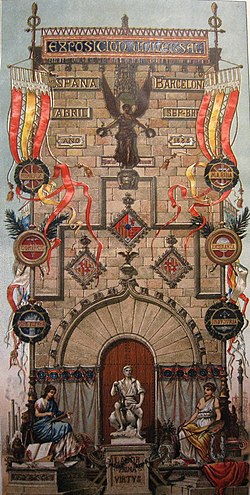
In 1888, Barcelona hosted the Exposición Universal de Barcelona, which led to a great extension of its urbanised area from Parc de la Ciutadella to Barceloneta and showcased the city's industrial prowess.
Image source: 1888 Barcelona Universal Exposition
1897 AD
% complete
In 1897, the city absorbed six surrounding municipalities and the new district of the Eixample (literally 'the extension') was laid out, dramatically reshaping Barcelona's urban form.
Image source: Eixample
1904 AD - 1924 AD
% complete
The continued growth of Barcelona saw Horta annexed in 1904 and Sarrià in 1924, further expanding the city's boundaries.
Image source: Horta-Guinardó
Jul 26, 1909 - Aug 1, 1909
% complete
During the last week of July 1909, ever since referred to as Tragic Week, the Spanish army clashed with the working classes of Barcelona and other cities of Catalonia in a violent uprising.
Image source: Tragic Week (Spain)
1924 AD - 1929 AD
% complete
A second major international exhibition was organised in 1929, leading to the urbanisation of the area around Plaça Espanya and providing the impetus for the construction of the metro, inaugurated in 1924.
Image source: 1929 Barcelona International Exposition
1932 AD - 1939 AD
% complete
In 1932, Barcelona became the capital of the autonomous region of Catalonia within the Second Spanish Republic, thus being the seat of the Generalitat, the Catalan institution of self-government.
Image source: Second Spanish Republic
Jul 18, 1936
% complete
The city had prepared to host the People's Olympics during the summer of 1936, building the Olympic Stadium and developing the Montjuïc area, but the insurrection of the army in July 1936 plunged Spain into civil war and the games never took place.
Image source: People's Olympiad
Mar 16, 1938 - Mar 18, 1938
% complete
The most severe aerial bombardment of Barcelona during the Spanish Civil War lasted three days beginning on 16 March 1938, causing hundreds of civilian deaths at the height of the war.
Image source: Bombing of Barcelona
Jan 26, 1939
% complete
The city finally fell into Nationalist hands on 26 January 1939, marking the effective end of Republican Catalonia during the Spanish Civil War.
Image source: Catalonia Offensive
1952 AD - 1960 AD
% complete
The neighbourhood of El Congrés i els Indians was developed for the International Eucharistic Congress in 1952, while the neighbourhoods of El Carmel, Verdum and Guinardó were developed later in the same decade amid rapid urban expansion.
Image source: El Congrés i els Indians
1970 AD
% complete
By 1970, Barcelona had an extremely dense population (1,557,863 inhabitants, 15,517 per km²), often housed in very poor quality accommodations built hastily to absorb migration into the city.
Image source: Outline of Barcelona
Nov 20, 1975
% complete
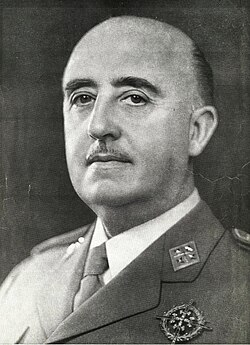
The death of Franco in 1975 brought on a period of democratisation throughout Spain, opening the way for the restoration of regional autonomy, including in Catalonia.
Image source: Francisco Franco
Sep 11, 1977
% complete
Massive, but peaceful, demonstrations on 11 September 1977 assembled over a million people in the streets of Barcelona to call for the restoration of Catalan autonomy, a landmark moment in Spain's democratic transition.
Image source: National Day for Yes
1981 AD - 2000 AD
% complete
The increased cost of housing led to a decline (−16.6%) in the population over the last two decades of the 20th century as many families moved out into the suburbs.
1986 AD
% complete
Two events in 1986 promoted Barcelona's development: Spanish accession to the European Community and particularly Barcelona's designation as host city of the 1992 Summer Olympics and later the 1992 Summer Paralympics, which transformed the city's waterfront and infrastructure.
Image source: 1992 Summer Olympics
2001 AD
% complete
This decline has been reversed since 2001, as a new wave of immigration, particularly from Latin America and Morocco, has gathered pace, restoring Barcelona's population growth and cultural dynamism.
Image source: Immigration to Spain
Or browse the full history timeline directory, with more than 2,000 topics.
This History of Barcelona timeline was generated with the help of AI, using information found on the internet.
We work hard to keep these timelines accurate, but mistakes do get through. If you spot one, email us at [email protected] and we'll fix it for future visitors.
Generate yours with AI or build it from scratch, for free.
Export your timeline, add your own events, edit or remove AI-generated events, and much more
No credit card required.
Cancel anytime.
Cancel anytime.
You can create an unlimited number of timelines with up to 10 events on each one, customize how they look, export them to PDF, PNG, PowerPoint, CSV, and Excel, and share them with a link. Paid plans raise the event limit and add features like spreadsheet imports and collaborators.
Yes. You can cancel your subscription from your account page at any time, and you will not be charged again. Your subscription stays active for the rest of the period you already paid for.
Yes. We will email you a reminder before the annual renewal, and we will also email you a receipt.
Yes. You can email us within 15 days of any payment, and we will issue you a full refund.
Check out our pricing docs or send us an email anytime: [email protected].