-
Use Cases
-
Resources
-
Pricing
Berlin, the capital of Germany, has a history spanning over 800 years. Founded in the 13th century, it grew into the capital of Prussia and later the German Empire. The 20th century brought dramatic transformations: the Weimar era's cultural flowering, Nazi rule and World War II devastation, and its division into East and West Berlin by the Berlin Wall in 1961. The fall of the Wall in 1989 and German reunification in 1990 restored Berlin as the unified capital of Germany, making its history one of the most compelling narratives of the modern era. More Less
1237
% complete
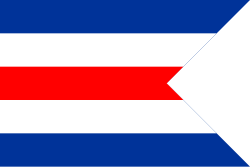
The settlement of Cölln on an island in the Spree River was first mentioned in documents in 1237. Along with the neighboring settlement of Berlin across the river, it formed the nucleus of what would become the German capital.
1251
% complete
Berlin received formal town privileges, allowing it to hold markets, collect tolls, and govern itself, which fueled its growth as a trading center in the Margraviate of Brandenburg.
Image source: History of Berlin
1307
% complete
The twin towns of Berlin and Cölln formally united politically, sharing a common government and presenting themselves as a single city, though they remained legally separate until 1710.
Image source: Cölln
1369
% complete
Berlin became a member of the Hanseatic League, the powerful commercial confederation of northern European cities, boosting its trade in cloth, grain, and timber.
Image source: Hanseatic League
1415
% complete
Frederick VI of Hohenzollern was made Elector of Brandenburg, beginning over 500 years of Hohenzollern rule and establishing Berlin as the dynasty's principal residence.
Image source: Frederick I, Elector of Brandenburg
1647
% complete
The famous linden-lined boulevard from the City Palace to the Tiergarten was laid out under Frederick William, the Great Elector, becoming Berlin's most elegant promenade.
Image source: Unter den Linden
1701
% complete
When Elector Frederick III crowned himself King Frederick I in Prussia, Berlin became the capital of the new Kingdom of Prussia, launching its rise as a major European power center.
Image source: Kingdom of Prussia
1710
% complete
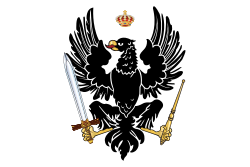
King Frederick I formally united Berlin, Cölln, and surrounding settlements into a single municipality known as Berlin, consolidating the city's administration.
1791
% complete
Designed by Carl Gotthard Langhans and inspired by the propylaea of Athens, the Brandenburg Gate was completed, becoming the defining symbol of Berlin and later of German division and reunification.
Image source: Brandenburg Gate
Oct 27, 1806 - 1808
% complete
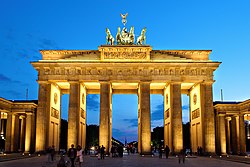
Napoleon's troops marched through the Brandenburg Gate after defeating Prussia at Jena–Auerstedt and occupied Berlin. The French emperor famously removed the Quadriga statue and took it to Paris.
Image source: Fall of Berlin (1806)
1810
% complete
Wilhelm von Humboldt founded the University of Berlin, which pioneered the modern research university model and attracted scholars like Hegel, Einstein, and the Grimm brothers.
Image source: Humboldt University of Berlin
Jan 18, 1871
% complete
Following victory in the Franco-Prussian War, Otto von Bismarck proclaimed the German Empire at Versailles with King Wilhelm I as emperor, making Berlin the capital of unified Germany and one of Europe's great metropolises.
Image source: German Empire
Oct 1, 1920
% complete
The Greater Berlin Act merged dozens of surrounding towns and districts into a single 'Greater Berlin,' tripling the population to about four million and creating the modern city boundaries.
1924 - 1929
% complete
Weimar-era Berlin became Europe's cultural capital, home to avant-garde art, cabaret, cinema at UFA studios, and intellectual giants, despite political turmoil and economic hardship.
Image source: Golden Twenties
Jan 30, 1933
% complete
Hitler was appointed Chancellor in Berlin, beginning Nazi rule. The Reichstag fire a month later was used to crush opposition, transforming the capital into the center of the Third Reich.
Image source: Adolf Hitler's rise to power
Aug 1, 1936 - Aug 16, 1936
% complete
Berlin hosted the Summer Olympics, which the Nazis used for propaganda. Jesse Owens's four gold medals famously undermined Hitler's claims of Aryan supremacy.
Image source: 1936 Summer Olympics
Nov 9, 1938 - Nov 10, 1938
% complete
During the nationwide November pogrom, Nazis destroyed synagogues and Jewish businesses across Berlin, including major synagogues such as those on Oranienburger Straße and in Spandau.
Image source: Kristallnacht
Apr 16, 1945 - May 2, 1945
% complete
Soviet forces stormed Berlin in fierce street fighting, capturing the city and leading to Germany's unconditional surrender. Much of central Berlin lay in ruins, and Hitler died in his bunker during the battle.
Image source: Battle of Berlin
Jul 1945
% complete
At the Potsdam Conference, the victorious Allies divided Berlin into American, British, French, and Soviet occupation sectors, even though the city sat deep within the Soviet zone of Germany.
Image source: Allied-occupied Germany
Jun 24, 1948 - May 12, 1949
% complete
The Soviet Union blockaded all land access to West Berlin. In response, the Western Allies mounted the Berlin Airlift, flying in food and fuel for nearly a year until Stalin lifted the blockade.
Image source: Berlin Blockade
Oct 7, 1949
% complete
With the founding of the German Democratic Republic, East Berlin was designated its capital, while West Berlin remained aligned with West Germany as a democratic enclave inside communist territory.
Image source: East Berlin
Jun 17, 1953
% complete
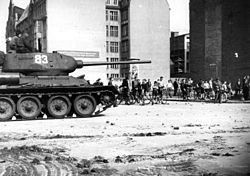
Workers in East Berlin struck against increased production quotas; the revolt spread across East Germany before being crushed by Soviet tanks, leaving at least 55 dead and deepening Cold War tensions.
Image source: East German uprising of 1953
Aug 13, 1961
% complete
East Germany sealed the border between East and West Berlin overnight, erecting barbed wire that evolved into a concrete wall, cutting families apart and becoming the starkest symbol of the Iron Curtain.
Image source: Berlin Wall
Jun 26, 1963
% complete
President John F. Kennedy spoke to hundreds of thousands of West Berliners in front of Schöneberg Town Hall, declaring solidarity with the isolated western enclave at the height of the Cold War.
Image source: Ich bin ein Berliner
Sep 3, 1971
% complete
The four occupying powers agreed to ease tensions over Berlin, guaranteeing Western access routes and improving travel and communication between the two halves of the divided city.
Image source: Four Power Agreement on Berlin
Nov 9, 1989
% complete
After weeks of mass protests, East Germany announced open borders and jubilant crowds surged through checkpoints, dancing atop the wall that had divided Berlin for 28 years.
Image source: Fall of the Berlin Wall
Oct 3, 1990
% complete
East and West Germany reunited as a single federal state, and reunified Berlin was designated the capital of Germany once again.
Image source: German reunification
1999
% complete
The Bundestag and parts of the federal government completed their relocation to Berlin, restoring the city's role as the seat of German political power.
Image source: Berlin-Bonn Act
Apr 1999
% complete
Norman Foster's glass dome atop the renovated Reichstag opened, symbolizing transparency in German democracy and becoming one of Berlin's most visited landmarks.
Image source: Reichstag building
May 10, 2005
% complete
Peter Eisenman's field of 2,711 concrete stelae near the Brandenburg Gate was dedicated as Germany's central Holocaust memorial, cementing Berlin's culture of remembrance.
Image source: Memorial to the Murdered Jews of Europe
Or browse the full history timeline directory, with more than 2,000 topics.
This History of Berlin timeline was generated with the help of AI, using information found on the internet.
We work hard to keep these timelines accurate, but mistakes do get through. If you spot one, email us at [email protected] and we'll fix it for future visitors.
Generate yours with AI or build it from scratch, for free.
Export your timeline, add your own events, edit or remove AI-generated events, and much more
No credit card required.
Cancel anytime.
Cancel anytime.
You can create an unlimited number of timelines with up to 10 events on each one, customize how they look, export them to PDF, PNG, PowerPoint, CSV, and Excel, and share them with a link. Paid plans raise the event limit and add features like spreadsheet imports and collaborators.
Yes. You can cancel your subscription from your account page at any time, and you will not be charged again. Your subscription stays active for the rest of the period you already paid for.
Yes. We will email you a reminder before the annual renewal, and we will also email you a receipt.
Yes. You can email us within 15 days of any payment, and we will issue you a full refund.
Check out our pricing docs or send us an email anytime: [email protected].