-
Use Cases
-
Resources
-
Pricing
The Berlin Airlift was a monumental humanitarian and logistical operation conducted by the United States, Britain, and their allies from June 1948 to September 1949. In response to the Soviet blockade of all ground and water routes into West Berlin, the Western Allies flew supplies—food, fuel, and medicine—to over two million residents of the city. The airlift delivered more than 2.3 million tons of cargo through nearly 280,000 flights, demonstrating Western resolve during the early Cold War and ultimately forcing the Soviets to lift the blockade. More Less
Jun 1945
% complete
In a June 1945 meeting, Stalin informed German communist leaders that he expected to slowly undermine the British position within their occupation zone, that the United States would withdraw within a year or two, and that nothing would then stand in the way of a united Germany under communist control within the Soviet orbit.
Image source: Berlin Blockade
Jan 1, 1946
% complete
Stalin and other leaders told visiting Bulgarian and Yugoslavian delegations in early 1946 that Germany must be both Soviet and communist, signalling Moscow's long-term ambitions for the defeated nation.
Jan 1, 1946
% complete
After harsh treatment, forced emigration, political repression and the particularly harsh winter of 1945–1946, Germans in the Soviet-controlled zone were hostile to Soviet endeavours. Local elections in 1946 resulted in a massive anti-communist protest vote, especially in the Soviet sector of Berlin.
Jan 1, 1946
% complete
In 1946 the Soviets stopped delivering agricultural goods from their zone in eastern Germany, an early sign of economic pressure on the Western zones and Berlin.
Jan 1, 1947
% complete
To coordinate the economies of the British and United States occupation zones, these were combined on 1 January 1947 into what was referred to as the Bizone, deepening the economic division of Germany.
Image source: Bizone
Jun 1947
% complete
The Marshall Plan, named after Secretary of State George C. Marshall, was introduced in June 1947 to rebuild Western Europe's economies. Its extension to West Germany would later provoke strong Soviet opposition.
Image source: Marshall Plan
Jun 12, 1947
% complete
An article by Yuliana Semyonova in Pravda on 12 June 1947 said that America's geopolitical strategy was fascist, reflecting escalating Soviet propaganda against the West.
Image source: Pravda
Jul 31, 1947
% complete
On 31 July 1947, the Central Committee directed the newspaper Literaturnaya Gazeta to criticise and target the American way of life; Soviet posters warned against America, with one showing a Soviet soldier warning Uncle Sam to 'stop messing around'.
Image source: Literaturnaya gazeta
Nov 1947 - Dec 1947
% complete
At a meeting of the Council of Foreign Ministers in London in November–December 1947, the Allies could not agree among themselves to reunite Germany, hardening the division between East and West.
Jan 1, 1948 - Jun 30, 1948
% complete
Trilateral talks were held in London between the UK, US, France and the Benelux nations, meeting twice in the first half of 1948 to discuss the future of Germany, going ahead despite Soviet threats to ignore any resulting decisions.
Jan 25, 1948
% complete
In response to the announcement of the first London meeting, in late January 1948 the Soviets began stopping British and American trains to Berlin to check passenger identities, an early harassment measure.
Mar 7, 1948
% complete
As outlined in an announcement on 7 March 1948, all of the governments present approved the extension of the Marshall Plan to Germany, finalised the economic merger of the western occupation zones and agreed upon the establishment of a federal system of government for them.
Mar 12, 1948
% complete
After a 9 March meeting between Stalin and his military advisers, a secret memorandum was sent to Molotov on 12 March 1948 outlining a plan to force the policy of the Western Allies into line with Soviet wishes by 'regulating' access to Berlin.
Jul 17, 1945 - Aug 2, 1945
% complete
From 17 July to 2 August 1945, the victorious Allies signed the Potsdam Agreement on the fate of postwar Europe, calling for the division of defeated Germany, west of the Oder–Neisse line, into four temporary occupation zones controlled by the United States, the United Kingdom, France and the Soviet Union.
Image source: Potsdam Agreement
Nov 30, 1945
% complete
On 30 November 1945, the Allied Control Council in Berlin approved the only written agreement regarding transportation to Berlin from the West, which would later become central to disputes over access during the blockade.
Image source: Allied Control Council
Mar 25, 1948
% complete
On 25 March 1948, the Soviets issued orders restricting Western military and passenger traffic between the American, British and French occupation zones and Berlin, tightening the screws on Western access.
Apr 10, 1948
% complete
The Soviets eased their restrictions on Allied military trains on 10 April 1948, but continued periodically to interrupt rail and road traffic during the next 75 days, while the United States continued supplying its military forces by using cargo aircraft.
May 1948
% complete
Anticipating the introduction of a new currency by the countries in the non-Soviet zones, the Soviet Union in May 1948 directed its military to introduce its own new currency and to permit only the Soviet currency in their sector of Berlin if the others brought in a different currency there.
Jun 18, 1948
% complete
The day after the 18 June 1948 announcement of the new Deutsche Mark, Soviet guards halted all passenger trains and traffic on the autobahn to Berlin, delayed Western and German freight shipments and required that all water transport secure special Soviet permission.
Image source: Deutsche Mark
Jun 24, 1948 - May 12, 1949
% complete
On 24 June 1948, Stalin ordered Soviet troops to block all rail and barge traffic in and out of Berlin, beginning one of the first major international crises of the Cold War and cutting off West Berlin from supplies by land and water.
Jun 25, 1948
% complete
On 25 June 1948, General Lucius D. Clay gave the order to launch Operation Vittles, beginning the American airlift of supplies into blockaded West Berlin.
Image source: Berlin Blockade
Jun 28, 1948
% complete
On 28 June 1948, General Curtis LeMay appointed Brigadier General Joseph Smith, commander of the installation at Wiesbaden, as the Berlin Airlift Task Force Commander.
Image source: Joseph Smith
Jun 30, 1948
% complete
MATS had been established weeks prior to Operation Vittles, and they became involved on 30 June 1948, when 35 MATS C-54s with crews arrived at Wiesbaden to aid the operation.
Image source: Military Air Transport Service
Jul 1948 - Sep 1948
% complete
Since the existing system could not endure through the winter, between July and September 1948 a 1,800-metre (5,900 ft)-long asphalt runway was constructed at Tempelhof, with the auxiliary runway upgraded from Marston Matting to asphalt between September and October 1948.
Image source: Berlin Tempelhof Airport
Jul 2, 1948
% complete
On 2 July 1948, approximately 100 C-47s from the European Air Transport Service were delivering supplies to Berlin, and by 20 July the USAF had increased its contribution to 105 C-47s and 54 C-54s.
Image source: Douglas C-47 Skytrain
Jul 8, 1948
% complete
General Lucius D. Clay, the American military governor who ordered the airlift, was featured on the cover of Time magazine on 8 July 1948, reflecting his prominence during the crisis.
Image source: Lucius D. Clay
Jul 22, 1948
% complete
This was recognised by the United States National Security Council at a meeting with Clay on 22 July 1948, when it became clear that a long-term airlift was necessary to sustain West Berlin.
Image source: United States National Security Council
Jul 23, 1948
% complete
On 23 July 1948, Major General William H. Tunner was made commander by Headquarters USAF to oversee the provisional Airlift Task Force Headquarters at Wiesbaden, including maintenance of facilities, air traffic control equipment and supporting personnel.
Image source: William H. Tunner
Jul 28, 1948
% complete
On 28 July 1948, Tunner arrived in Wiesbaden to take over the airlift operation, bringing experience from commanding the Hump airlift over the Himalayas during World War II.
Jul 30, 1948
% complete
On 30 July 1948, the Airlift Task Force (Provisional) was formed; however, there were coordination issues between the British and American operations due to increasing air traffic.
Aug 4, 1948
% complete
Tunner wanted to expand American operation bases closer to Berlin, and on 4 August 1948 preliminary plans were put in place for expansion to RAF Fassberg in the British sector.
Image source: Faßberg
Aug 21, 1948
% complete
Tunner complained to the MATS commander on 21 August 1948, writing that they were lacking air traffic controllers in the Air Force as flight volumes grew dramatically.
Aug 31, 1948
% complete
By the end of August 1948, after two months, the airlift was succeeding: daily operations flew more than 1,500 flights a day and delivered more than 4,500 tons of cargo, enough to keep West Berlin supplied.
Oct 15, 1948
% complete
Following discussions, the Combined Airlift Task Force (CALTF) was officially established on 15 October 1948 and controlled both the USAFE and RAF lift operations from a central location, resolving earlier coordination problems.
Dec 1948 - Feb 1949
% complete
The winter of 1948–1949 was one of the worst on record and resulted in fog, low ceilings and low visibility; the Allies used technology such as ground-controlled approach radar as mitigation to keep aircraft flying.
Jan 1949
% complete
In January 1949, Major General Laurence S. Kuter took overall command of the airlift operation, continuing the effort to keep West Berlin supplied through the difficult winter months.
Image source: Laurence S. Kuter
Apr 15, 1949 - Apr 16, 1949
% complete
By April 1949, airlift operations were running smoothly and Tunner wanted to shake up his command to discourage complacency. From noon on 15 April to noon on 16 April 1949, crews worked around the clock in the famous 'Easter Parade', delivering a record amount of cargo to demonstrate the airlift's capability.
Aug 18, 1949
% complete
On 18 August 1949, Flt Lt Roy Mather DFC AFC and his crew flew back to Wunstorf for the 404th time during the blockade, the record number of flights for any pilot of any nationality, either civilian or military.
Image source: Royal Air Force
Aug 1, 1948 - Aug 4, 1948
% complete
Starting on 1 August 1948, the Soviets offered free food to anyone who crossed into East Berlin and registered their ration cards there; almost 22,000 Berliners received their cards by 4 August 1948.
Aug 1948 - Sep 1948
% complete
In late August and early September 1948, a soft-power offensive began, with the Red Army Choir (the Alexandrov Ensemble) performing for mass audiences in public squares of the Soviet Zone.
Image source: Alexandrov Ensemble
Aug 1948
% complete
An opinion poll in August 1948 showed that 80 percent of those polled listened most to RIAS, a US-sponsored radio station in Berlin, whereas only 15 percent listened more to Radio Berlin, a Soviet-run station.
Sep 1948
% complete
In the autumn of 1948 it became impossible for the non-Communist majority in Greater Berlin's citywide parliament to attend sessions at city hall within the Soviet sector. The parliament decided to meet instead in the canteen of the Technische Hochschule in Berlin in the British sector, boycotted by SED members.
Image source: Technical University of Berlin
Sep 9, 1948
% complete
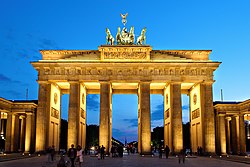
On 9 September 1948, a crowd of 500,000 people gathered at the Brandenburg Gate, next to the ruined Reichstag in the British sector, demonstrating support for the elected city government against Soviet pressure.
Nov 1948
% complete
By November 1948, so-called Free Shops began in East Berlin and Brandenburg allowing West Berliners to purchase provisions using the Eastmark, part of Soviet efforts to draw West Berliners eastward.
Image source: East German mark
Nov 30, 1948
% complete
On 30 November 1948 the SED gathered its elected parliament members and 1,100 further activists and held an unconstitutional so-called 'extraordinary city assembly' in East Berlin's Metropol-Theater which declared the elected city government deposed and replaced it with a new one led by Oberbürgermeister Friedrich Ebert Jr.
Image source: Friedrich Ebert Jr.
Dec 5, 1948
% complete
The city parliament voted for its re-election on 5 December 1948, inhibited in the eastern sector and denounced by the SED as a Spalterwahl ('divisive election'). Turnout amounted to 86.3% of the western electorate, with the SPD gaining 64.5% of votes, the CDU 19.4%, and the LDP 16.1%; almost 85 percent of West Berliners voted against communist parties.
Dec 7, 1948
% complete
On 7 December 1948 the new, de facto West-Berlin-only city parliament elected a new city government headed by Lord Mayor Ernst Reuter, who had already once been elected lord mayor in early 1946 but had been prevented from taking office by a Soviet veto.
Image source: Ernst Reuter
Sep 9, 1949
% complete
On 9 September 1949, a rally of nearly 300,000 Berliners gathered at the Brandenburg Gate to protest against the violence of the East German authorities, showing continued resistance to communist control.
Image source: Brandenburg Gate
Apr 25, 1949
% complete
On 25 April 1949, the Soviet news agency TASS reported a willingness by the Soviets to lift the blockade, signalling a possible end to the crisis.
Image source: TASS
May 1949
% complete
General Clay, whose retirement had been announced by President Truman, was saluted by 11,000 US soldiers and dozens of aircraft as he departed Berlin, honouring his leadership during the crisis.
May 3, 1949
% complete
General Clay's retirement had been announced by US President Truman on 3 May 1949, shortly before the end of the blockade he had done so much to overcome.
May 4, 1949
% complete
On 4 May 1949, the Allies announced an agreement to end the blockade in eight days, setting the stage for the restoration of normal supply routes to West Berlin.
May 12, 1949
% complete
The Soviet blockade of Berlin was lifted at one minute after midnight on 12 May 1949, due to economic issues in East Berlin, ending eleven months of siege. For a time the Americans and British continued to supply the city by air, worried the Soviets might resume the blockade.
Jul 24, 1949
% complete
By 24 July 1949, three months' worth of supplies had been amassed in West Berlin, providing a buffer in case the Soviets attempted to reimpose the blockade.
Sep 30, 1949
% complete
The Berlin Airlift officially ended on 30 September 1949 after fifteen months, having carried supplies to the people of West Berlin throughout the blockade in one of history's greatest humanitarian aviation efforts.
Jan 1, 1955
% complete
The airlift played a major role in aligning West Berlin with the United States and Britain as the major protecting powers, and in drawing West Germany into the NATO orbit several years later in 1955.
Image source: NATO
Jan 1, 1961
% complete
The airlift led to major-power conflict over Berlin that stretched at least from 1946 to the construction of the Berlin Wall in 1961, as Khrushchev repeatedly tried to push Eisenhower and later Kennedy on the status of the city.
Image source: Berlin Wall
Or browse the full history timeline directory, with more than 2,000 topics.
This Berlin Airlift timeline was generated with the help of AI, using information found on the internet.
We work hard to keep these timelines accurate, but mistakes do get through. If you spot one, email us at [email protected] and we'll fix it for future visitors.
Generate yours with AI or build it from scratch, for free.
Export your timeline, add your own events, edit or remove AI-generated events, and much more
No credit card required.
Cancel anytime.
Cancel anytime.
You can create an unlimited number of timelines with up to 10 events on each one, customize how they look, export them to PDF, PNG, PowerPoint, CSV, and Excel, and share them with a link. Paid plans raise the event limit and add features like spreadsheet imports and collaborators.
Yes. You can cancel your subscription from your account page at any time, and you will not be charged again. Your subscription stays active for the rest of the period you already paid for.
Yes. We will email you a reminder before the annual renewal, and we will also email you a receipt.
Yes. You can email us within 15 days of any payment, and we will issue you a full refund.
Check out our pricing docs or send us an email anytime: [email protected].