-
Use Cases
-
Resources
-
Pricing
The Red Scare refers to two periods of intense anti-communist hysteria in the United States: the First Red Scare (1919–1920), sparked by fears of Bolshevik revolution following World War I, and the Second Red Scare (1947–1957), marked by McCarthyism, government loyalty investigations, and widespread suspicion of communist infiltration in American institutions. More Less
1914 - Nov 11, 1918
% complete
During World War I, citizens of the United States were intensely patriotic, and anarchist and left-wing social agitation aggravated national, social, and political tensions, setting the stage for the First Red Scare.
Image source: Red Scare
1916 - 1917
% complete
The Industrial Workers of the World (IWW), also known as the Wobblies, backed several labor strikes in 1916 and 1917, fueling fears of radicalism within the American labor movement.
Image source: Industrial Workers of the World

Jun 1917
% complete
In June 1917, as a response to World War I, Congress passed the Espionage Act to prevent any information relating to national defense from being used to harm the United States or to aid her enemies.
Image source: Espionage Act of 1917
1918
% complete
Before the bombings of 1919, President Woodrow Wilson pressured Congress to legislate the anti-anarchist Sedition Act of 1918 to protect wartime morale by deporting putatively undesirable political people. Wilson used the act to limit free speech by criminalizing language deemed disloyal to the U.S. government.
1939
% complete
By 1939, the Communist Party USA had about 50,000 members, reflecting a period when the party sought integration into the American political mainstream under chairman Earl Browder with the slogan "Communism is Twentieth-Century Americanism".
Image source: Communist Party USA

Aug 23, 1939
% complete
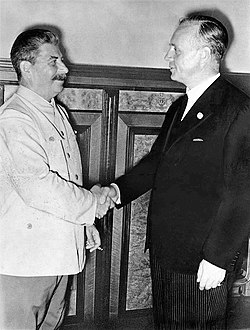
After the Soviet Union signed the non-aggression Molotov–Ribbentrop Pact with Nazi Germany on 23 August 1939, negative attitudes towards communists in the United States were on the rise.
Image source: Molotov–Ribbentrop Pact
Sep 11, 1939
% complete
While the American communist party at first attacked Germany for its invasion of western Poland on 1 September 1939, on 11 September it received a blunt directive from Moscow denouncing the Polish government.
1940
% complete
In 1940, soon after World War II began in Europe, Congress legislated the Alien Registration Act (Smith Act), making it a crime to advocate the overthrow of the U.S. government by force or violence and requiring federal registration of all foreign nationals.
Image source: Smith Act
Apr 1940
% complete
By April 1940, the Communist Party's Daily Worker's line seemed not so much antiwar as simply pro-German, reflecting Moscow's shifting directives after the Molotov–Ribbentrop Pact.
Image source: Daily Worker
Aug 1940
% complete
In August 1940, after NKVD agent Ramón Mercader killed Trotsky with an ice axe, CPUSA chairman Earl Browder perpetuated Moscow's fiction that the killer, who had been dating one of Trotsky's secretaries, was a disillusioned follower.
Image source: Leon Trotsky
Jun 22, 1941
% complete
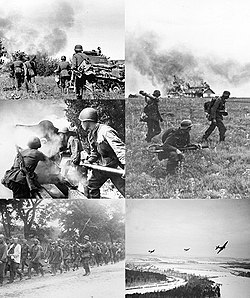
In allegiance to the Soviet Union, the Communist Party changed its policy again after Hitler broke the Molotov–Ribbentrop Pact by attacking the Soviet Union on 22 June 1941.
Image source: Operation Barbarossa
Oct 1917 - 1923
% complete
The first Red Scare in the United States accompanied the Russian Revolution (specifically the October Revolution) and the Revolutions of 1917–1923, revolving around a perceived threat from the American labor movement, anarchist revolution, and political radicalism.
Nov 1918 - Dec 31, 1919
% complete
After World War I ended in November 1918, the number of strikes increased to record levels in 1919, with more than 3,600 separate strikes by steel workers, railroad shop workers, the Boston police department, and many others.
1919
% complete
In the 1919 case of Schenck v. United States, the Supreme Court, introducing the clear-and-present-danger test, effectively deemed the Espionage Act of 1917 and the Sedition Act of 1918 constitutional.
Image source: Schenck v. United States
1919 - 1920
% complete
In 1919–20, several states enacted "criminal syndicalism" laws outlawing advocacy of violence in effecting and securing social change, further suppressing radical political activity.
1919 - 1921
% complete
The Justice Department launched the Palmer Raids (1919–21), a series of raids and arrests targeting suspected anarchists, communists, and other radicals during the First Red Scare.
Image source: Palmer Raids
Apr 1919
% complete
In April 1919, authorities discovered a plot for mailing 36 bombs to prominent members of the U.S. establishment, intensifying public fear of anarchist and leftist violence.
Jun 2, 1919
% complete
On 2 June 1919, in eight cities, eight bombs exploded simultaneously, prompting Attorney General A. Mitchell Palmer to launch the Palmer Raids against suspected radicals.
May 1, 1920
% complete
Defensively, Attorney General Palmer warned that a government-deposing left-wing revolution would begin on 1 May 1920—May Day, the International Workers' Day. When it failed to materialize, his credibility collapsed.
Jul 1920
% complete
In July 1920, Palmer's once-promising Democratic Party bid for the U.S. presidency faltered as the predicted revolutionary uprising never came and criticism of his tactics mounted.
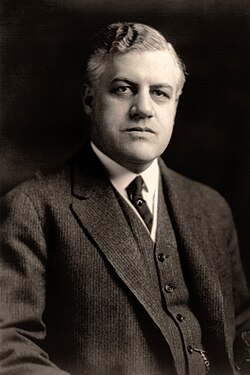
Image source: A. Mitchell Palmer
Sep 16, 1920
% complete
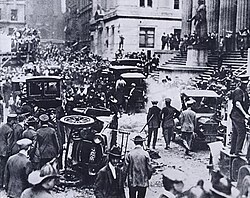
Wall Street was bombed on 16 September 1920, near Federal Hall National Memorial and the JP Morgan Bank, killing dozens and deepening fears of anarchist terrorism.
Image source: Wall Street bombing
1946
% complete
In Canada, the 1946 Kellock–Taschereau Commission investigated espionage after top-secret documents concerning RDX, radar and other weapons were handed over to the Soviets by a domestic spy-ring.
Image source: Gouzenko Affair
Mar 1947
% complete
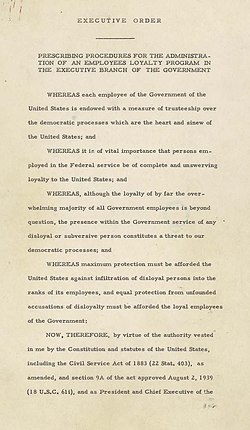
In March 1947, President Harry S. Truman signed Executive Order 9835, creating the Federal Employees Loyalty Program establishing political-loyalty review boards that determined the "Americanism" of federal employees and required loyalty oaths. This led to more than 2,700 dismissals and 12,000 resignations from 1947 to 1956.
Image source: Executive Order 9835
1948 - 1949
% complete
The Berlin Blockade (1948–49), along with the Soviet occupation of Eastern Europe and the end of the Chinese Civil War, contributed to an increased and widespread fear of communist espionage that coincided with McCarthyism.
Image source: Berlin Blockade
1948 - 1950
% complete
The trial of Alger Hiss was among the events of the late 1940s and early 1950s that surprised the American public and influenced popular opinion about U.S. national security and communist infiltration.
Image source: Alger Hiss
1949
% complete
In 1949, anti-communist fear and fear of American traitors was aggravated by the Chinese Communists winning the Chinese Civil War against the Western-sponsored Kuomintang and their founding of the People's Republic of China.
Image source: Chinese Communist Revolution
1949 - 1953
% complete
The formal establishment of the People's Republic of China in 1949 and the beginning of the Korean War in 1950 meant that Asian Americans, especially those of Chinese or Korean descent, came under increasing suspicion of being Communist sympathizers. Laws such as the China Aid Act of 1950 and Refugee Relief Act of 1953 assisted Chinese students who wished to settle in the United States.
Aug 29, 1949
% complete
The Soviet Union's first nuclear weapon test in 1949 (RDS-1) shocked the American public, intensifying fears of Soviet power and espionage and influencing popular opinion about U.S. security.
Image source: RDS-1
1950
% complete
From 1950, senator Joseph McCarthy played a key role in disseminating fears of communism. In 1950 he addressed the Senate, citing 81 separate cases, and made accusations against suspected communists.
Image source: Joseph McCarthy
1950
% complete
Senator Pat McCarran (D., Nev.) introduced the McCarran Internal Security Act of 1950, which was passed by the U.S. Congress to combat perceived communist threats within the United States.
Oct 1950 - Dec 1950
% complete
Chinese intervention (October–December 1950) in the Korean War (1950–1953) against U.S. forces further aggravated anti-communist fear and suspicion of Asian Americans in the United States.
Image source: Korean War
1952
% complete
The film My Son John (1952), about parents' suspicions their son is a spy, reflected and contributed to popular works depicting feared communist espionage during the era.
Image source: My Son John
1953
% complete
The trial of Ethel and Julius Rosenberg in 1953, which ended in their execution for spying for the Soviet Union, shocked the American public and intensified fears of communist espionage.
Image source: Julius and Ethel Rosenberg
1954
% complete
In 1954, Congress passed the Communist Control Act of 1954, which prevented members of the communist party in America from holding office in labor unions and other labor organizations.
Apr 1954 - Jun 1954
% complete
In 1954, after accusing the army, including war heroes, Senator Joseph McCarthy lost credibility in the eyes of the American public, and the Army-McCarthy Hearings were held in the summer of 1954, televised nationally.
Image source: Army–McCarthy hearings
1955 - 1959
% complete
From 1955 through 1959, the Supreme Court made several decisions restricting how the government could enforce anti-communist policies, including limiting the federal loyalty program to those with access to sensitive information, allowing defendants to face their accusers, reducing congressional investigation committees' strength, and weakening the Smith Act.
1957
% complete
In the 1957 case Yates v. United States, the Supreme Court limited Congress's ability to circumvent the First Amendment, part of a broader judicial retreat from the excesses of McCarthyism.
1961
% complete
In the 1961 case Scales v. United States, the Supreme Court addressed Congress's ability to circumvent the First Amendment in relation to membership in the Communist Party.
Image source: Scales v. United States
1967
% complete
In 1967, during the Supreme Court case United States v. Robel, the Court continued to limit governmental anti-communist measures, further winding down the legal apparatus of the Red Scares.
1995
% complete
In 1995, the American government declassified details of the Venona Project following the Moynihan Commission, which, combined with the opening of the USSR Comintern archives, provided substantial validation of intelligence gathering, outright spying, and policy influencing by Americans on behalf of the Soviet Union from 1940 through 1980.
Image source: Venona project
2000 - 2023
% complete
Between 2000 and 2023, there were 224 reported instances of Chinese espionage directed at the United States, fueling contemporary concerns about Chinese influence and intelligence operations.
2019
% complete
According to The New York Times in 2019, China's growing military and economic power has resulted in a "New Red Scare" in the United States.
Mar 25, 2019
% complete
The fourth iteration of the Committee on the Present Danger, a United States foreign policy interest group, was established on 25 March 2019, branding itself Committee on the Present Danger: China (CPDC).
2026
% complete
In 2026, scholars began to use the terms "New Red Scare" and "Third Red Scare" to refer to Donald Trump's recent campaign against his political opponents, most notably the Democratic Socialists of America and New York Mayor Zohran Mamdani.
Or browse the full history timeline directory, with more than 2,000 topics.
This Red Scare timeline was generated with the help of AI, using information found on the internet.
We work hard to keep these timelines accurate, but mistakes do get through. If you spot one, email us at [email protected] and we'll fix it for future visitors.
Generate yours with AI or build it from scratch, for free.
Export your timeline, add your own events, edit or remove AI-generated events, and much more
No credit card required.
Cancel anytime.
Cancel anytime.
You can create an unlimited number of timelines with up to 10 events on each one, customize how they look, export them to PDF, PNG, PowerPoint, CSV, and Excel, and share them with a link. Paid plans raise the event limit and add features like spreadsheet imports and collaborators.
Yes. You can cancel your subscription from your account page at any time, and you will not be charged again. Your subscription stays active for the rest of the period you already paid for.
Yes. We will email you a reminder before the annual renewal, and we will also email you a receipt.
Yes. You can email us within 15 days of any payment, and we will issue you a full refund.
Check out our pricing docs or send us an email anytime: [email protected].