-
Use Cases
-
Resources
-
Pricing
Red Square (Krasnaya Ploshchad) is the historic central square of Moscow, Russia, surrounded by landmarks such as the Kremlin, St. Basil's Cathedral, GUM department store, and Lenin's Mausoleum. Originally a marketplace in the late 15th century, it evolved into a site for royal ceremonies, Soviet military parades, and modern public celebrations, becoming one of Russia's most recognizable symbols. More Less
1485 - 1495
% complete
Ivan III commissioned Italian masters to rebuild the Kremlin's defenses in brick. The completed red-brick walls defined the western edge of the future Red Square and gave the surrounding area its distinctive architectural character.
Image source: Moscow Kremlin Wall
Jul 12, 1561
% complete
Ivan the Terrible's architects Postnik Yakovlev and Barma completed the Cathedral of Vasily the Blessed (St. Basil's), built to commemorate the capture of Kazan. Its nine colorful onion domes made it the most famous landmark on Red Square.
Image source: Saint Basil's Cathedral
1599
% complete
The circular stone platform known as Lobnoye Mesto ('Place of the Skull') was built in front of St. Basil's Cathedral. Tsars used it for proclamations and ceremonies, and it became one of Red Square's most recognizable features.
Image source: Lobnoye Mesto
1815 - 1821
% complete
After Napoleon's invasion, neoclassical Upper Trading Rows were built along the eastern side of Red Square to house hundreds of shops, formalizing the square's centuries-old commercial role.
Image source: GUM (department store)
1883
% complete
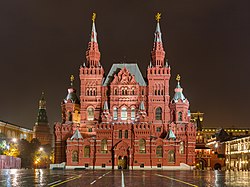
The State Historical Museum opened at the northern end of Red Square, designed by Vladimir Sherwood in a Russian revival style with deep-red brickwork. It anchored the square's architectural ensemble and showcased Russia's national history.
Image source: State Historical Museum
Dec 2, 1893
% complete
Architect Alexander Pomerantsev's new Upper Trading Rows, later renamed GUM, opened facing Red Square. Its glass-roofed arcade of over a thousand shops became one of Europe's grandest shopping arcades.
1493
% complete
A catastrophic fire swept through Moscow, destroying much of the area east of the Kremlin. Ivan III subsequently ordered that the cleared space remain open, forbidding new construction and laying the groundwork for what would become Red Square.
1500
% complete
The cleared area east of the Kremlin became Moscow's main trading site, called simply 'Torg' (the Market). Merchants from across Muscovy gathered there to sell goods, establishing the square's enduring role as a center of public life.
Image source: Red Square
1661
% complete
Tsar Alexei Mikhailovich officially sanctioned the name 'Krasnaya Ploshchad.' In old Russian, 'krasnaya' meant both 'beautiful' and 'red,' so the name conveyed the square's beauty rather than any political connotation.
Jun 6, 1671
% complete
The Cossack rebel leader Stenka Razin was publicly executed by quartering on Red Square after his failed uprising against the tsarist government. His execution became part of the square's long history as a site of public punishment.
Image source: Stenka Razin
1737
% complete
Another great Moscow fire ravaged the city, including structures around Red Square, destroying parts of the Kremlin and many wooden buildings. Rebuilding efforts gradually replaced wooden structures with stone ones around the square.
Image source: Saint Basil's Cathedral
Sep 14, 1812 - Oct 19, 1812
% complete
During Napoleon's invasion of Russia, French forces entered Moscow through the area near Red Square. The subsequent fires damaged the Kremlin and nearby buildings, but the square itself remained largely intact.
Image source: French invasion of Russia
1856
% complete
Red Square served as the setting for grand coronation festivities for Russian tsars, including Alexander II. The square hosted processions, feasts for the populace, and ceremonial displays underscoring the monarchy's connection with the people.
Image source: Alexander II of Russia
May 26, 1896
% complete
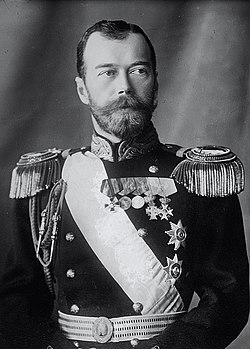
Nicholas II's coronation celebrations included traditional festivities connected to Red Square, though they were overshadowed by the deadly stampede at Khodynka Field. The event foreshadowed the growing unrest that would end Romanov rule.
Image source: Nicholas II of Russia
Nov 7, 1917
% complete
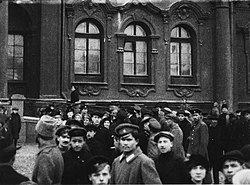
The Bolsheviks overthrew the Provisional Government in Petrograd, transforming Russia. Moscow soon became the Soviet capital, and Red Square was reimagined as the ceremonial heart of the world's first socialist state.
Image source: October Revolution
May 1, 1918
% complete
The Bolsheviks began holding mass parades and demonstrations on Red Square for revolutionary holidays such as May Day and the anniversary of the October Revolution, turning the historic square into the stage for state spectacle.
Image source: Moscow Victory Day Parade
1924
% complete
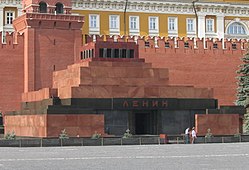
After Vladimir Lenin's death, a wooden mausoleum was erected beside the Kremlin wall; it was rebuilt in granite by architect Alexei Shchusev in 1930. Lenin's embalmed body has been displayed there ever since, making the mausoleum central to Red Square's Soviet identity.
Image source: Lenin's Mausoleum
1929
% complete
The Iverskaya Chapel and Resurrection Gate, which had framed the southern entrance to Red Square, were demolished under Stalin to allow tanks and heavy vehicles to pass into the square. Both were rebuilt in the 1990s.
Image source: Iberian Gate and Chapel
Nov 7, 1931
% complete
Annual November 7 parades on Red Square grew into massive showcases of Soviet military hardware, including tanks and aircraft flyovers, projecting the industrial might of the USSR to domestic and foreign audiences.
Image source: 1941 October Revolution Parade
1936
% complete
As part of Stalin's campaign against religion, the 17th-century Kazan Cathedral at the corner of Red Square was torn down to ease parade traffic. It was faithfully reconstructed only in 1990–1993 after the Soviet collapse.
Image source: Our Lady of Kazan
Nov 7, 1941
% complete
Despite German troops being within sight of the capital, Stalin held the traditional Revolution Day parade on Red Square. Soldiers marched straight from the ceremony to the front lines, becoming an iconic symbol of Soviet defiance in World War II.
Jun 24, 1945
% complete
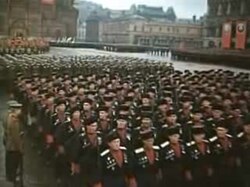
Marshal Georgy Zhukov rode a white horse across Red Square reviewing thousands of victorious soldiers. Captured Nazi banners were symbolically thrown down at Lenin's Mausoleum, marking the USSR's triumph in the Great Patriotic War.
Image source: 1945 Moscow Victory Parade
1957
% complete
During the Cold War, Soviet leaders atop the Lenin Mausoleum reviewed parades featuring intercontinental ballistic missiles and other advanced weaponry, using Red Square as a stage for strategic messaging to the West.
Image source: May Day
Apr 14, 1961
% complete
Days after becoming the first human in space, Yuri Gagarin was feted in Moscow, with jubilant crowds and officials gathering near Red Square to celebrate his pioneering Vostok 1 flight, a landmark moment of the Space Race.
Image source: Yuri Gagarin
1966
% complete
De Gaulle's official visit to the USSR included appearances in Moscow, reflecting the era of détente. Foreign leaders' receptions on and around Red Square underscored its role as the diplomatic showcase of Soviet power.
Image source: Charles de Gaulle
Jul 19, 1980 - Aug 3, 1980
% complete
Although the Olympic stadium lay elsewhere, Moscow's 1980 Summer Olympics transformed the capital, with Red Square serving as a symbolic backdrop for the games boycotted by the United States and dozens of allies amid Cold War tensions.
Image source: 1980 Summer Olympics
1990
% complete
UNESCO designated the Kremlin and Red Square a World Heritage Site, recognizing the outstanding universal value of their architectural ensemble spanning five centuries of Russian history.
Image source: Red Square
Sep 28, 1991
% complete
Months before the USSR dissolved, Metallica, AC/DC, Pantera, and others performed a free Monsters of Rock concert on Red Square, drawing hundreds of thousands — a striking symbol of the collapse of Soviet cultural isolation.
Image source: Monsters of Rock
Dec 26, 1991
% complete
The USSR formally dissolved, and Red Square transitioned from the ceremonial core of a communist superpower to the centerpiece of the Russian Federation, with new uses and meanings emerging for its landmarks.
Image source: Dissolution of the Soviet Union
1993
% complete
The Kazan Cathedral, destroyed in 1936, was rebuilt on its original Red Square site based on surviving plans and photographs, restoring one of the square's historic religious landmarks after decades of absence.
May 9, 1995
% complete
Post-Soviet Russia restored full military parades on Red Square each May 9 to mark victory over Nazi Germany, making the annual display of troops and hardware a defining fixture of modern Russian statehood.
May 24, 2003
% complete
Former Beatle Paul McCartney played a free outdoor concert just off Red Square, delighting generations of Russian fans for whom Beatles music had once been forbidden. The show symbolized Russia's full cultural opening to the West.
Image source: Paul McCartney in Red Square
Or browse the full history timeline directory, with more than 2,000 topics.
This Red Square timeline was generated with the help of AI, using information found on the internet.
We work hard to keep these timelines accurate, but mistakes do get through. If you spot one, email us at [email protected] and we'll fix it for future visitors.
Generate yours with AI or build it from scratch, for free.
Export your timeline, add your own events, edit or remove AI-generated events, and much more
No credit card required.
Cancel anytime.
Cancel anytime.
You can create an unlimited number of timelines with up to 10 events on each one, customize how they look, export them to PDF, PNG, PowerPoint, CSV, and Excel, and share them with a link. Paid plans raise the event limit and add features like spreadsheet imports and collaborators.
Yes. You can cancel your subscription from your account page at any time, and you will not be charged again. Your subscription stays active for the rest of the period you already paid for.
Yes. We will email you a reminder before the annual renewal, and we will also email you a receipt.
Yes. You can email us within 15 days of any payment, and we will issue you a full refund.
Check out our pricing docs or send us an email anytime: [email protected].