-
Use Cases
-
Resources
-
Pricing
The Red Fort (Lal Qila) is a historic fortified palace complex in Delhi, India, commissioned by Mughal Emperor Shah Jahan in 1638 and completed in 1648. Built of red sandstone, it served as the main residence of Mughal emperors for nearly 200 years and remains a powerful symbol of India's history. Today, it is a UNESCO World Heritage Site and the site where the Prime Minister hoists the national flag every Independence Day. More Less
May 13, 1638
% complete
Construction of the Red Fort began in the sacred Islamic month of Muharram, on 13 May 1638, after Emperor Shah Jahan decided to shift his capital from Agra to Delhi.
Image source: Red Fort
May 12, 1639
% complete
Emperor Shah Jahan commissioned the construction of the Red Fort on 12 May 1639, following his decision to shift the Mughal capital from Agra to Delhi. The fort would serve as the main residence of the Mughal emperors.
Apr 6, 1648
% complete
Supervised by Shah Jahan himself, the construction of the Red Fort was completed on 6 April 1648, establishing it as the principal palace and seat of Mughal power in Delhi.
1650
% complete
The French traveller François Bernier described witnessing the jeweled Peacock Throne at the Red Fort during the 17th century, a testament to the immense wealth of the Mughal court.
1659
% complete
A later addition to the Red Fort, the Moti Masjid mosque was built in 1659 as a private place of worship for Emperor Aurangzeb.
Image source: Moti Masjid (Red Fort)
1660
% complete
During Aurangzeb's reign, the aesthetic appeal of the Lahori Gate was modified by the construction of a barbican, which Shah Jahan poetically described as "a veil drawn across the face of a beautiful woman."
Image source: Lahori Gate, Red Fort, Delhi
1712
% complete
In 1712, Jahandar Shah was crowned the Mughal Emperor. He and his successor Farrukhsiyar are believed to have been murdered within the fort.
Image source: Jahandar Shah
1712 - 1719
% complete
Later Mughal emperors Jahandar Shah (1712–1713) and Farrukhsiyar (1713–1719) are believed to have been murdered inside the Red Fort, reflecting the dynasty's growing instability.
Image source: Farrukhsiyar
1739
% complete
During Nadir Shah's invasion of 1739, the Red Fort was plundered and stripped of its artwork and jewels, marking a catastrophic loss for the Mughal treasury.
1739
% complete
In 1739, the Persian emperor Nadir Shah decisively defeated the Mughal army despite its considerable strength of approximately 200,000 soldiers.
Image source: Nader Shah's invasion of India
1752
% complete
A treaty signed in 1752 established the Marathas as the protectors of the throne in Delhi, extending their influence over the declining Mughal court.
Image source: Maratha Empire
1758
% complete
The 1758 Maratha victory over the Afghans at Sirhind, followed by their defeat at Panipat, catapulted them into further conflict with Ahmad Shah Durrani.
Image source: Third Battle of Panipat
1760
% complete
In 1760, the Marathas stripped and melted the silver ceiling of the Diwan-i-Khas to raise funds for the defence of Delhi from the armies of Ahmed Shah Durrani.
Image source: Diwan-i-Khas (Red Fort)
1761
% complete
In 1761, after the Marathas lost the third battle of Panipat, Delhi was raided by Ahmad Shah Durrani, deepening the suffering of the city and the fort's inhabitants.
Image source: Third Battle of Panipat
Feb 5, 1765
% complete
In 1764, the Jat ruler of Bharatpur, Maharaja Jawahar Singh, attacked Delhi, and eventually captured the Red Fort on 5 February 1765.
Image source: Jawahar Singh
1783
% complete
In 1783, Sikh Misls led by Jassa Singh Ahluwalia, Jassa Singh Ramgarhia, and Baghel Singh Dhaliwal conquered Delhi and the Red Fort.
Image source: Baghel Singh
1788
% complete
In 1788, Ghulam Kadir, the Rohilla grandson of Najib ad-Dawlah, looted Delhi and killed female members of the Mughal royal family.
Image source: Ghulam Kadir
1842
% complete
At the centre of the reservoir stands the Zafar Mahal, an eponymous red sandstone structure added around 1842 by Bahadur Shah Zafar.
Image source: Red Fort
1857
% complete
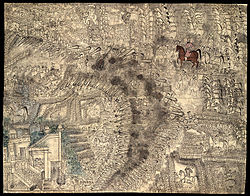
The last Mughal emperor to occupy the fort, Bahadur Shah Zafar, became a symbol of the Indian Rebellion of 1857 against Company rule, in which the residents of Shahjahanabad participated. Despite its position as the seat of Mughal power, the Red Fort was not a site of any engagements during the rebellion.
Image source: Indian Rebellion of 1857
1857 - 1860
% complete
At the northern edge of the Red Fort stood the Moti Mahal, a twin building that was demolished during or shortly after the 1857 rebellion.
Sep 17, 1857
% complete
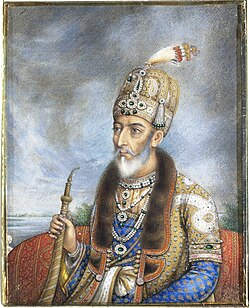
Bahadur Shah Zafar left the fort on 17 September 1857, was apprehended by British forces, returned to the Red Fort, tried in 1858, and exiled to Rangoon on 7 October of that year.
Image source: Bahadur Shah Zafar
1858
% complete
Following the Indian Rebellion of 1857, many of the fort's marble structures were demolished by the British, although the defensive walls remained largely intact. The side arcades and central tank were demolished, and one palace was repurposed into a tea house for soldiers.
1858
% complete
The baoli (step-well) is one of the few structures within the Red Fort that survived the widespread demolitions carried out by the British after the rebellion of 1857. Its chambers were repurposed as a prison.
1899 - 1905
% complete
Lord Curzon, who served as the Viceroy of India from 1899 to 1905, initiated restoration efforts for the Red Fort.
Image source: Mary Curzon, Baroness Curzon of Kedleston
1913
% complete
Even prior to its designation as a monument of national importance in 1913, efforts were undertaken to ensure its preservation for posterity.
Nov 1945 - Dec 1945
% complete
The first trial was conducted at the Red Fort between November and December 1945. The fort's baoli chambers housed INA officers General Shah Nawaz Khan, Colonel Prem Kumar Sahgal, and Colonel Gurbaksh Singh Dhillon during the trials of 1945–46.
Image source: Indian National Army trials
Aug 15, 1947
% complete
On 15 August 1947, the first Prime Minister of India, Jawaharlal Nehru, hoisted the Indian national flag above the Lahori Gate, the main entrance of the Red Fort.
Dec 22, 2000
% complete
The Red Fort was the site of a terrorist attack on 22 December 2000, carried out by six Lashkar-e-Taiba operatives.
Image source: 2001 Indian Parliament attack
Dec 22, 2003
% complete
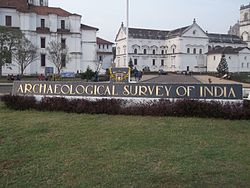
A significant portion of the Red Fort remained under the control of the Indian Army until 22 December 2003, when it was transferred to the Archaeological Survey of India for restoration and conservation.
Image source: Archaeological Survey of India
2007
% complete
The Red Fort, as part of the Red Fort Complex, was recognised as a UNESCO World Heritage Site in 2007.
2009
% complete
In 2009, the Comprehensive Conservation and Management Plan (CCMP), prepared by the Archaeological Survey of India under the auspices of a Supreme Court direction to revitalise the fort, was announced.
Apr 2018
% complete
In April 2018, the Dalmia Group adopted the Red Fort for maintenance, development, and operations under the government's "Adopt A Heritage" scheme, through a contract worth ₹25 crores for five years.
Image source: Qutb Minar
May 2018
% complete
In May 2018, the Indian National Congress demanded the suspension of the agreement until an "impartial review" could be conducted by the Central Advisory Board of Archaeology or another recognized body of experts.
Image source: Indian National Congress
2019
% complete
Four museums inaugurated in 2019 are housed in the colonial-era barracks: Barrack B1 is dedicated to the 1857 War of Independence, Barrack B2 commemorates the Jallianwala Bagh massacre, and Barrack B3 focuses on Subhas Chandra Bose and the INA movement.
Jan 26, 2021
% complete
On 26 January 2021, during the 2021 Indian farmers' Republic Day protest, a coterie of protesting farmers breached the fort, hoisted religious flags from its ramparts, and scaled the domes of the fort.
Image source: 2021 Indian farmers' Republic Day protest
Sep 2025
% complete
Since the late 20th century, environmental pollution has turned the Red Fort's color from red to black. According to recent Italo-Indian studies in September 2025, repeated events of air pollution have contributed to the formation of tarry black crusts on the fort's walls.
Or browse the full history timeline directory, with more than 2,000 topics.
This Red Fort timeline was generated with the help of AI, using information found on the internet.
We work hard to keep these timelines accurate, but mistakes do get through. If you spot one, email us at [email protected] and we'll fix it for future visitors.
Generate yours with AI or build it from scratch, for free.
Export your timeline, add your own events, edit or remove AI-generated events, and much more
No credit card required.
Cancel anytime.
Cancel anytime.
You can create an unlimited number of timelines with up to 10 events on each one, customize how they look, export them to PDF, PNG, PowerPoint, CSV, and Excel, and share them with a link. Paid plans raise the event limit and add features like spreadsheet imports and collaborators.
Yes. You can cancel your subscription from your account page at any time, and you will not be charged again. Your subscription stays active for the rest of the period you already paid for.
Yes. We will email you a reminder before the annual renewal, and we will also email you a receipt.
Yes. You can email us within 15 days of any payment, and we will issue you a full refund.
Check out our pricing docs or send us an email anytime: [email protected].