-
Use Cases
-
Resources
-
Pricing
Aurangzeb, also known as Alamgir, was the sixth emperor of the Mughal Empire in India, reigning from 1658 to 1707. He expanded the empire to its greatest territorial extent through relentless military campaigns but is also remembered for his conservative policies, including the reintroduction of jizya taxes and religious restrictions. His long reign marked both the height of Mughal power and the beginning of its decline. More Less
Nov 3, 1618
% complete
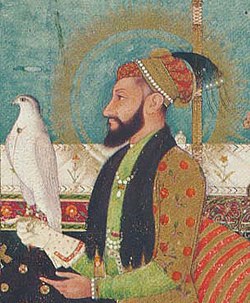
Muhi-ud-Din Muhammad, later known as Aurangzeb, was born on November 3, 1618, in Dahod, Gujarat. He was the third son of Prince Khurram (the future Emperor Shah Jahan) and Mumtaz Mahal, growing up in the opulent Mughal court during his father's rise to power.
Image source: Aurangzeb
Jan 1628
% complete
Aurangzeb's father ascended the Mughal throne in 1628 after the death of Jahangir. As a prince of the emperor, Aurangzeb received a thorough education in Islamic theology, Persian literature, and the arts of war and statecraft befitting a royal heir.
Image source: Shah Jahan
1636
% complete
At age 18, Aurangzeb was appointed viceroy of the Deccan provinces by Shah Jahan. This early command gave him valuable administrative and military experience in southern India, where he would later devote much of his reign.
Apr 1637
% complete
Aurangzeb married the Safavid princess Dilras Banu Begum in April 1637. She became his first wife and chief consort, bearing him several children including his eventual successor Muhammad Azam Shah. Her death in 1657 deeply affected him.
Image source: Dilras Banu Begum
1645
% complete
Aurangzeb was appointed governor of Multan and Kabul in 1645, commanding frontier provinces. He led campaigns in Central Asia, including an unsuccessful siege of Kandahar against the Safavids in 1649 and further attempts in 1652–1653 that drained imperial resources.
1653
% complete
Aurangzeb returned to the Deccan as viceroy in 1653, governing from Aurangabad. He expanded Mughal control over the region and conducted campaigns against Qutbshahi Golconda and Adilshahi Bijapur, gaining military prestige and building a loyal power base.
Sep 1657
% complete
When Shah Jahan fell seriously ill in September 1657, rumors of his death triggered a brutal struggle for the throne among his four sons: Dara Shikoh, Shuja, Murad Baksh, and Aurangzeb. Each prince mobilized armies to claim supremacy.
Image source: Shah Jahan
Feb 14, 1658
% complete
Aurangzeb allied with his younger brother Murad Baksh and defeated an army sent by Dara Shikoh at Dharmat (Bahadurgarh) near Ujjain on February 14, 1658, clearing the path toward Agra and the imperial capital.
May 29, 1658
% complete
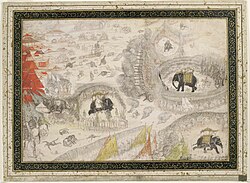
On May 29, 1658, Aurangzeb decisively defeated his eldest brother Dara Shikoh at Samugarh near Agra in one of the largest battles fought in India up to that time. The victory effectively made Aurangzeb master of the empire despite Dara's superior numbers.
Image source: Battle of Samugarh
Jun 1658 - 1666
% complete
After capturing Agra, Aurangzeb confined his ailing father Shah Jahan in the Agra Fort. The former emperor spent his final eight years as a prisoner, gazing at the Taj Mahal he had built for Mumtaz Mahal, until his death in January 1666.
Jul 1658 - Dec 4, 1661
% complete
Having used his younger brother Murad Baksh as an ally, Aurangzeb arrested him shortly after taking power and imprisoned him at Gwalior Fortress. Murad was executed on December 4, 1661, after being implicated in a murder case, completing Aurangzeb's consolidation of sole rule.
Image source: Murad Bakhsh
Jul 21, 1658
% complete
Aurangzeb formally enthroned himself on July 21, 1658, taking the regnal title Alamgir ('Conqueror of the World'). A more lavish second coronation followed in June 1659 once his rivals were fully eliminated and his rule secured.
Jan 5, 1659
% complete
Aurangzeb crushed his middle brother Shuja, governor of Bengal, at Khajwa on January 5, 1659. Shuja fled southward and eventually disappeared in Burma, removing another rival from contention for the throne.
Image source: Battle of Khajwa
Aug 30, 1659
% complete
After fleeing across the empire following Samugarh, Dara Shikoh was captured through betrayal in Sindh. Aurangzeb declared him a heretic for his syncretic religious views and had him executed in Delhi on August 30, 1659, eliminating the last serious claimant to the throne.
Image source: Dara Shikoh
1658 - 1707
% complete
Throughout his reign Aurangzeb corresponded with and issued firmans to European trading companies, including the English East India Company and the French Compagnie des Indes, granting them limited trading privileges while taxing their commerce heavily.
Image source: East India Company
1690 - 1707
% complete
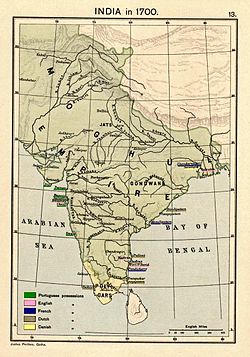
By around 1690 the Mughal Empire under Aurangzeb reached its maximum extent, covering nearly the whole Indian subcontinent with perhaps a quarter of humanity living under its sway. Yet the cost of constant warfare left the treasury strained and set the stage for fragmentation after his death.
Image source: Mughal Empire
Mar 1707 - Jun 1707
% complete
Aurangzeb had left no clear succession plan. His surviving sons immediately fought; Bahadur Shah I defeated and killed his brother Azam Shah at Jajau in June 1707, beginning the era of weaker emperors and gradual Mughal decline.
Mar 20, 1707
% complete
Aurangzeb died on March 20, 1707, aged 88, at Ahmednagar in the Deccan, exhausted after nearly fifty years on the throne and decades of Maratha warfare. In keeping with his austere piety he was buried in a simple open tomb at Khuldabad, funded by earnings from sewing caps and copying the Quran.
Image source: Tomb of Aurangzeb
1658 - 1707
% complete
Despite his austere personal habits, Aurangzeb commissioned major religious architecture, most famously the grand Badshahi Mosque in Lahore (completed 1673), one of the largest mosques in the world, alongside madrasas and charitable foundations.
Image source: Badshahi Mosque
1667 - 1676
% complete
Aurangzeb commissioned a panel of scholars to compile the Fatawa-e-Alamgiri, a massive compendium of Hanafi jurisprudence completed around 1676. It served as the legal code of the Mughal Empire and influenced law in South Asia for centuries.
Image source: Fatawa 'Alamgiri
1668 - 1679
% complete
Over the course of his reign Aurangzeb issued a series of edicts promoting Sunni orthodoxy: appointing censors of morals, banning un-Islamic customs like music at court, prohibiting alcohol and gambling, and ordering destruction of some temples deemed sites of sedition.
Image source: Aurangzeb
Nov 11, 1675
% complete
The ninth Sikh Guru, Tegh Bahadur, was arrested and brought to Delhi, where he was executed on November 11, 1675, after refusing to convert to Islam. His martyrdom radicalized the Sikh community under his son Guru Gobind Singh, leading to armed resistance.
Image source: Guru Tegh Bahadur
Apr 2, 1679
% complete
On April 2, 1679, Aurangzeb reintroduced the jizya poll tax on non-Muslim subjects, which had been abolished by Akbar a century earlier. The controversial levy alienated Hindus and other communities and provoked protests, including demonstrations in Delhi.
Image source: Jizya
1660
% complete
Mughal forces under Daud Khan captured the fort of Palamau in eastern India in 1660, extending imperial authority into the Chota Nagpur plateau region during the early years of Aurangzeb's reign.
Image source: Palamu district
1660
% complete
In 1660 Aurangzeb dispatched large armies under Shaista Khan and others to subdue the rising Maratha power of Shivaji in the hill country of western India, beginning decades of intermittent warfare with the Marathas.
Apr 1663
% complete
Shivaji personally led a daring night raid on Shaista Khan's headquarters in Pune in April 1663, cutting off three of the general's fingers and humiliating the mighty Mughal army, which withdrew from Maratha territory soon afterward.
Image source: Shaista Khan
Apr 1665
% complete
Following pressure from Jai Singh I, Shivaji signed the Treaty of Surat/Purandar in 1665, ceding most of his forts to the Mughals, paying tribute, and agreeing to serve the empire—though hostilities later resumed.
Image source: Treaty of Purandar (1665)
1670 - 1672
% complete
Severe famine struck parts of the empire between roughly 1670 and 1672, compounded by outbreaks of plague. Contemporary chroniclers recorded enormous mortality, straining imperial finances and administration.
Image source: List of famines
1671
% complete
In 1671 the Ahom kingdom decisively defeated a Mughal invasion force on the Brahmaputra River at Saraighat under Lachit Barphukan, halting Mughal expansion into Assam and marking one of the empire's notable military failures.
Image source: Battle of Saraighat
1672
% complete
In 1672 thousands of Satnami religious dissenters rebelled near Delhi and even threatened the capital itself. Aurangzeb personally led troops and crushed the uprising with great severity, restoring order but revealing strains in imperial authority.
Image source: Satnampanth
1678 - 1681
% complete
The death of Jaswant Singh of Marwar in 1678 led Aurangzeb to attempt direct annexation of his kingdom, provoking fierce Rajput resistance. The costly war spread to Mewar and ended inconclusively in 1681, weakening Mughal-Rajput relations permanently.
Image source: Muhammad Akbar (Mughal prince)
Apr 3, 1680
% complete
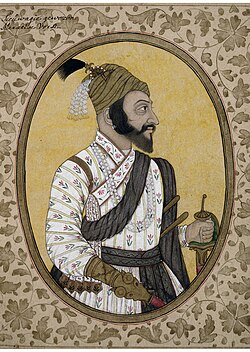
The Maratha founder Shivaji died on April 3, 1680. His death briefly eased pressure on the Mughals but his son Sambhaji continued resistance, prompting Aurangzeb to commit ever larger resources to conquering the Deccan.
Image source: Shivaji
1681
% complete
In 1681 Aurangzeb moved his entire court and household from Delhi to the Deccan, never returning north. For the last quarter-century of his life he directed endless campaigns against the Marathas from camps and newly founded cities like Aurangabad.
1681 - 1682
% complete
In 1681 Aurangzeb's fourth son Akbar proclaimed himself emperor and joined forces with Maratha rebels against his father. The revolt collapsed within months and Akbar fled to Persia, where he lived in exile until his death in 1704.
Sep 1686
% complete
The long siege of Bijapur ended in September 1686 when the Adilshahi capital surrendered to Mughal forces. Its annexation removed one of the last independent Muslim sultanates of the Deccan and extended the empire to its greatest extent.
Image source: Siege of Bijapur
1687
% complete
Aurangzeb besieged the Qutbshafi capital of Golconda for eight months before its fall in 1687, annexing the wealthy kingdom of Hyderabad into the empire and adding vast revenues and diamond mines to Mughal coffers.
Mar 11, 1689
% complete
Mughal forces captured the Maratha king Sambhaji in 1689 and Aurangzeb had him executed after torture for refusing to convert to Islam. Rather than ending Maratha resistance, the execution inspired fiercer guerrilla warfare led by his brother Rajaram.
Image source: Sambhaji
Or browse the full history timeline directory, with more than 2,000 topics.
This Aurangzeb timeline was generated with the help of AI, using information found on the internet.
We work hard to keep these timelines accurate, but mistakes do get through. If you spot one, email us at [email protected] and we'll fix it for future visitors.
Generate yours with AI or build it from scratch, for free.
Export your timeline, add your own events, edit or remove AI-generated events, and much more
No credit card required.
Cancel anytime.
Cancel anytime.
You can create an unlimited number of timelines with up to 10 events on each one, customize how they look, export them to PDF, PNG, PowerPoint, CSV, and Excel, and share them with a link. Paid plans raise the event limit and add features like spreadsheet imports and collaborators.
Yes. You can cancel your subscription from your account page at any time, and you will not be charged again. Your subscription stays active for the rest of the period you already paid for.
Yes. We will email you a reminder before the annual renewal, and we will also email you a receipt.
Yes. You can email us within 15 days of any payment, and we will issue you a full refund.
Check out our pricing docs or send us an email anytime: [email protected].