
-
Use Cases
-
Resources
-
Pricing
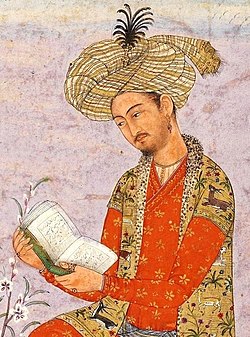
Babur (1483–1530), born Zahir-ud-din Muhammad, was a Central Asian ruler and military commander who founded the Mughal Empire in India. A descendant of Timur on his father's side and Genghis Khan on his mother's side, he conquered Kabul and then defeated the Sultan of Delhi at the First Battle of Panipat in 1526, laying the foundation for one of history's greatest empires. He was also a gifted poet and diarist, famous for his memoirs, the Baburnama. More Less
Feb 14, 1483
% complete
Babur, born Zahīr ud-Dīn Muhammad, was born on 14 February 1483 in the city of Andijan in the Fergana Valley (now in Uzbekistan). He was the eldest son of Umar Shaikh Mirza II, the Timurid governor of Fergana, and a great-great-great-grandson of the conqueror Timur.
1494
% complete
After his father Umar Sheikh Mirza died while tending pigeons in an ill-constructed dovecote that toppled into a ravine below the palace, eleven-year-old Babur became the Timurid ruler of Fergana. He ascended the throne at its capital Akhsikath and had to put down a rebellion.
1502
% complete
By 1502, Babur had resigned all hopes of recovering Fergana; he was left with nothing and was forced to try his luck elsewhere. That same year, Ulugh Beg II, Babur's paternal uncle who ruled Kabul, died leaving only an infant heir.
1514
% complete
After three years spent campaigning in Turkestan, Babur returned to Kabul in 1514, having again lost the newly conquered lands to the Shaybanids.
Image source: Babur
Dec 26, 1530
% complete
Babur died on 26 December 1530 in Agra and was succeeded by his son Humayun. The founder of the Mughal Empire left behind a legacy spanning from Central Asia to India.
1497
% complete
In 1497, Babur besieged Samarkand for seven months before eventually gaining control over the storied Timurid capital, one of his earliest major military successes.
1500 - 1501
% complete
Babur again laid siege to Samarkand in 1500–1501 and briefly took the city, but he was in turn besieged by his most formidable rival, Muhammad Shaybani, Khan of the Uzbeks, who defeated him and founded the Khanate of Bukhara.
Oct 1504
% complete
In October 1504, the exiled Babur crossed the snowy Hindu Kush mountains and captured Kabul from the remaining Arghun chieftains, who retreated to Kandahar. With this move he gained a new kingdom, re-established his fortunes, and would remain its ruler until 1526.
1505
% complete
Because of the low revenue generated by his new mountain kingdom of Kabul, Babur began his first expedition to India in 1505, writing in his memoirs, "My desire for Hindustan had been constant."
1510
% complete
Muhammad Shaybani, Babur's longtime Uzbek rival, was defeated and killed by Ismail I, Shah of Shi'a Safavid Persia, in 1510, opening new opportunities for Babur in Transoxiana.
1511 - 1512
% complete
Forming a partnership with Safavid emperor Ismail I, Babur left his brother Nasir Mirza to rule Kabul and managed to take Samarkand for the third time; he also took Bukhara but lost both cities to the Uzbeks in 1512.
1519
% complete
After the siege and capture of Bajaur in 1519, Babur married Bibi Mubarika, the daughter of Yousafzai chief Shah Mansur, forging ties with Afghan tribes.
1519
% complete
After his third loss of Samarkand, Babur gave full attention to the conquest of North India, launching a campaign that brought him to the Chenab River in Punjab in 1519.
1521
% complete
In 1521, following the death of Uways Mirza, Babur took control of Badakhshan, extending his influence north of the Hindu Kush.
1522
% complete
In 1522, Babur besieged and annexed Kandahar from the Arghun dynasty, securing an important strategic city on his route toward India.
1524
% complete
Until 1524, Babur's aim was only to expand his rule into Punjab, fulfilling the legacy of his ancestor Timur. He started for Lahore in 1524 but found that Daulat Khan Lodi had been driven out by forces sent by Ibrahim Lodi, the Sultan of Delhi.
Nov 1525
% complete
In November 1525, Babur got news at Peshawar that Daulat Khan Lodi had switched sides, and Babur drove out Ala-ud-Din as he pressed on toward Delhi.
Apr 20, 1526
% complete
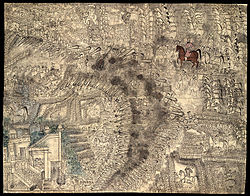
Babur reached Panipat on 20 April 1526 and met Ibrahim Lodi's numerically superior army of about 100,000 soldiers and 1,000 elephants. Using gunpowder weapons and tactics, Babur defeated and killed Ibrahim Lodi, the last Sultan of the Lodi dynasty, founding the Mughal Empire.
Image source: Third Battle of Panipat
Mar 16, 1527
% complete
The Battle of Khanwa was fought between Babur and the Rajput ruler of Mewar, Rana Sanga, on 16 March 1527. Babur's victory crushed the Rajput challenge and consolidated Mughal power in Hindustan.
Image source: Battle of Khanwa
Jan 20, 1528
% complete
Upon reaching Chanderi on 20 January 1528, Babur offered Shamsabad to Medini Rai in exchange for Chanderi as a peace overture, but the offer was rejected and the fortress fell to Mughal forces.
1529
% complete
By 1529, most of the major oppositions in Hindustan had been defeated or forced into submission. In spring, Babur marched down the Ganges to engage the eastern Afghan Confederacy under Sultan Mahmud Lodi and the Sultanate of Bengal under Nusrat Shah.
May 1529
% complete
The Battle of Ghaghra in May 1529 was the final major conflict fought by Babur in his struggle to consolidate power over Hindustan, defeating the eastern Afghan Confederacy and its allies.
Image source: Battle of Ghaghra
1500
% complete
Babur's first child with his wife, a daughter named Fakhr-un-Nissa, died within a year of her birth in 1500.
1504
% complete
In 1504, Babur married Zaynab Sultan Begum, who died childless within two years.
1506 - 1508
% complete
In the period 1506–08, Babur married four women: Maham Begum in 1506, Masuma Sultan Begum, Gulrukh Begum, and Dildar Begum. Maham Begum later became the mother of his successor Humayun.
1530
% complete
In 1530, Humayun, Babur's eldest son and intended heir, fell dangerously ill at Sambhal. According to an account preserved by Gulbadan Begum, Babur walked three times round the sick-bed and prayed that the illness be transferred to himself, offering his own life for his son's recovery.
Image source: Humayun
1526
% complete
One of Babur's chief surviving architectural monuments is the congregational mosque erected at Sambhal in 1526 during his brief reign as emperor.
Image source: Babri Masjid
1528 - 1529
% complete
Among the congregational mosques erected during Babur's reign were two dated 1528–29: the Kabuli Bagh Mosque at Panipat, whose site is still called Kabuli Bagh, and a mosque at Ayodhya, known centuries later as the Babri Mosque.
Image source: Kabuli Bagh Mosque
1528 - 1529
% complete
A garden Babur designed himself near the Ghaggar river was completed in 1528–29, and the quarter of Agra developed by his nobles was nicknamed "Kabul" by local people.
1529
% complete
In his secret will of 935 AH (1529 AD) addressed to Humayun, Babur advised his son to administer justice according to the ways of every religion, avoid the sacrifice of cows, not ruin temples and shrines of law-obeying communities, and overlook dissensions between Shias and Sunnis.
1539 - 1544
% complete
As per Babur's wishes, his mortal remains were moved from Agra to Kabul and reburied in Bagh-e Babur sometime between 1539 and 1544, where his grave remains a revered site today.
Image source: Gardens of Babur
Nov 1589
% complete
The Baburnama, written by Babur in Chaghatai Turkic, was rendered into Persian for the imperial library by Abdul Rahim Khan-i-Khanan in November 1589 during the reign of his grandson Akbar, and was repeatedly illustrated by Mughal painters thereafter.
Image source: Baburnama
1944
% complete
Shahenshah Babar, an Indian film about the emperor directed by Wajahat Mirza, was released in 1944, bringing Babur's story to the silver screen.
Image source: Babur
1960
% complete
The Indian biographical film Babar, directed by Hemen Gupta, covered the emperor's life with Gajanan Jagirdar in the lead role.
Image source: Babar: The Movie
Dec 1992
% complete
In December 1992, the Ayodhya mosque attributed to Babur's era was demolished by activists of the Vishva Hindu Parishad and the Bharatiya Janata Party, setting off communal rioting that killed more than a thousand people and remaining a charged issue in Indian politics.
Image source: Demolition of the Babri Masjid
Oct 2005
% complete
In October 2005, Pakistan developed the Babur Cruise Missile, named in honour of the Mughal founder, reflecting his enduring historical significance.
Image source: Babur (cruise missile)
Feb 14, 2008
% complete
On 14 February 2008, stamps in Babur's name were issued in Uzbekistan to commemorate his 525th birth anniversary, honoring the memory of the empire's founder in his homeland.
Or browse the full history timeline directory, with more than 2,000 topics.
This Babur timeline was generated with the help of AI, using information found on the internet.
We work hard to keep these timelines accurate, but mistakes do get through. If you spot one, email us at [email protected] and we'll fix it for future visitors.
Generate yours with AI or build it from scratch, for free.
Export your timeline, add your own events, edit or remove AI-generated events, and much more
No credit card required.
Cancel anytime.
Cancel anytime.
You can create an unlimited number of timelines with up to 10 events on each one, customize how they look, export them to PDF, PNG, PowerPoint, CSV, and Excel, and share them with a link. Paid plans raise the event limit and add features like spreadsheet imports and collaborators.
Yes. You can cancel your subscription from your account page at any time, and you will not be charged again. Your subscription stays active for the rest of the period you already paid for.
Yes. We will email you a reminder before the annual renewal, and we will also email you a receipt.
Yes. You can email us within 15 days of any payment, and we will issue you a full refund.
Check out our pricing docs or send us an email anytime: [email protected].