-
Use Cases
-
Resources
-
Pricing
The Mughal Empire was one of the largest and most influential empires in Indian history, founded by Babur in 1526 after his victory at the Battle of Panipat. At its height under rulers like Akbar, Jahangir, Shah Jahan, and Aurangzeb, it unified much of the Indian subcontinent, producing remarkable achievements in art, architecture (including the Taj Mahal), administration, and culture before gradually declining due to internal strife, succession wars, and British colonial expansion, formally ending in 1857. More Less
1500 - 1600
% complete
Though the Mughals were of Turko-Mongol origin, their reign enacted the revival and height of the Persian language in the Indian subcontinent, and by the end of the 16th century Turki (Chagatai) was understood by relatively few at court.
1582
% complete
In the sixteenth century, Akbar was the first to initiate and use metal cylinder rockets known as bans, particularly against war elephants, during the battle of Sanbal.
Image source: Mughal Empire
1582
% complete
Fathullah Shirazi, a Persian polymath and mechanical engineer working for Akbar, developed an early multi-gun shot around 1582, showcasing Mughal advances in military technology.
Image source: Fathullah Shirazi
1589
% complete
The seamless celestial globe was invented in Kashmir by Ali Kashmiri ibn Luqman in 998 AH (1589–90 CE), a remarkable achievement of Mughal-era metallurgy and astronomy.
1600 - 1700
% complete
During the 17th century, the Mughal Empire saw a synthesis between Islamic and Hindu astronomy, where Islamic observational instruments were combined with Hindu computational techniques.
1657
% complete
In 1657, the Mughal Army used rockets during the siege of Bidar, demonstrating the continued military application of pyrotechnic technology in Indian warfare.
Image source: Mysorean rockets
1668
% complete
Aurangzeb (reigned 1658–1707) was never an enthusiastic patron of painting, largely for religious reasons, and took a turn away from the pomp and ceremonial of the court around 1668, after which he probably commissioned no more paintings.
Image source: Mughal painting
1668
% complete
A 17th-century celestial globe was made by Diya' ad-din Muhammad in Lahore in 1668 (now in Pakistan), continuing the tradition of exquisite astronomical instruments in Mughal India.
1526 - 1530
% complete
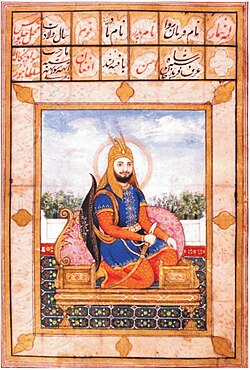
The Mughal Empire was founded by Babur, who reigned from 1526 to 1530. He established Mughal rule in North India after his victory over the Delhi Sultanate, laying the foundations for one of the world's great empires.
Image source: Babur
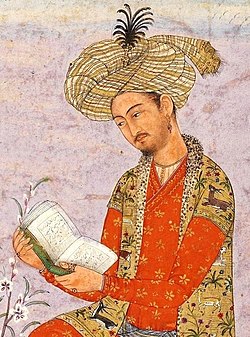
1526 - 1681
% complete
Kabul served as the summer capital of the Mughals from 1526 to 1681, reflecting the empire's enduring ties to its Central Asian origins and its strategic position linking India to the wider Islamic world.
Apr 21, 1526
% complete
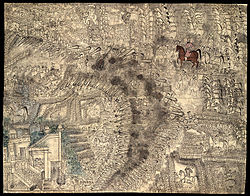
Babur, a Central Asian ruler descended from Timur and Genghis Khan, defeated the Sultan of Delhi, Ibrahim Lodi, at the First Battle of Panipat with the help of Safavid and Ottoman support. Using gunpowder weapons against superior numbers, Babur swept down the plains of North India and founded the Mughal Empire.
Image source: Third Battle of Panipat
1530
% complete
The instability of the empire became evident under Humayun, Babur's son, who reigned from 1530. His rule was marked by internal strife and external threats that nearly destroyed the young empire.
Image source: Humayun
1540 - 1545
% complete
The rebellious Sher Shah Suri (reigned 1540–1545) drove Humayun out of India and forced him into exile in Persia, interrupting Mughal rule for more than a decade.
Image source: Sher Shah Suri
1555
% complete
Humayun returned triumphantly from Persia in 1555 and restored Mughal rule in parts of India. However, he died in an accident the following year, leaving the throne to his young son Akbar.
Oct 15, 1542
% complete
Akbar, born Jalal-ud-din Muhammad, was born at Umarkot Fort to Humayun and his wife Hamida Banu Begum, a Persian princess. He would go on to become one of the greatest Mughal emperors, reigning from 1556 to 1605.
Image source: Akbar
1556 - 1605
% complete
Akbar (reigned 1556–1605) consolidated the empire and built the Mughal imperial structure, sometimes dated to around 1600 under his rule. His reign marked a golden age of expansion, administration, and cultural synthesis.
1569
% complete
Jahangir, born Salim, was born to Akbar and his wife Mariam-uz-Zamani, an Indian princess. He would reign as emperor from 1605 to 1627, continuing the empire's prosperity.
Jan 5, 1592
% complete
Shah Jahan was born to Jahangir and his wife Jagat Gosain. He would reign from 1628 to 1658, an era remembered for architectural magnificence including the Taj Mahal.
Image source: Shah Jahan
1605 - 1627
% complete
Jahangir (reigned 1605–1627) presided over a period of relative peace and economic expansion, maintaining the administrative structures and cultural patronage established by his father Akbar.
Image source: Jahangir
1628 - 1658
% complete
Shah Jahan (reigned 1628–1658) presided over the height of Mughal architecture and courtly splendor. The relative peace maintained by the empire during much of the 17th century contributed significantly to India's economic expansion.
1590
% complete
The Bengal Subah province came under Mughal control in 1590 and became especially prosperous, remaining so until the British East India Company seized control in 1757.
Image source: Bengal Subah
1595
% complete
Around 1595, modern historians estimated the Mughal Empire's annual state revenues at approximately 99,000,000 rupees, reflecting the enormous wealth generated by its agrarian and commercial economy.
1600
% complete
Under Akbar's reign in 1600, the Mughal Empire's urban population reached up to 17 million people, about 15% of the empire's total population—larger than the entire urban population of Europe at the time.
1600 - 1700
% complete
Geared sugar rolling mills first appeared in Mughal India by the 17th century, using the principle of rollers as well as worm gearing—an early example of mechanized industry.
1650
% complete
By the mid-17th century, Indian cultivators began extensively growing two new crops from the Americas, maize and tobacco, diversifying agriculture and boosting rural incomes.
1750
% complete
Up until 1750, India produced about 25% of the world's industrial output, accounting for 24.5% of global manufacturing—a testament to the scale of the subcontinent's economy even amid political decline.
1658
% complete
Shah Jahan's eldest son, the liberal Dara Shikoh, became regent in 1658 as a result of his father's illness, setting off a bitter war of succession among Shah Jahan's sons.
Image source: Dara Shikoh
1658
% complete
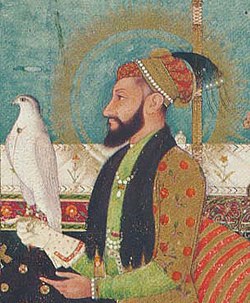
With the support of Islamic orthodoxy, Aurangzeb, a younger son of Shah Jahan, seized the throne in 1658, beginning a reign that would see the empire reach both its greatest extent and the onset of its decline.
Image source: Aurangzeb
1658 - 1666
% complete
Although Shah Jahan fully recovered from his illness, Aurangzeb kept him imprisoned until he died in 1666, ending the life of one of the Mughal Empire's most celebrated rulers.
1659
% complete
Aurangzeb defeated his brother Dara Shikoh in 1659 and had him executed, eliminating his chief rival for the throne and consolidating his hold on power.
1682 - 1707
% complete
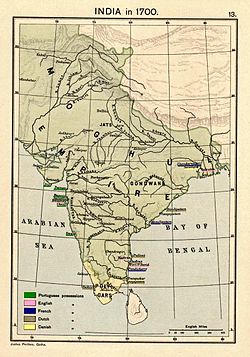
Aurangzeb led campaigns from 1682 in the Deccan, annexing the remaining Muslim powers of Bijapur and Golconda. The prolonged conflict in the region had a ruinous effect on the empire and stretched it to its maximum geographical extent.
1707 - 1720
% complete
After Aurangzeb died in 1707, historians have offered numerous accounts of the factors involved in the rapid collapse of the empire between 1707 and 1720. The Mughal imperial structure lasted until 1720, shortly after the death of this last major emperor.
1712
% complete
However, after Aurangzeb's successor died in 1712, the Mughal dynasty began to sink into chaos and violent feuds, accelerating the fragmentation of imperial authority.
1717
% complete
After 150 years of rule by Mughal viceroys, Bengal gained de facto independence as a dominion under Murshid Quli Khan, the first Nawab of Bengal, in 1717.
Image source: Nawabs of Bengal
1719
% complete
After the execution of Emperor Farrukhsiyar in 1719, local Mughal successor states took power region after region, marking the effective end of centralized Mughal authority.
Image source: Farrukhsiyar
1719
% complete
In 1719 alone, four emperors successively ascended the throne as figureheads under the Sadaat-e-Bara nobles. Their leaders, the Sayyid Brothers, became the de facto sovereigns of the empire.
Image source: Sayyid brothers
1719 - 1748
% complete
During the reign of Muhammad Shah (1719–1748), the empire began to break up, and vast tracts of central India passed from Mughal to Maratha hands.
Image source: Muhammad Shah
1757
% complete
The British East India Company seized control of the Bengal Subah in 1757, ending centuries of Mughal-era prosperity in the region and beginning direct colonial intervention in India.
1760
% complete
Reduced subsequently to the region in and around Old Delhi by 1760, the once-vast Mughal Empire retained only nominal authority over the remnants of its former dominions.
1761
% complete
Delhi was sacked by the Afghans, and when the Third Battle of Panipat was fought between the Maratha Empire and the Afghans led by Ahmad Shah Durrani in 1761, the victorious Afghans left Emperor Shah Alam II having ignominiously taken temporary refuge with the British to the east.
1771
% complete
In 1771, the Marathas recaptured Delhi from the Rohillas, reasserting their influence over the former imperial capital and further diminishing Mughal autonomy.
Image source: Maratha Empire
1784
% complete
In 1784, the Marathas officially became the protectors of the Mughal emperor in Delhi, a state of affairs that continued until the Second Anglo-Maratha War.
1793 - 1858
% complete
The British East India Company took control of the former Mughal province of Bengal-Bihar in 1793 after abolishing local rule (Nizamat), marking the beginning of the British colonial era over the Indian subcontinent, which lasted until 1858.
Image source: Company rule in India
1857
% complete
By 1857, a considerable part of former Mughal India was under East India Company control. The last Mughal emperor, Bahadur Shah Zafar, nominally led the rebellion, but after a crushing defeat the uprising was suppressed.
Image source: Indian Rebellion of 1857
1858
% complete
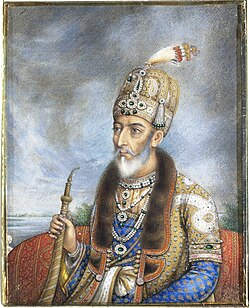
After the crushing defeat in the Indian Rebellion of 1857, Bahadur Shah Zafar was deposed by the British East India Company and exiled in 1858 to Rangoon, Burma, formally dissolving the Mughal Empire under the British Raj.
Image source: Bahadur Shah Zafar
Or browse the full history timeline directory, with more than 2,000 topics.
This Mughal Empire timeline was generated with the help of AI, using information found on the internet.
We work hard to keep these timelines accurate, but mistakes do get through. If you spot one, email us at [email protected] and we'll fix it for future visitors.
Generate yours with AI or build it from scratch, for free.
Export your timeline, add your own events, edit or remove AI-generated events, and much more
No credit card required.
Cancel anytime.
Cancel anytime.
You can create an unlimited number of timelines with up to 10 events on each one, customize how they look, export them to PDF, PNG, PowerPoint, CSV, and Excel, and share them with a link. Paid plans raise the event limit and add features like spreadsheet imports and collaborators.
Yes. You can cancel your subscription from your account page at any time, and you will not be charged again. Your subscription stays active for the rest of the period you already paid for.
Yes. We will email you a reminder before the annual renewal, and we will also email you a receipt.
Yes. You can email us within 15 days of any payment, and we will issue you a full refund.
Check out our pricing docs or send us an email anytime: [email protected].