
-
Use Cases
-
Resources
-
Pricing
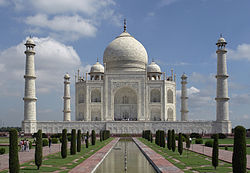
The Taj Mahal is an ivory-white marble mausoleum in Agra, India, commissioned in 1632 by Mughal Emperor Shah Jahan to house the tomb of his beloved wife Mumtaz Mahal. Widely regarded as one of the finest examples of Mughal architecture and a symbol of eternal love, it took over 20 years and thousands of artisans to complete. More Less
1609
The calligraphy on the buildings was created in 1609 by Abdul Haq, who was conferred the title of 'Amanat Khan' by Shah Jahan. His work includes inscriptions such as 'Return to the Lord at peace with Him, and He at peace with you.'
1631
The Taj Mahal was commissioned in 1631 by Shah Jahan (r. 1628–1658), the fifth Mughal emperor, to house the tomb of his late wife Mumtaz Mahal; it would later also house Shah Jahan's own tomb.
Jun 17, 1631
Mumtaz Mahal, the beloved wife of Mughal emperor Shah Jahan, died on 17 June 1631 while giving birth to their 14th child, Gauhara Begum. Her death prompted the grieving emperor to commission a grand mausoleum in her memory.
1632
Construction of the Taj Mahal commenced in 1632, beginning one of the most ambitious architectural projects in history on the banks of the Yamuna river in Agra.
1633
On the occasion of the second anniversary of Mumtaz Mahal's death in 1633, the cenotaphs were covered by a screen made of gold, which was later replaced by the famous marble screen in 1643.
1636
In his 1636 book Padshahnama, court historian Abdul Hamid Lahori referred to the Taj Mahal as rauza-i munawwara (Perso-Arabic: روضه منواره), meaning the illumined or illustrious tomb.
1643
In 1643, the original gold screen covering the cenotaphs was replaced with an intricately carved marble screen, which remains one of the most celebrated features of the interior today.
Feb 6, 1643
While the structure was still partially completed, Shah Jahan held the first ceremony at the mausoleum on 6 February 1643, marking the 12th anniversary of the death of Mumtaz Mahal.
Image source: Taj Mahal
1648
Construction of the central mausoleum was completed in 1648, although work on other parts of the complex continued for another five years.
1653
The Taj Mahal complex is believed to have been completed in its entirety in 1653 at a cost estimated at the time to be around ₹32 million, which in 2015 would be approximately ₹52.8 billion (US$827 million).
This Taj Mahal timeline was generated with the help of AI, using information found on the internet.
We work hard to keep these timelines accurate, but mistakes do get through. If you spot one, email us at [email protected] and we'll fix it for future visitors.
Generate yours with AI or build it from scratch, for free.