-
Resources
-
Pricing
The Delhi Sultanate was a series of Muslim dynasties that ruled much of northern India from the thirteenth to the early sixteenth century. More Less
Build a timeline like this one in minutes, for free. Start Yours →
Part of our collection of Indian history timelines.
997 - 1030
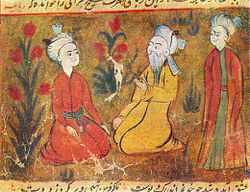
Mahmud of Ghazni, the son of a Turkic Mamluk military slave, raided and plundered kingdoms in northern India seventeen times. His campaigns ranged from east of the Indus River to west of the Yamuna River.
Image source: Mahmud of Ghazni
1173
Mu'izz ad-Din Muhammad Ghori, commonly known as Muhammad of Ghor, began a systematic war of expansion into northern India in 1173. His campaigns laid the military foundation for the later Delhi Sultanate.
Image source: Muhammad of Ghor
1191
The Rajput confederacy led by Prithviraj Chauhan defeated Muhammad of Ghor in the first battle near Tarain. The result was reversed in the following year.
Image source: Second Battle of Tarain
1192
Muhammad of Ghor routed the Rajput confederacy led by Ajmer ruler Prithviraj Chauhan near Tarain. Some historians use 1192 as the beginning of the Delhi Sultanate because of Muhammad's resulting presence and territorial claims in South Asia.
1193 - 1194
Under the command of Ghuri, campaigns in Rajasthan, Punjab, Haryana, and Uttar Pradesh included the destruction of temples and defacement of Hindu idols. This is identified as the first historical record of such a campaign in the listed account.
Image source: Ghurid campaigns in India
1206
The Delhi Sultanate was established in 1206 in the former Ghurid territories in India. It became a late medieval empire based primarily in Delhi and eventually stretched across large parts of the Indian subcontinent.
Image source: Delhi Sultanate
1206 - 1526
The history of the Delhi Sultanate is generally divided into five periods: Mamluk from 1206 to 1290, Khalji from 1290 to 1320, Tughlaq from 1320 to 1414, Sayyid from 1414 to 1451, and Lodi from 1451 to 1526.
1206
Muhammad of Ghor was assassinated in 1206 by Isma'ili Shi'a Muslims. His death left his former Indian territories to be consolidated by military commanders, including Qutb ud-Din Aibak.
1206 - 1210
Qutb ud-Din Aibak reigned as Sultan of Delhi for four years. His rule marked the beginning of the Mamluk, or Slave, dynasty and the first period of the Delhi Sultanate.
Image source: Qutb ud-Din Aibak
1210
After Aibak died, Aram Shah assumed power in 1210. His brief reign ended when he was assassinated in 1211 by Aibak's son-in-law, Shams ud-Din Iltutmish.
Image source: Aram Shah
1211 - 1236
Shams ud-Din Iltutmish took power after Aram Shah's assassination and ruled until 1236. He consolidated the early Delhi Sultanate and expanded the Qutb Minar complex.
Image source: Iltutmish
1236 - 1240
Razia Sultana ruled from 1236 to 1240 during a succession struggle following Iltutmish's reign. Her enthronement made her one of the few female rulers in Islamic history.
Image source: Razia Sultana
1266 - 1287
After power shifted among rulers including Rukn ud-Din Firuz and Razia Sultana, Ghiyas ud-Din Balban came to power. He ruled the Delhi Sultanate from 1266 to 1287.
Image source: Ghiyas ud din Balban
1000 - 1500
During the medieval Delhi Sultanate era, India's population experienced lasting growth after a millennium of stagnation according to uncertain modern estimates. The population increased by nearly 50 percent to about 110 million by 1500.
1000 - 1500
According to Angus Maddison's estimates, India's GDP grew nearly 8% to $60.5 billion in 1500, while its share of global GDP declined from 33 percent to 22 percent.
1199
The Qutb Minar complex in Delhi was begun under Muhammad of Ghor around 1199. The project was continued by Qutb ud-Din Aibak and later sultans, becoming a major symbol of the new Islamic state.
Image source: Qutb Minar
1200 - 1299
Amir Khusrau, who lived during the thirteenth-century Delhi Sultanate, used a form of Hindustani in his writings. He referred to this lingua franca as Hindavi.
Image source: Amir Khusrau
1200 - 1399
The worm-gear roller cotton gin was invented in the thirteenth or fourteenth centuries. Habib suggested that this development may have occurred in peninsular India before spreading more widely during the Mughal era.
Image source: Cotton gin
1234 - 1299
Under the Mamluks and Khaljis, campaigns involving temple desecration expanded into Bihar, Madhya Pradesh, Gujarat, and Maharashtra. The listed historical account records instances from 1234 through the late thirteenth century.
Image source: Somnath Temple
1236
The Tomb of Iltutmish was added to the Qutb complex by 1236. Its dome is now missing, while its intricate carving reflects the adaptation of local craftsmen to unfamiliar architectural traditions.
Image source: Iltutmish
1296 - 1316
Alauddin Khalji replaced private markets with four centralized government-run markets. He appointed a market controller and imposed strict price controls on goods ranging from clothing and household items to vegetables and prepared food.
1300 - 1399
The listed historical account states that temple-desecration campaigns extended to Andhra Pradesh, Karnataka, and Tamil Nadu under Malik Kafur and Ulugh Khan in the fourteenth century. Orissa temples were also destroyed under the Tughlaqs.
1300 - 1399
The balance of evidence indicates that in the latter half of the fourteenth century, if not earlier, jizyah was levied as a discriminatory tax on non-Muslims. The extent to which it could be enforced outside major centers of Muslim authority remains difficult to determine.
Image source: Jizya
1300 - 1311
The Qutb Minar complex was expanded under Ala ud-Din Khalji in the early fourteenth century. The Alai Darwaza gatehouse, completed in 1311, demonstrates the period's developing use of arches and domes.
Image source: Qutb Minar complex
1320 - 1324
The tomb of Shah Rukn-e-Alam was built at Multan between 1320 and 1324. Its large octagonal brick structure and polychrome glazed decoration remained closely related to architectural styles from Iran and Afghanistan.
Image source: Tomb of Shah Rukn-e-Alam
1323
According to the Sri Vaishnava temple chronicle Kōil Oḻugu, an expedition led by Ulugh Khan, later Muhammad bin Tughluq, sacked the Ranganathaswamy Temple at Srirangam. The chronicle estimates that 12,000 Vaishnava scholars and temple functionaries were killed.
Image source: Ranganathaswamy Temple, Srirangam
1350
The earliest unambiguous reference to a spinning wheel in India is dated to 1350. Its appearance belongs to the period of technological and economic change associated with medieval India.
Image source: Spinning wheel
1354
Firuz Shah's palace complex at Hisar, Haryana, was begun in 1354. Although now largely ruined, parts of the complex remain in fair condition and reflect the sultan's extensive building activity.
Image source: Firoz Shah palace complex
1400 - 1499
Paper was already established and widespread in Bengal by the fifteenth century. The Chinese traveler Ma Huan described Bengali paper as white and made from tree bark, suggesting a route of transmission from China distinct from the Middle Eastern rag-based method.
Image source: History of paper
1290 - 1296
Jalal ud-Din Firuz ruled for six years and founded the Khalji dynasty's period of the Delhi Sultanate. He was murdered in 1296 by Muhammad Salim of Samana on the orders of his nephew and son-in-law Juna Muhammad Khalji.
Image source: Jalal-ud-Din Khalji
1292
Ala ud-Din Khalji began his military career as governor of Kara and led a raid on the Kingdom of Malwa in 1292. The operation sought plunder and loot before his accession as sultan.
1294
As governor of Kara, Ala ud-Din Khalji led a second major raid in 1294 against Devagiri. The campaign brought substantial plunder and helped establish his military reputation.
Image source: Alauddin Khalji's conquest of Devagiri
1296 - 1316
After arranging the murder of his uncle Jalal ud-Din Firuz, Ala ud-Din Khalji became sultan. His reign expanded the sultanate, strengthened its army, and introduced extensive market controls.
1296 - 1316
Historians estimate that the Delhi Sultanate under the Khaljis maintained between 300,000 and 400,000 horse cavalry and 2,500 to 3,000 war elephants as a standing army.
1298
Between 15,000 and 30,000 Mongols near Delhi, many of whom had recently converted to Islam, were slaughtered in a single day after a mutiny during an invasion connected with Gujarat. The episode illustrates the sultanate's resistance to Mongol attacks.
1311
Malik Kafur's 1311 campaign reached the Pandya kingdom. His forces plundered the Nataraja Temple at Chidambaram and the Ranganathaswamy Temple at Srirangam before sacking Madurai and seizing its accumulated treasury.
Image source: Malik Kafur
1316
Ala ud-Din Khalji died in 1316 after being assassinated by his nobles. His general Malik Kafur then assumed de facto power with support from non-Khalji nobles including Kamal al-Din Gurg.
Image source: Alauddin Khalji
1320
Khusrau Khan ruled for only a few months after the political crisis following Ala ud-Din Khalji's death. Ghazi Malik defeated and killed him in 1320.
Image source: Khusrau Khan
1320
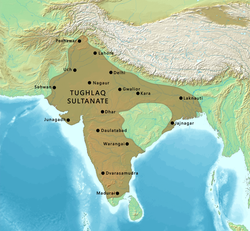
Ghazi Malik assumed power in 1320 and became known as Ghiyath al-Din Tughluq. His accession ended the Khalji dynasty and began the Tughlaq period of the Delhi Sultanate.
Image source: Tughlaq dynasty
1325
According to some historians, Ghiyath al-Din Tughluq was killed by his son Juna Khan, who assumed power in 1325 and became Muhammad bin Tughlaq.
Image source: Muhammad bin Tughluq
1329 - 1332
Muhammad bin Tughlaq introduced base-metal coins between 1329 and 1332. The policy contributed to the collapse of state revenues during a reign increasingly challenged by revolts.
1351
Muhammad bin Tughlaq died in 1351 while trying to chase and punish rebels in Gujarat. His death followed years of revolt and the contraction of the Delhi Sultanate's territory.
1351 - 1388
Firuz Shah Tughlaq ruled from 1351 to 1388 and attempted to recover the old kingdom's boundaries. He waged an eleven-month war with Bengal in 1359 and was also known as the dynasty's longest-ruling and greatest-building sultan.
Image source: Firuz Shah Tughlaq
1327 - 1339
Revolts against Muhammad bin Tughlaq began in 1327 and continued throughout his reign. By 1339, eastern regions under local Muslim governors and southern territories led by Hindu kings had revolted and declared independence.
1335 - 1378
Jalaluddin Ahsan Khan, a Sayyid from Kaithal, revolted in 1335 and founded the Madurai Sultanate in southern India. Later Delhi incursions under the Tughlaqs were connected with the establishment of this independent sultanate.
Image source: Madurai Sultanate
1347
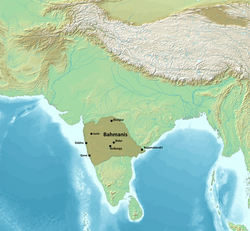
The Bahmani Sultanate became independent in 1347 through the rebellion of Ismail Mukh. Its emergence was part of the fragmentation of Tughlaq authority in southern India.
Image source: Bahmani Sultanate
1394 - 1397
From 1394 to 1397, two relatives each called themselves sultan: Mahmud Shah Tughluq ruled from Delhi, while Nusrat Shah Tughluq ruled from Firozabad. Their conflict continued until Timur's invasion.
1398
Timur's devastating raid on Delhi in 1398 caused a major political transformation across northern India. It coincided with the re-emergence of powers such as Vijayanagara and Mewar and the independence of new Muslim sultanates including Bengal and Bahmani.
1415 - 1451
The Sayyid dynasty was founded by Khizr Khan and ruled the Delhi Sultanate from 1415 to 1451. It governed after the disruption caused by Timur's invasion.
Image source: Sayyid dynasty
1451
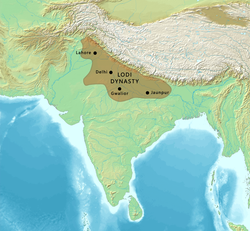
The Lodi dynasty displaced the Sayyid dynasty in 1451, producing a resurgence of the Delhi Sultanate. The Lodis were the final ruling dynasty of the sultanate.
Image source: Lodi dynasty
1489 - 1517
After Bahlul Lodi died, his son Nizam Khan assumed power, renamed himself Sikandar Lodi, and ruled from 1489 to 1517.
Image source: Sikandar Khan Lodi
1517 - 1526
Sikandar Lodi died a natural death in 1517, after which his second son Ibrahim Lodi assumed power. His reign ended with the Timurid invasion led by Babur.
Image source: Ibrahim Khan Lodi
1526
Babur defeated and killed Ibrahim Lodi in the Battle of Panipat in 1526. The conquest ended the Delhi Sultanate and led to its succession by the Mughal Empire.
Image source: First Battle of Panipat
Build a timeline like this one in minutes, for free. Start Yours →
Or browse the full history timeline directory, with more than 2,500 topics.
This Delhi Sultanate timeline was generated with the help of AI, using information found on the internet.
We work hard to keep these timelines accurate, but mistakes do get through. If you spot one, email us at [email protected] and we'll fix it for future visitors.
Generate yours with AI or build it from scratch, for free.
Export your timeline, add your own events, edit or remove AI-generated events, and much more
No credit card required.
15-day money-back guarantee.
You can create an unlimited number of timelines with up to 10 events on each one, customize how they look, export them to PDF, PNG, PowerPoint, CSV, and Excel, and share them with a link. Timelines made with Timeline Maker AI keep every event the generator created, and you can add up to 5 events of your own. Paid plans remove the event limit, add spreadsheet imports and hide Preceden's branding, and the higher-priced plan also adds collaborators, a custom logo and a custom domain.
Yes. You can cancel your subscription from your account page at any time, and you will not be charged again. Your subscription stays active for the rest of the period you already paid for.
Yes. We email you a reminder 15 days before your annual renewal, and we email you a receipt after every payment.
Yes. You can email us within 15 days of any payment, and we will issue you a full refund.
Check out our pricing docs or send us an email anytime: [email protected].