-
Use Cases
-
Resources
-
Pricing
Boxing is one of the world's oldest combat sports, with roots tracing back to ancient civilizations such as Egypt, Greece, and Rome. The modern sport evolved in 18th-century England with the introduction of the London Prize Ring rules and later the Marquess of Queensberry Rules, which established gloves, rounds, and fair play. Today, boxing is a global professional and amateur sport governed by organizations like the WBA, WBC, IBF, and WBO, and remains an Olympic event. More Less
1500 BC - 1400 BC
% complete
The earliest evidence of the use of gloves in combat sports can be found on Minoan Crete around 1500–1400 BC, showing that hand protection was used by fighters thousands of years before the modern era.
Image source: Boxing glove
1500 BC - 1000 BC
% complete
The earliest references to musti-yuddha, the ancient Indian art of fist fighting, come from Indian epic poetry such as the Rig Veda (c. 1500–1000 BCE), marking one of the oldest literary records of boxing-like combat.
1350 BC
% complete
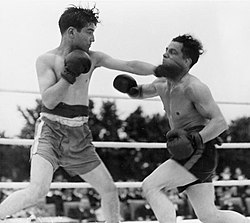
A relief sculpture from Egyptian Thebes dating to approximately 1350 BC shows both boxers and spectators, providing some of the earliest visual evidence of organized fist-fighting contests with an audience.
Image source: Boxing
700 BC - 400 BC
% complete
The Ramayana, composed between approximately 700 and 400 BCE, contains further references to musti-yuddha, demonstrating the enduring presence of fist fighting in Indian culture across many centuries.
1100 - 1700
% complete
Detailed records of various fist-fighting sports were maintained in different cities and provinces of Italy between the 12th and 17th centuries, showing that organized fighting sports persisted throughout medieval and early modern Europe.
1117
% complete
In ancient Rus, bare-knuckle boxing was known as kulachniy boy ('fist fight'), first appearing in the Church Slavonic Primary Chronicle published around 1117, documenting a long tradition of fist fighting in Eastern Europe.
Image source: Russian boxing
1500
% complete
The sport resurfaced in England during the early 16th century as bare-knuckle boxing, also known as prizefighting, beginning the tradition of professional fights for monetary prizes that would shape the modern sport.
Image source: Bare-knuckle boxing
1600 - 1900
% complete
Throughout the 17th to 19th centuries, boxing bouts were motivated by money, as fighters competed for prize money, promoters controlled the gate, and spectators bet on the result, making the sport inseparable from gambling and commerce.
1681
% complete
The first documented account of a bare-knuckle fight in England appeared in 1681 in the London Protestant Mercury, marking the beginning of press coverage of the sport.
Jan 6, 1681
% complete
On 6 January 1681, the first recorded boxing match took place in Britain when Christopher Monck, 2nd Duke of Albemarle, later lieutenant governor of Jamaica, engineered a match between his butler and his butcher; the butcher won the prize.
Image source: Christopher Monck, 2nd Duke of Albemarle
1713
% complete
An early article on boxing was published in Nottingham in 1713 by Sir Thomas Parkyns, 2nd Baronet, a wrestling patron from Bunny, Nottinghamshire, who had practised the techniques he described, contributing early technical literature to the sport.
Image source: Sir Thomas Parkyns, 2nd Baronet
1719
% complete
In 1719, James Figg became the first English bare-knuckle champion, establishing himself as a pioneering figure who helped popularize prizefighting as a recognized competitive pursuit in England.
Image source: James Figg
1790
% complete
In 1790, in Waddington, Lincolnshire, Mary Farmery and Susanna Locker both laid claim to the affections of a young man; Farmery challenged Locker to a fight for the prize, which was accepted, an early example of a women's prize fight.
Image source: Women's boxing
1800 - 1830
% complete
British sportswriter Pierce Egan coined the term 'the sweet science'—or more fully 'the sweet science of bruising'—as an epithet for prizefighting, describing England's bare-knuckle fight scene in the early nineteenth century.
1743
% complete
The first boxing rules, called the Broughton Rules, were introduced by champion Jack Broughton in 1743 to protect fighters in the ring, where deaths sometimes occurred, representing the first formal attempt to regulate the sport.
Image source: Jack Broughton
1850 - 1867
% complete
Boxing evolved through the prizefights of the 16th to 18th centuries, largely in Great Britain, to its modern forerunner in the mid-19th century with the introduction of the Marquess of Queensberry Rules in 1867, transforming the sport from bare-knuckle brawling into regulated competition.
1867
% complete
In 1867, the Marquess of Queensberry rules were drafted by John Graham Chambers for amateur championships held at Lillie Bridge in London for lightweights, middleweights, and heavyweights. These rules became the general rules governing modern boxing since their publication.
Image source: Marquess of Queensberry Rules
1870 - 1900
% complete
Throughout the late 19th century, boxing, or prizefighting, was primarily a sport of dubious legitimacy, existing in a legal gray area and often associated with gambling and criminal elements.
1882
% complete
In 1882, the Coney case found that a bare-knuckle fight was an assault occasioning actual bodily harm, despite the consent of the participants, dealing a major legal blow to unregulated prizefighting in England.
Image source: R v Coney
1890
% complete
Gloves have been required in competition since the late nineteenth century, though modern boxing gloves are much heavier than those worn by early twentieth-century fighters, reflecting evolving safety standards.
1892
% complete
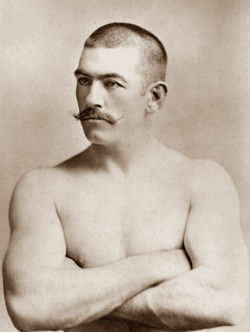
Sullivan fought at the Pelican Athletic Club in New Orleans, Louisiana in 1892, a landmark bout associated with the transition from bare-knuckle prizefighting to gloved, rules-based boxing in America.
Image source: John L. Sullivan
1897
% complete
The first instance of film censorship in the United States occurred in 1897 when several states banned the showing of prize-fighting films from the state of Nevada, where it was legal at the time, showing how controversial the sport remained.
Image source: Film censorship in the United States
1900 - 1950
% complete
Throughout the early 20th century, boxers struggled to achieve legitimacy, as the sport continued to battle associations with gambling, corruption, and legal restrictions even as it grew in popularity.
1900 - 1925
% complete
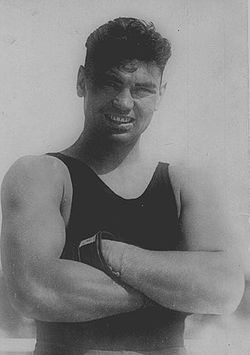
Through the early 20th century, it was common for fights to have unlimited rounds, ending only when one fighter quit, benefiting high-energy fighters like Jack Dempsey whose relentless stamina could wear down opponents.
Image source: Jack Dempsey
1908
% complete
The modern Olympic movement revived interest in amateur sports, and amateur boxing became an Olympic sport in 1908, giving the sport a new platform of international legitimacy.
Image source: Boxing at the Summer Olympics
Oct 30, 1974
% complete
Used by Muhammad Ali in his 1974 'the Rumble in the Jungle' bout against George Foreman, the rope-a-dope method involves lying back against the ropes, covering up defensively and allowing the opponent to attempt numerous punches until they tire.
Image source: The Rumble in the Jungle
1989
% complete
The International Boxing Hall of Fame (IBHOF) opened in Canastota, New York in 1989, creating a permanent institution honoring the greatest figures in the history of the sport.
Image source: International Boxing Hall of Fame
1990
% complete
The first inductees in 1990 included Jack Johnson, Benny Leonard, Jack Dempsey, Henry Armstrong, Sugar Ray Robinson, Archie Moore, and Muhammad Ali, enshrining the sport's most legendary champions.
2013
% complete
A boxing museum opened in Las Vegas, Nevada in 2013, founded by Steve Lott, former assistant manager for Mike Tyson, preserving the artifacts and stories of the sport's rich history.
2016
% complete
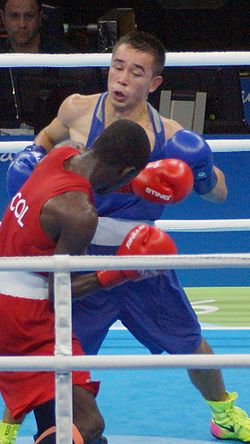
In 2016, professional boxers were admitted to the Olympic Games and other tournaments sanctioned by AIBA, ending the long separation between professional and amateur boxing at the highest level of competition.
Image source: Boxing at the 2016 Summer Olympics
1980 - 2007
% complete
From 1980 to 2007, more than 200 amateur boxers, professional boxers and Toughman fighters died due to ring or training injuries, underscoring the persistent dangers of the sport despite safety reforms.
Image source: Chronic traumatic encephalopathy
Mar 1981
% complete
In March 1981, neurosurgeon Fred Sonstein sought to use CT scans to track the degeneration of boxers' cognitive functions after seeing the decline of Bennie Briscoe, pioneering medical monitoring of fighters' brain health.
1982 - 1983
% complete
Fifteen rounds remained the internationally recognized limit for championship fights for most of the 20th century until the early 1980s, when the death of boxer Kim Duk-koo prompted the World Boxing Council and other organizations to reduce the limit to twelve rounds.
Image source: Kim Duk-koo
1994 - 2017
% complete
More comprehensive studies of neurological function on larger samples performed by Johns Hopkins University in 1994 and accident rates analyzed by the National Safety Council in 2017 show amateur boxing is a comparatively safe sport due to its regulations and greater control of athletes, although the studies did not focus on CTE or its long-term effects.
Image source: Amateur boxing
1997
% complete
In 1997, the American Association of Professional Ringside Physicians was established to develop medical protocols, based on research and education, to prevent injuries in boxing.
2007
% complete
In 2007, one study of amateur boxers showed that protective headgear did not prevent brain damage, and another found that amateur boxers faced a high risk of brain damage, raising serious questions about safety equipment.
2007
% complete
Boxing was banned in Sweden until 2007, when the ban was lifted, but strict restrictions were imposed, including four three-minute rounds for fights, reflecting ongoing caution about fighter safety.
Image source: World Boxing
2011
% complete
A 2011 study of bouts from 1890 to 2011 calculated an average mortality rate of 13 participants per year for the years studied, quantifying the deadly toll of the sport across more than a century.
2013
% complete
The International Boxing Association (AIBA) restricted the use of head guards for senior male competitors at the World Championships and the Olympics after 2013, a significant change in amateur boxing safety policy.
Image source: International Boxing Association
Dec 2014
% complete
Norway legalized professional boxing in December 2014, lifting a long-standing ban and allowing Norwegian fighters to compete professionally at home under regulated conditions.
2022
% complete
An Australian study published in the Journal of Science and Medicine in Sport in 2022 found that efforts made to improve safety in the sport in 2011 were unsuccessful at preventing deaths of participants, highlighting continuing concerns about boxing's dangers.
Or browse the full history timeline directory, with more than 2,000 topics.
This History of Boxing timeline was generated with the help of AI, using information found on the internet.
We work hard to keep these timelines accurate, but mistakes do get through. If you spot one, email us at [email protected] and we'll fix it for future visitors.
Generate yours with AI or build it from scratch, for free.
Export your timeline, add your own events, edit or remove AI-generated events, and much more
No credit card required.
Cancel anytime.
Cancel anytime.
You can create an unlimited number of timelines with up to 10 events on each one, customize how they look, export them to PDF, PNG, PowerPoint, CSV, and Excel, and share them with a link. Paid plans raise the event limit and add features like spreadsheet imports and collaborators.
Yes. You can cancel your subscription from your account page at any time, and you will not be charged again. Your subscription stays active for the rest of the period you already paid for.
Yes. We will email you a reminder before the annual renewal, and we will also email you a receipt.
Yes. You can email us within 15 days of any payment, and we will issue you a full refund.
Check out our pricing docs or send us an email anytime: [email protected].