-
Use Cases
-
Resources
-
Pricing
Mixed Martial Arts (MMA) is a full-contact combat sport that combines techniques from boxing, wrestling, Brazilian jiu-jitsu, Muay Thai, karate, and other disciplines. Its roots trace back to ancient Olympic Pankration, but modern MMA emerged in the 20th century through vale tudo in Brazil and Japanese shoot wrestling. The sport gained worldwide prominence with the founding of the Ultimate Fighting Championship (UFC) in 1993, evolving from a no-holds-barred spectacle into a highly regulated mainstream sport with unified rules, weight classes, and global superstars. More Less
264 BC
% complete
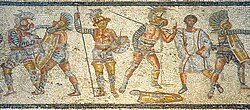
Roman gladiatorial games featured armed and unarmed combatants fighting in diverse styles before massive crowds. While not a direct precursor, these spectacles reflected humanity's enduring fascination with one-on-one combat contests.
Image source: Gladiator
Jan 1, 1600
% complete
In China, challenge matches fought on raised platforms called lei tai pitted practitioners of different kung fu styles against each other. These bouts, held for centuries, allowed cross-style competition and are an early example of mixed-style fighting.
Image source: Lei tai
1899
% complete
Edward William Barton-Wright created Bartitsu in London, blending jujutsu, boxing, savate, and cane fighting into one of the first Western hybrid martial arts systems, predating modern MMA by decades.
Image source: Bartitsu
1914
% complete
Japanese judoka Mitsuyo Maeda traveled to Brazil, where he taught his grappling art to the Gracie family. His teachings laid the foundation for Brazilian jiu-jitsu, a cornerstone of modern mixed martial arts.
Image source: Mitsuyo Maeda
1925
% complete
Carlos Gracie established the Gracie family's first academy in Rio de Janeiro, developing Brazilian jiu-jitsu and promoting 'Gracie Challenges' that invited fighters of any style to test their arts against his family's grappling.
Image source: Carlos Gracie
1930
% complete
Vale tudo ('anything goes') competitions spread across Brazil, featuring minimal-rules fights between practitioners of different disciplines. The Gracie family used these bouts to demonstrate the effectiveness of their jiu-jitsu.
Image source: Vale Tudo
Aug 12, 1963
% complete
Judo champion Gene LeBell fought boxer Milo Savage in Salt Lake City in one of America's earliest televised mixed-style matches, winning by chokehold and helping spark interest in cross-discipline combat.
1967
% complete
Bruce Lee developed Jeet Kune Do, advocating that fighters should absorb what is useful from every style rather than adhering to a single discipline. His philosophy is often cited as a conceptual precursor to MMA.
Image source: Bruce Lee
Jun 26, 1976
% complete
Boxing legend Muhammad Ali faced wrestler Antonio Inoki in a bizarre mixed-rules bout in Japan. The awkward fight ended in a draw but is considered a landmark early crossover event between striking and grappling styles.
Image source: Muhammad Ali vs. Antonio Inoki
Sep 21, 1993
% complete
Japanese promoters Masakatsu Funaki and Minoru Suzuki founded Pancrase, one of the first organizations dedicated to regulated mixed-style fighting, which helped develop many of MMA's early stars.
Image source: Pancrase
Nov 12, 1993
% complete
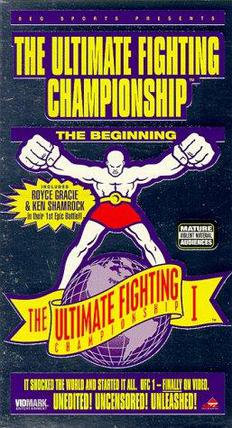
The inaugural UFC tournament took place in Denver, Colorado, marketed as a no-holds-barred contest to determine which martial art was most effective. Brazilian jiu-jitsu practitioner Royce Gracie won, shocking the martial arts world.
Image source: UFC 1
Nov 12, 1993
% complete
Royce Gracie defeated three larger opponents in one night using Brazilian jiu-jitsu, proving ground fighting's effectiveness against strikers and igniting a global revolution in how martial artists trained.
Image source: Royce Gracie
Oct 11, 1997
% complete
PRIDE FC debuted at the Tokyo Dome and quickly became the world's premier MMA organization, hosting legendary events and fighters like Fedor Emelianenko, Wanderlei Silva, and Mirko Cro Cop throughout the 2000s.
Jan 8, 2001
% complete
Frank and Lorenzo Fertitta, along with Dana White, bought the struggling UFC through their company Zuffa. They introduced unified rules, secured athletic commission sanctioning, and transformed the sport into a legitimate business.
Image source: Ultimate Fighting Championship
Apr 1, 2001
% complete
The New Jersey State Athletic Control Board formalized the Unified Rules of MMA, establishing weight classes, rounds, legal techniques, and judging criteria that became the regulatory standard for the sport worldwide.
Jun 19, 2004 - Dec 31, 2007
% complete
Russian fighter Fedor Emelianenko went undefeated in PRIDE, defeating elite heavyweights like Antônio Rodrigo Nogueira and Mirko Cro Cop, and is widely regarded as one of the greatest MMA fighters of all time.
Image source: Fedor Emelianenko
Jan 17, 2005
% complete
The UFC's reality television series gave viewers an inside look at aspiring fighters competing for a UFC contract. Its success brought MMA into mainstream American households and saved the promotion financially.
Image source: The Ultimate Fighter
Apr 9, 2005
% complete
The legendary slugfest between Forrest Griffin and Stephan Bonnar at The Ultimate Fighter finale is credited with launching the UFC's mainstream popularity, watched live by millions on free television.
Apr 16, 2005
% complete
Chuck Liddell knocked out Randy Couture to win the light heavyweight title and became the UFC's first true crossover star, appearing on magazine covers and late-night television during his championship reign.
Image source: Chuck Liddell
Mar 27, 2007
% complete
The UFC's parent company acquired its Japanese rival PRIDE, consolidating much of the world's top MMA talent under one banner and ending the era of two dominant global promotions.
Apr 19, 2008
% complete
Canadian Georges St-Pierre reclaimed the UFC welterweight title and began a years-long reign of dominance over the division, becoming one of the sport's most respected and marketable champions.
Image source: Georges St-Pierre
Aug 9, 2008
% complete
Brazilian middleweight Anderson Silva defended his UFC title ten consecutive times, dazzling fans with pinpoint striking and earning recognition as one of the most dominant champions in MMA history.
Image source: Anderson Silva
Jul 11, 2009
% complete
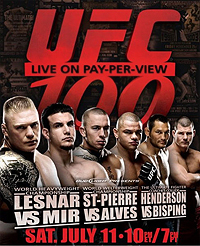
UFC 100 drew massive pay-per-view numbers and featured Brock Lesnar, Georges St-Pierre, and Dan Henderson in marquee bouts, symbolizing the sport's arrival as a major global entertainment property.
Image source: UFC 100
Feb 23, 2013
% complete
Ronda Rousey defeated Liz Carmouche at UFC 157 in the promotion's first women's fight, headlining the card and opening the door for female athletes to become some of MMA's biggest stars.
Feb 23, 2013 - Nov 15, 2015
% complete
Olympic judoka Ronda Rousey dominated the women's bantamweight division with lightning-fast armbar victories, becoming the first female MMA fighter to achieve mainstream celebrity status in film and media.
Image source: Ronda Rousey
Dec 12, 2015
% complete
Conor McGregor captured the featherweight title by knocking out long-reigning champion José Aldo just 13 seconds into their fight, one of the most stunning moments in MMA history that cemented McGregor as the sport's biggest draw.
Image source: UFC 194
Aug 26, 2017
% complete
MMA star Conor McGregor crossed over to face undefeated boxing champion Floyd Mayweather Jr. in Las Vegas. The spectacle generated hundreds of millions in revenue and showcased MMA fighters' mainstream appeal.
Image source: Floyd Mayweather Jr. vs. Conor McGregor
Oct 6, 2018
% complete
Khabib Nurmagomedov submitted Conor McGregor in the highest-selling pay-per-view in UFC history at the time, then retired undefeated at 29-0 after defending his lightweight title, cementing his legacy among the all-time greats.
Image source: UFC 229
Jul 6, 2019
% complete
Amanda Nunes became the first woman to hold UFC titles in two weight classes simultaneously, defeating legends like Cris Cyborg, Ronda Rousey, and Valentina Shevchenko to earn recognition as the greatest female MMA fighter ever.
Image source: Amanda Nunes
Or browse the full history timeline directory, with more than 2,000 topics.
This History of Mixed Martial Arts timeline was generated with the help of AI, using information found on the internet.
We work hard to keep these timelines accurate, but mistakes do get through. If you spot one, email us at [email protected] and we'll fix it for future visitors.
Generate yours with AI or build it from scratch, for free.
Export your timeline, add your own events, edit or remove AI-generated events, and much more
No credit card required.
Cancel anytime.
Cancel anytime.
You can create an unlimited number of timelines with up to 10 events on each one, customize how they look, export them to PDF, PNG, PowerPoint, CSV, and Excel, and share them with a link. Paid plans raise the event limit and add features like spreadsheet imports and collaborators.
Yes. You can cancel your subscription from your account page at any time, and you will not be charged again. Your subscription stays active for the rest of the period you already paid for.
Yes. We will email you a reminder before the annual renewal, and we will also email you a receipt.
Yes. You can email us within 15 days of any payment, and we will issue you a full refund.
Check out our pricing docs or send us an email anytime: [email protected].