-
Use Cases
-
Resources
-
Pricing
1841
Realists rejected Romanticism, which had dominated French literature and art since the early 19th century. This opposition helped define Realism as an approach concerned with contemporary life rather than Romantic idealization.
Image source: Realism (arts)
1845
The Realist movement began in the mid-19th century as a reaction to Romanticism and History painting. It sought to redirect artistic attention toward ordinary contemporary experience.
1848 - 1849
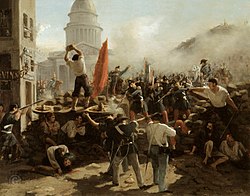
Multiple uprisings took place across Europe in 1848–49, including revolts in France, the German states, the Italian states, Hungary, and Poland. These upheavals formed an important political context for the rise of socially attentive Realist art.
Image source: Revolutions of 1848
1841 - 1848
Before his stylistic change after 1848, Courbet's early works emulated the sophisticated manner of Old Masters including Rembrandt and Titian. This phase preceded his more deliberately inelegant Realist manner.
1848
After 1848, Courbet moved toward a boldly inelegant style inspired by popular prints, shop signs, and the work of folk artisans. The shift contrasted with the polished Old Master manner of his earlier works.
1848
Adolph Menzel created Laying Out the March Dead in 1848. The work depicted civilian coffins after the March Revolution in Berlin, linking Realist subject matter to contemporary political upheaval.
1849
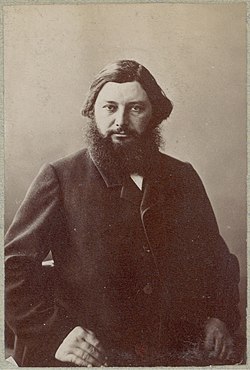
Although Courbet's early works emulated the sophisticated manner of Old Masters such as Rembrandt and Titian, after 1848 he adopted a boldly inelegant style. This style was inspired by popular prints, shop signs, and other work by folk artisans.
Image source: Gustave Courbet
1849
Courbet's first Realist works in 1849 and his later artworks often depicted poor and working-class people. These subjects had not been the focus of earlier art, while Romantic art generally portrayed a beautiful and idealized world.
1869
Courbet visited Munich in 1869 to exhibit his works and demonstrate his manner of painting from nature. Leibl and several other young German painters met him there.
1869 - 1870
After meeting Courbet in Munich, Wilhelm Leibl spent a year in Paris. His time there formed part of the development of his commitment to Realist painting.
1871
Much of Leibl's body of work consisted of paintings of ordinary people. His subjects reflected the Realist interest in everyday life rather than idealized historical or mythological themes.
1871
Leibl returned to Munich and formed the Leibl Circle in 1871 with other artists from the Academy of Fine Arts in Munich. The group focused on realism in painting.
1872 - 1875
Menzel's The Iron Rolling Mill, made from 1872 to 1875, portrayed an industrial factory scene. It represented the modern working environment within his Realist body of work.
1881
Leibl's Three Women in Church, painted in 1881, exemplified his attention to ordinary people and everyday settings.
1852 - 1863
Later in his career, the Pre-Raphaelite Ford Madox Brown's work became more traditionally Realist. This development is exemplified by The Last of England, made from 1852 to 1855, and Work, made in 1855 and 1863.
1852 - 1855
Ford Madox Brown's The Last of England, made from 1852 to 1855, exemplified the more traditionally Realist direction of his later work.
1855 - 1863
Ford Madox Brown's Work, made in 1855 and 1863, exemplified the more traditionally Realist character of his later career.
1862
Active a decade earlier than the work at The Graphic, Frederick Walker followed a similar trajectory from printing to Realist painting. He became influential on Herkomer's work and on other British artists later in the 19th century.
1866 - 1869
Thomas Eakins, one of the early American Realists, spent time in Paris from 1866 to 1869. His experience connected American Realism with European artistic developments.
1867
Winslow Homer, one of the early American Realists, spent time in Paris in 1867. His Paris experience formed part of the international context of American Realism.
Image source: Winslow Homer
1872 - 1876
Hubert von Herkomer and Ford Madox Brown worked together at The Graphic from 1872 to 1876. They produced woodcut images for the illustrated newspaper.
1872 - 1876
The woodcut images produced by Herkomer and Brown for The Graphic drew attention to social issues and poverty in the United Kingdom.
1886
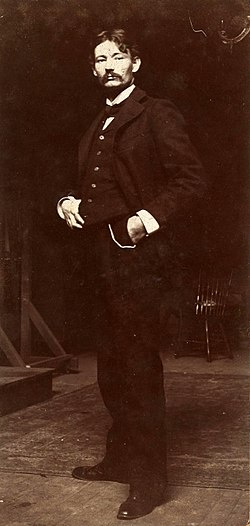
Robert Henri attended the Pennsylvania Academy of Fine Art in 1886. Teaching there was heavily influenced by Thomas Eakins' Realist style, although Eakins had been forced to resign shortly before Henri began.
Image source: Robert Henri
1886
Although Thomas Eakins was forced to resign just before Robert Henri started at the Pennsylvania Academy of Fine Art, Eakins' Realist style heavily influenced the academy's teaching and Henri's artistic formation.
Image source: Thomas Eakins
1853 - 1860
The Macchiaioli artist group formed in Italy between 1853 and 1860. The group was influenced by Realism after some of its members traveled to Paris.
1853 - 1860
When not painting in the Tuscan countryside, members of the Macchiaioli spent time in Florence and at the Caffé Michelangiolo. It was a common meeting place for thinkers and artists in the mid-19th century.
1853 - 1860
Some members of the Macchiaioli traveled to Paris between 1853 and 1860 and encountered influences that shaped the group's relationship to the Realist art style.
1860 - 1900
The Hague School was a group of Realist artists based in The Hague, Netherlands, between 1860 and 1900. The group became associated with landscape painting and Dutch subjects.
1860 - 1900
The Hague School was influenced by the Barbizon School's landscape painting, French naturalism, and French Realism. It combined these influences with themes drawn from 17th-century Dutch masters.
1870
Vassili Vereschagin's art also reflected his travels in India. These experiences contributed to the geographic range of his Realist subjects.
1870
Vassili Vereschagin was known for art depicting warfare. His work expanded Realist subject matter to include the direct consequences and settings of military conflict.
1870
Ilya Repin became known not only for paintings of peasants but also for themes of revolution. These subjects placed social and political experience within Russian Realist art.
1870 - 1873
Ilya Repin painted Barge Haulers on the Volga from 1870 to 1873. The work depicted peasants and exemplified the socially attentive subjects associated with Russian Realism.
1870
Russian Realism became associated with artists such as Ilya Repin and Vassili Vereschagin. Their subjects included peasants, revolution, warfare, and travel.
1880 - 1886
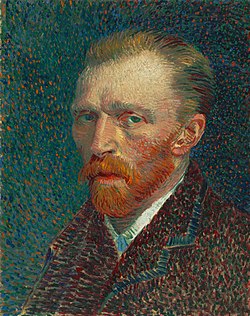
Vincent van Gogh was instructed by Mauve and originally painted in the Realist style. His early development therefore included a period shaped by Realist instruction.
Image source: Vincent van Gogh
1886
When Vincent van Gogh visited Paris in 1886, he was influenced by Impressionist artworks. This encounter marked a change from the Realist style of his earlier work.
Or browse the full history timeline directory, with more than 2,500 topics.
This Realism in Art timeline was generated with the help of AI, using information found on the internet.
We work hard to keep these timelines accurate, but mistakes do get through. If you spot one, email us at [email protected] and we'll fix it for future visitors.
Generate yours with AI or build it from scratch, for free.
Export your timeline, add your own events, edit or remove AI-generated events, and much more
No credit card required.
Cancel anytime.
Cancel anytime.
You can create an unlimited number of timelines with up to 10 events on each one, customize how they look, export them to PDF, PNG, PowerPoint, CSV, and Excel, and share them with a link. Paid plans raise the event limit and add features like spreadsheet imports and collaborators.
Yes. You can cancel your subscription from your account page at any time, and you will not be charged again. Your subscription stays active for the rest of the period you already paid for.
Yes. We will email you a reminder before the annual renewal, and we will also email you a receipt.
Yes. You can email us within 15 days of any payment, and we will issue you a full refund.
Check out our pricing docs or send us an email anytime: [email protected].