-
Use Cases
-
Resources
-
Pricing
Celtic Art encompasses the visual traditions associated with Celtic-speaking peoples, especially intricate geometric patterns, spirals, animals, and interlace. It developed from Iron Age La Tène art and flourished in medieval manuscripts, metalwork, stone carving, and monumental crosses, while continuing to influence artists today. More Less
1000 BC
A case has been made for artistic continuity in Europe from the Bronze Age and earlier Neolithic age. Archaeologists, however, generally use “Celtic” more specifically for the European Iron Age from around 1000 BC until Roman conquest, while art historians usually begin Celtic art with the La Tène period.
Image source: Celtic art
500 BC - 1 BC
Art historians typically identify Celtic art with the La Tène period, broadly spanning the fifth to first centuries BC. Its designs are characterized by flowing curves, vegetal motifs, complex ornament, and highly stylized human and animal forms.
Image source: La Tène culture
300 BC - 400
Although fine Irish finds survive from the first and second centuries, little or nothing in La Tène style is known from the third and fourth centuries. This absence corresponds to a period of instability in Ireland.
300 BC - 1 BC
From the third century BC, Celtic peoples began producing coins by imitating Greek and later Roman types. Over time, Celtic artists transformed classical models, exaggerating hair and rendering horses as vigorously curved, highly abstract elements.
Image source: Celtic coinage
300 BC - 1 BC
Northern France and western Germany contain especially rich La Tène sites. Over the following three centuries, the style spread widely, reaching Ireland, Italy, and modern Hungary.
300 BC
A group of important Celtic artworks and artifacts discussed in the tradition are dated to the third century BC, or sometimes earlier. Their dating places them within the formative and expansive phases of La Tène art.
100 BC
The Gundestrup cauldron, dated to the first century BC, is the largest surviving piece of European Iron Age silver, measuring 69 centimeters in diameter and 42 centimeters in height. Its iconography appears partly Celtic, but its manufacture and style remain debated and may be Thracian.
100 BC
The fragmented Gaulish Coligny calendar, dated to the first century BC or AD, is the oldest known material Celtic calendar. Its surviving bronze fragments provide evidence for Celtic calendrical knowledge and writing.
Image source: Coligny calendar
1944
Paul Jacobsthal’s Early Celtic Art, published in 1944, became the foundation of modern study of the art of the Celtic Iron Age. His work established a major scholarly framework for classifying and interpreting La Tène material.
400 - 850
From the fifth to the mid-ninth centuries, Pictish art is known primarily through stone sculpture and a smaller number of high-quality metalwork pieces. No illuminated Pictish manuscripts are known.
400 - 700
The art of the fifth through seventh centuries continued late Iron Age La Tène traditions while incorporating Roman and Romano-British influences that had gradually reached Britain and Ireland.
Image source: Insular art
400 - 1100
Medieval Celtic art was practiced by peoples of Ireland and parts of Britain during the roughly 700-year period from the Roman withdrawal from Britain in the fifth century to the establishment of Romanesque art in the twelfth century.
400 - 600
Enamel decoration on penannular brooches, dragonesque brooches, and hanging bowls suggests continuity between earlier Celtic decoration, including the Staffordshire Moorlands Pan, and the flowering of Christian Insular art from the sixth century onward.
500 - 900
Christianity brought Mediterranean and Germanic influences to Irish art. Contacts with Anglo-Saxons helped create the Insular, or Hiberno-Saxon, style, whose golden age came in the eighth and early ninth centuries before Viking raids disrupted monastic life.
500 - 900
Insular art, also called the Hiberno-Saxon style, developed from the sixth through ninth centuries. It combined Irish, British, Anglo-Saxon, Christian, and later Scandinavian influences across manuscripts and metalwork.
600
The seventh-century Bobbio Orosius is identified as the earliest known example within the Insular manuscript tradition. It illustrates the early development of decorated Christian book production.
Image source: Bobbio Orosius
600 - 699
The few fragments excavated from the seventh-century Benty Grange hanging bowl are typical of many surviving examples. Hanging bowls formed part of the metalwork tradition associated with early medieval Britain.
600 - 800
During the seventh and ninth centuries, Irish Celtic missionaries traveled to Northumbria and brought the Irish tradition of manuscript illumination into contact with Anglo-Saxon metalworking knowledge and motifs.
Image source: Hiberno-Scottish mission
700
Knowledge of hanging-bowl manufacture spread to Scotland and Ireland in the eighth century. This transmission contributed to the movement of metalworking techniques and decorative forms across the Insular world.
700 - 800
The manuscript form reached its peak when Irish Celtic missionaries traveled to Northumbria during the seventh and eighth centuries. Their illumination tradition encountered Anglo-Saxon metalworking knowledge and motifs, producing distinctive Insular decoration.
700 - 800
Some Insular manuscripts may have been produced in Wales, including the eighth-century Lichfield Gospels and Hereford Gospels. Their existence reflects the geographically broad nature of Insular manuscript culture.
800
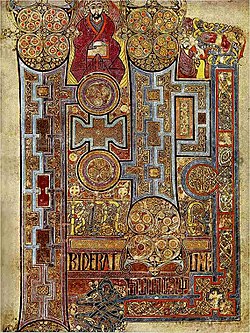
Insular manuscript art reached its peak in the late eighth century with the Book of Kells. The manuscript is renowned for its exceptionally elaborate decoration, intricate interlace, and fusion of Christian and Insular artistic traditions.
Image source: Book of Kells
800 - 1100
Plain silver became popular in Anglo-Saxon England during the ninth through eleventh centuries, probably because Viking trade and raiding increased the amount of silver in circulation. Ireland produced several magnificent silver penannular brooches during this period.
850
The Pictish stones may largely date from after the Scottish takeover of the Pictish kingdom in the mid-ninth century. Their chronology reflects the transition between Pictish and emerging Scottish political and artistic traditions.
Image source: Pictish stone
900
Celtic high-cross art reached an apex in the early tenth century. Muiredach’s Cross at Monasterboice and the Ahenny High Cross are among the finest surviving examples of this monumental tradition.
900 - 1170
Scandinavian influences entered Celtic art late in the medieval period through Viking activity and Norse-Gaelic communities. Original Celtic work came to an end with the Norman invasion of 1169–1170 and the introduction of the broader European Romanesque style.
1000 - 1099
The late Insular Ricemarch Psalter, certainly written in Wales in the eleventh century, shows strong Viking influence. It represents a later phase of manuscript production shaped by changing artistic contacts.
1075
The impact of the Vikings on Irish art became especially visible in the late eleventh century, when Irish metalwork began imitating Scandinavian Ringerike and Urnes styles. The Cross of Cong and Shrine of Manchan exemplify this development.
1607
The English form of the term “Celtic” is attested from 1607, providing a modern linguistic label for the peoples, cultures, and artistic traditions later grouped under Celtic art.
1670
In the late seventeenth century, scholars including Edward Lhuyd drew academic attention to historic links among Gaulish, Brythonic, and Goidelic-speaking peoples. The term Celtic consequently came to be applied not only to continental Celts but also to those in Britain and Ireland.
Image source: Edward Lhuyd
1700 - 1799
Eighteenth-century interest in primitivism and the idea of the “noble savage” produced a wave of enthusiasm for Celtic and Druidic subjects. This helped shape later romantic and nationalist interpretations of Celtic art.
1829
Following the Catholic Emancipation Act of 1829, the Irish revival developed as a conscious effort to demonstrate Irish national identity. Comparable movements in other countries later became part of the wider Celtic Revival.
1850
Interest in Celtic art was stimulated by the discovery of the Tara Brooch in 1850. The object was subsequently exhibited in London and Paris, helping popularize intricate early medieval Celtic ornament among Victorian audiences.
Image source: Tara Brooch
1870 - 1900
The late nineteenth-century reintroduction of monumental Celtic crosses for graves and other memorials became one of the most enduring aspects of the Celtic Revival. The practice spread far beyond communities with a specific Celtic heritage.
1900 - 1910
Interlace became a modern decorative style in architecture, especially in America around 1900. Louis Sullivan used related ornament in architecture, while Thomas A. O’Shaughnessy applied it to stained glass and wall stenciling in Chicago’s Irish-American community.
1970 - 2000
The late twentieth-century movement renewing Celtic visual culture is often called the Celtic Renaissance. It extended Celtic-inspired design into contemporary popular and artistic forms.
2009
The animated feature film The Secret of Kells, released in 2009, is set during the creation of the Book of Kells. It makes extensive use of Insular design and introduced its visual language to a modern film audience.
Image source: The Secret of Kells
2017
A group of contemporary Celtic artists and enthusiasts designated June 9 as International Day of Celtic Art in 2017. The observance reflects continuing interest in Celtic art as a living tradition.
Jun 6, 2019 - Jun 9, 2019
The First International Day of Celtic Art Conference was held from June 6 to 9, 2019, in Andover, New York. It brought contemporary Celtic artists and enthusiasts together around the study and practice of Celtic art.
Jun 8, 2023 - Jun 11, 2023
The second International Day of Celtic Art Conference took place at The Saint Patrick Centre in Downpatrick, Northern Ireland, from June 8 to 11, 2023. It continued the international exchange among contemporary Celtic artists and enthusiasts.
Or browse the full history timeline directory, with more than 2,500 topics.
This Celtic Art timeline was generated with the help of AI, using information found on the internet.
We work hard to keep these timelines accurate, but mistakes do get through. If you spot one, email us at [email protected] and we'll fix it for future visitors.
Generate yours with AI or build it from scratch, for free.
Export your timeline, add your own events, edit or remove AI-generated events, and much more
No credit card required.
Cancel anytime.
Cancel anytime.
You can create an unlimited number of timelines with up to 10 events on each one, customize how they look, export them to PDF, PNG, PowerPoint, CSV, and Excel, and share them with a link. Paid plans raise the event limit and add features like spreadsheet imports and collaborators.
Yes. You can cancel your subscription from your account page at any time, and you will not be charged again. Your subscription stays active for the rest of the period you already paid for.
Yes. We will email you a reminder before the annual renewal, and we will also email you a receipt.
Yes. You can email us within 15 days of any payment, and we will issue you a full refund.
Check out our pricing docs or send us an email anytime: [email protected].