-
Use Cases
-
Resources
-
Pricing
Coin collecting, also known as numismatics, is one of the world's oldest hobbies. From ancient rulers who kept coins as trophies to Renaissance scholars who studied them systematically, and finally to the modern era of professional grading and online marketplaces, the history of coin collecting reflects humanity's enduring fascination with money as art, history, and investment. More Less
27 BC - 14 AD
% complete
Roman Emperor Augustus is recorded by Suetonius as giving foreign coins and curiosities as gifts, one of the earliest known instances of coin collecting. His interest in unusual currency helped establish the tradition of coins as objects of fascination beyond mere commerce.
Image source: Augustus
1400 - 1500
% complete
During the Italian Renaissance, humanists began collecting and studying ancient Greek and Roman coins to learn about classical antiquity. Coins served as miniature artworks and historical documents, fueling a scholarly movement that became modern numismatics.
Image source: Numismatics
1500
% complete
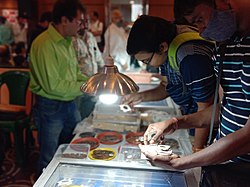
Maximilian I assembled one of the first royal coin collections, helping popularize coin collecting among European nobility. Royal cabinets of curiosities increasingly featured ancient and foreign coins as symbols of learning and prestige.
Image source: Maximilian I, Holy Roman Emperor
1514
% complete
The Italian humanist Petrus Gynaecius (Pier Francesco Giambullari is sometimes cited; more reliably, Guillaume Budé's era) saw the first published works on ancient coinage emerge during the Renaissance. These early numismatic treatises marked the beginning of scholarly study of coins.
Image source: Coin collecting
1514
% complete
French humanist Guillaume Budé published De Asse et Partibus, a landmark study of Roman monetary units. The work established philological methods for studying ancient coins and inspired generations of collectors across Europe.
Image source: Guillaume Budé
1650 - 1800
% complete
Wealthy young Europeans on the Grand Tour purchased ancient coins from sites in Italy and Greece as cultured souvenirs. This travel-driven demand spread coin collecting among the gentry and stimulated excavation markets in the Mediterranean.
Image source: Grand Tour

1677 - 1683
% complete
Elias Ashmole's donation formed the Ashmolean Museum, which included significant numismatic holdings. Institutional collections like this preserved coins for public study and set precedents for university numismatic cabinets.
Image source: Ashmolean Museum
1700 - 1800
% complete
The 18th century saw the rise of specialized coin auctions in London and Paris, creating organized marketplaces where rarities changed hands at documented prices. Auction catalogues became essential references for collectors and researchers.
Image source: Auction
1750
% complete
Professional coin dealers emerged across Europe in the 18th century, establishing shops, mail-order catalogs, and international networks. The dealer profession professionalized the hobby and made rare coins accessible beyond aristocratic circles.
1821
% complete
Mints began striking specially finished proof coins intended for collectors rather than circulation. Proof coinage transformed minting itself into a service for the collecting community and created premium products prized for their mirror-like surfaces.
Image source: Proof coinage
1836
% complete
The Numismatic Chronicle, launched by the Numismatic Society of London (founded 1836), became the premier English-language scholarly journal for coin research. It elevated numismatics into an academic discipline with rigorous publication standards.
1838
% complete
The founding of dedicated numismatic societies in 19th-century Europe formalized coin collecting as a scholarly pursuit. Societies organized meetings, publications, and auctions that connected collectors and researchers across borders.
Image source: Royal Numismatic Society
1846
% complete
Following its founding, the Smithsonian developed what became the National Numismatic Collection, one of the largest public assemblies of coins and currency. Government institutions worldwide similarly preserved monetary heritage for research and exhibition.
Image source: National Numismatic Collection
1858
% complete
The American Numismatic Society was founded in New York City, becoming a leading institution for numismatic research, education, and preservation in the United States. Its museum and library grew into world-class collections supporting scholars and hobbyists alike.
Image source: American Numismatic Society
1892
% complete
The World's Columbian Exposition half dollar became the first US commemorative coin, sold to collectors and fair visitors. Commemoratives created a new collecting niche blending patriotism, history, and numismatics.
Image source: Commemorative coin
1935
% complete
Publisher Wayte Raymond introduced National Coin Albums, allowing collectors to organize and display coins systematically. Affordable storage solutions democratized the hobby and encouraged thematic collecting.
1936
% complete
The US Mint began offering annual uncirculated coin sets by mail, institutionalizing the relationship between mints and collectors. Direct sales programs later expanded to proofs and commemoratives worldwide.
Image source: United States Mint
1940
% complete
Whitman's coin folders made 'filling holes' a beloved American pastime, letting children and families complete date-and-mintmark sets inexpensively. This fueled a postwar boom in everyday coin collecting.
Image source: Whitman Publishing
1946
% complete
R.S. Yeoman's Red Book provided retail price guides and images for US coins, becoming the best-selling coin book in history. Standardized pricing references brought transparency to the coin market.
Image source: A Guide Book of United States Coins
1979
% complete
The Gold Maple Leaf joined the Krugerrand (1967) in establishing pure gold bullion coins marketed to investors and collectors. Bullion coinage blurred lines between numismatics and precious metals investing.
1982
% complete
Founded in Dallas, Heritage Auctions grew into the world's largest collectibles auction house, setting record prices for rare coins. High-profile auctions brought mainstream media attention to numismatic treasures.
Image source: Heritage Auctions
Feb 1985
% complete
PCGS introduced standardized third-party grading with tamper-evident holders, revolutionizing trust in the coin market. Certified grading enabled sight-unseen trading and fueled dramatic growth in coin investing.
Image source: Professional Coin Grading Service
1987
% complete
NGC emerged as a major competitor to PCGS, expanding third-party certification globally. Competition between grading services raised standards and increased liquidity in high-value coin trading.
Image source: Numismatic Guaranty Company
1995
% complete
Online platforms like eBay connected buyers and sellers worldwide, dramatically expanding market access and price discovery. Digital communities, forums, and databases reshaped how collectors learn, trade, and authenticate coins.
Image source: EBay
1999 - 2008
% complete
The US Mint's ten-year State Quarters program drew an estimated 100 million Americans into checking change for new designs. It remains one of the most successful efforts to engage the public in coin collecting.
Image source: 50 State quarters
2000 - 2020
% complete
Comprehensive online resources such as NGC Coin Explorer and auction archives digitized decades of numismatic knowledge. Collectors gained instant access to populations, pedigrees, and prices, making the hobby more informed than ever before.
2008 - 2012
% complete
Economic turmoil pushed investors toward gold and silver coins while bargain hunting boosted collector activity. The period demonstrated coins' dual appeal as both historical artifacts and stores of value.
Image source: 2007–2008 financial crisis
2010
% complete
Consolidation among historic American auction houses created powerhouse firms handling landmark collections. Mergers reflected the maturing, globalized nature of the numismatic market.
Image source: Stack's Bowers
2013
% complete
A specimen of the first US silver dollar achieved a then-record price at auction, underscoring the investment potential of top-tier rarities. Record sales attracted new wealth and media coverage to the hobby.
Image source: Flowing Hair dollar
Or browse the full history timeline directory, with more than 2,000 topics.
This History of Coin Collecting timeline was generated with the help of AI, using information found on the internet.
We work hard to keep these timelines accurate, but mistakes do get through. If you spot one, email us at [email protected] and we'll fix it for future visitors.
Generate yours with AI or build it from scratch, for free.
Export your timeline, add your own events, edit or remove AI-generated events, and much more
No credit card required.
Cancel anytime.
Cancel anytime.
You can create an unlimited number of timelines with up to 10 events on each one, customize how they look, export them to PDF, PNG, PowerPoint, CSV, and Excel, and share them with a link. Paid plans raise the event limit and add features like spreadsheet imports and collaborators.
Yes. You can cancel your subscription from your account page at any time, and you will not be charged again. Your subscription stays active for the rest of the period you already paid for.
Yes. We will email you a reminder before the annual renewal, and we will also email you a receipt.
Yes. You can email us within 15 days of any payment, and we will issue you a full refund.
Check out our pricing docs or send us an email anytime: [email protected].