-
Use Cases
-
Resources
-
Pricing
Edinburgh, the capital of Scotland, boasts a history spanning over a thousand years. From its early settlement around Castle Rock to its role as a royal burgh, the heart of the Scottish Reformation, the intellectual hub of the Enlightenment, and a UNESCO World Heritage city today, Edinburgh has shaped and been shaped by the political, cultural, and intellectual currents of Scotland and Europe. More Less
80 AD
% complete
When the Romans arrived in the Lothian area towards the end of the 1st century AD, they discovered a Celtic Brythonic tribe whose name they recorded as the Votadini.
Image source: Votadini
600 AD
% complete
At some point before the 7th century AD, the Gododdin, presumed descendants of the Votadini, built a hillfort known as Din Eidyn in the area of Eidyn, modern Edinburgh.
Image source: Eidyn
650 AD
% complete
Traditionally and less certainly, Saint Cuthbert is said to have preached the gospel around the Castle Rock in the second half of the seventh century.
Image source: Cuthbert
650 AD - 950 AD
% complete
From the seventh to the tenth centuries Edinburgh was part of the Anglian Kingdom of Northumbria. Anglian influence predominated with Edinburgh as a frontier stronghold, and it may have been established as a stronghold by the Northumbrians in the seventh century.
Image source: History of Edinburgh
854 AD
% complete
A chronicle compiled in 1130, copying from earlier texts, mentioned a church at Edwinesburch in AD 854 which came under the authority of the Bishop of Lindisfarne. It is inferred that there was an established settlement by the middle of the ninth century.
875 AD
% complete
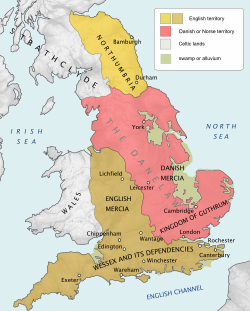
In the late ninth century the Danelaw, centred on York, was established in the wake of Viking raids on Britain, reshaping the political landscape of northern England and affecting the frontier around Lothian.
Image source: Danelaw
954 AD
% complete
The Chronicle of the Kings of Alba records that 'oppidum Eden', usually identified as Edinburgh, was evacuated and abandoned to the Scots until the present day. This indicates that Lothian was ceded to the Scottish king Indulf, who reigned from AD 954 to 962.
Image source: Indulf
1018 AD
% complete
By the early 11th century the Scottish hold over the area was secured when Malcolm II ended the Northumbrian threat by his victory at the Battle of Carham in 1018.
Image source: Battle of Carham
1070 AD
% complete
While Malcolm Canmore kept his court and residence at Dunfermline north of the Forth, he began spending more time at Edinburgh where he built a chapel for his wife Margaret to carry out her devotions. Refugees also fled to Edinburgh after the Norman Harrying of the North (1069–70).
Image source: Malcolm III of Scotland
1130 AD
% complete
Around 1130, King David I established the town of Edinburgh as one of Scotland's earliest royal burghs, protected by his royal fortress on the slope below the castle rock.
1291 AD - 1341 AD
% complete
Edinburgh was largely in English hands from 1291 to 1314 and from 1333 to 1341 during the Wars of Scottish Independence. Lord Basset was made Governor of Edinburgh Castle in 1291, and in 1334 Edward Balliol granted Edward III large portions of southern Scotland including Edinburgh under the Treaty of Newcastle.
Image source: Wars of Scottish Independence
1298 AD
% complete
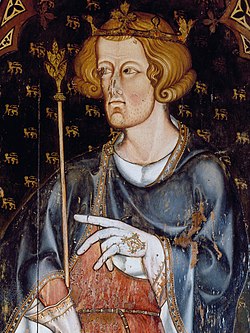
When the English invaded Scotland in 1298, King Edward I chose not to enter the English-controlled town of Edinburgh but passed by with his army.
Image source: Edward I of England
1350 AD
% complete
By the middle of the 14th century, Edinburgh was being described as the capital of Scotland, and around 1365 it was known as 'the Paris of Scotland'.
1470 AD
% complete
King James II (1430–60) was born, crowned, married and buried in the Abbey of Holyrood, and James III (1451–88) described Edinburgh in one of his charters as 'the principal burgh of our kingdom'.
Image source: James III of Scotland
1530 AD
% complete
By the reign of James V (1512–42), Edinburgh's assessment for taxation sometimes equalled the combined figures for the next three burghs; its share of total burgh taxation amounted to a fifth or a quarter, and its total customs to a half or more.
Image source: James V
1544 AD
% complete
Despite wholesale destruction reported by contemporaries at the time of the Hertford Raid in 1544, the town slowly recovered, its merchant burgesses and craftsmen continuing to serve the needs of the royal court and nobility.
1560 AD
% complete
The town played a central role in events leading to the establishment of Protestantism in the mid-16th century Scottish Reformation. In 1560, when Scotland's total population was about one million, Edinburgh reached 12,000 people, with another 4,000 in Canongate and Leith.
Image source: Siege of Leith
1561 AD
% complete
The Catholic Mary, Queen of Scots returned to Scotland from France in 1561 and suffered from deep discord sown prior to her arrival. Though initially welcomed, the tragic chain of events at Holyrood Palace, including the murders of David Rizzio and Henry Darnley, culminated in her forced abdication in 1567.
Image source: Mary, Queen of Scots
1571 AD - 1573 AD
% complete
The civil war following Mary's escape, defeat at Langside and flight to England ended with the final surrender of her remaining loyal supporters in the 'Lang Siege' of Edinburgh Castle in 1573.
Image source: Edinburgh Castle
1583 AD
% complete
In 1579, Edinburgh's town council revived plans to establish a university, having already sought but not received Mary's approval. Philosophical and religious instruction at the institution which became the University of Edinburgh began in 1583.
Image source: University of Edinburgh
1603 AD
% complete
In 1603 King James VI of Scotland succeeded to the English throne, uniting the monarchies of Scotland and England. Despite promising to return every three years, he came back only once, in 1617.
Image source: Union of the Crowns
1639 AD - 1640 AD
% complete
Stiff Presbyterian opposition to Charles I's attempt to introduce Anglican forms of worship and governance in the Church of Scotland culminated in the Bishops' Wars of 1639 and 1640, the initial conflicts of the civil war period, during which Edinburgh figured prominently.
Image source: Bishops' Wars
1650 AD
% complete
In 1650, following Scottish support for the restoration of Charles Stuart to the throne of England, Edinburgh was occupied by the Commonwealth forces of Oliver Cromwell after the Battle of Dunbar.
1654 AD
% complete
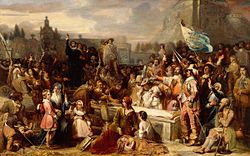
At the Mercat Cross in 1654, acting on Cromwell's behalf, Monck proclaimed Cromwell Protector of England, Ireland and Scotland and that Scotland was united with the Commonwealth of England.
Image source: George Monck, 1st Duke of Albemarle
1689 AD
% complete
The triumph of Presbyterianism in 1689 determined the settled form of the Church of Scotland, ending decades of internal religious division between Presbyterians and Episcopalians.
Image source: Church of Scotland
1696 AD
% complete
Thomas Aikenhead, son of a surgeon in the city, aged 18, was indicted for blasphemy by order of the Privy Council for calling the New Testament 'The History of the Imposter Christ'; he was hanged in 1696, the last person executed for heresy in Britain.
1707 AD
% complete
In 1706 and 1707, the Acts of Union were passed by the Parliaments of England and Scotland, uniting the two kingdoms into the Kingdom of Great Britain. This meant the end of the Scottish Parliament, and members of parliament, aristocrats and placemen moved to London.
Image source: Acts of Union 1707
1726 AD
% complete
The Faculty of Medicine at the University of Edinburgh, formed in 1726, soon attracted students from across Britain and the American colonies. Its chief sponsor was Archibald Campbell, 1st Earl of Islay, later 3rd Duke of Argyll, Scotland's most influential political leader.
1728 AD - 1797 AD
% complete
The Edinburgh Musical Society was constituted in 1728 by well-to-do music lovers. They built St Cecilia's Hall in Niddry Street in 1763 as their private concert hall, hired flautist Francesco Barsanti at £50, had close links to the city's Masonic lodges, and dissolved in 1797.
Image source: St Cecilia's Hall
1730 AD - 1750 AD
% complete
By the first half of the 18th century, rising prosperity was evidenced by the growth of the Bank of Scotland, Royal Bank of Scotland and British Linen Bank, all based in the city.
Image source: Bank of Scotland
1745 AD
% complete
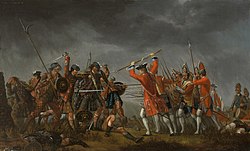
During the Jacobite rising of 1745, Edinburgh was briefly occupied by the Jacobite 'Highland Army' before its march into England.
Image source: Jacobite rising of 1745
1752 AD
% complete
Although the idea of northwards expansion had been first mooted around 1680 during the Duke of York's residence at Holyrood, the immediate catalyst was a decision by the Convention of Royal Burghs in 1752 to propose improvements to the capital for the benefit of commerce.
Image source: New Town, Edinburgh
1768 AD - 1898 AD
% complete
First published in three volumes between 1768 and 1771 with 2,659 pages and 160 engravings, it quickly became a standard reference work. The fourth edition (1810) ran to 16,000 pages in 20 volumes, and it continued to be published in Edinburgh until sold to an American publisher in 1898.
Image source: Encyclopædia Britannica
1783 AD
% complete
The Royal Society of Edinburgh, founded in 1783, became Scotland's national academy of science and letters. That same era saw Thomas Jefferson write to Dugald Stewart in June 1789 that, as far as science was concerned, 'no place in the world can pretend to a competition with Edinburgh'.
Image source: Royal Society of Edinburgh
1802 AD - 1929 AD
% complete
Founded in 1802, The Edinburgh Review became one of the most influential intellectual magazines of 19th-century Britain, publishing until 1929. Under editor Francis Jeffrey it promoted Romanticism and Whig politics.
Image source: Edinburgh Review
1802 AD
% complete
Observing conditions in the 1770s, an English visitor reported that no people in the world lived in greater hardship than the lower classes there. From 1802 onwards a 'Second New Town' developed north of James Craig's original New Town, and the New Town had been added progressively from the second half of the 18th century onwards.
1820 AD
% complete
From around 1820 the city acquired its soubriquets 'Modern Athens' and 'Athens of the North' because of a perceived similarity in topography, neo-classical architecture of its new public buildings and New Town, and its reputation as an intellectual centre.
1821 AD
% complete
By 1821, Edinburgh had been overtaken by Glasgow as Scotland's largest city, having been outgrown in the first two decades of the 19th century.
1832 AD - 1844 AD
% complete
From 1832 to 1844, Chambers's Edinburgh Journal was the most read periodical in Britain, with a circulation over 80,000.
Image source: Chambers's Edinburgh Journal
1865 AD - 1867 AD
% complete
Following Henry Littlejohn's Report on the Sanitary Conditions of the City of Edinburgh in 1865, major street improvements were carried out in the Old Town under Lord Provost William Chambers through the Edinburgh Improvement Act 1867.
Image source: William Chambers (publisher)
1900 AD - 1980 AD
% complete
Piecemeal improvements to the Old Town followed in the early 20th century instigated by pioneering town planner Patrick Geddes, who described his work as 'conservative surgery'. Economic stagnation through two world wars saw the fabric deteriorate before major slum clearance in the 1960s and 1970s began reversing the process.
Image source: Patrick Geddes
Apr 2, 1916
% complete
During the First World War, Edinburgh was bombed on the night of 2–3 April 1916.
Jul 22, 1940
% complete
The Port of Leith was hit on 22 July 1940 when a 1000 lb bomb fell on the Albert Dock, though it is unclear whether the originally intended target had been the well-defended Rosyth Dockyard. Bombs were dropped on at least 11 other occasions between June 1940 and July 1942 in opportunistic attacks.
Image source: Leith
1965 AD
% complete
In the mid-1960s, the working-class area of Dumbiedykes was swept away almost overnight and the George Square area, representing much of the city's original southwards expansion, fell victim to new University building developments.
Image source: Dumbiedykes
1990 AD
% complete
Since the 1990s a new financial district, including a new Edinburgh International Conference Centre, has grown mainly on demolished railway property to the west of the castle, stretching into Fountainbridge, which has undergone radical change since the 1980s with the demise of industrial and brewery premises.
Image source: Fountainbridge
1998 AD - 1999 AD
% complete
In 1998, the Scotland Act, which came into force the following year, established a devolved Scottish Parliament and Scottish Executive (renamed the Scottish Government since September 2007). Following devolution, Scotland's Parliament was re-established in Edinburgh.
Image source: Scotland Act 1998
Or browse the full history timeline directory, with more than 2,000 topics.
This History of Edinburgh timeline was generated with the help of AI, using information found on the internet.
We work hard to keep these timelines accurate, but mistakes do get through. If you spot one, email us at [email protected] and we'll fix it for future visitors.
Generate yours with AI or build it from scratch, for free.
Export your timeline, add your own events, edit or remove AI-generated events, and much more
No credit card required.
Cancel anytime.
Cancel anytime.
You can create an unlimited number of timelines with up to 10 events on each one, customize how they look, export them to PDF, PNG, PowerPoint, CSV, and Excel, and share them with a link. Paid plans raise the event limit and add features like spreadsheet imports and collaborators.
Yes. You can cancel your subscription from your account page at any time, and you will not be charged again. Your subscription stays active for the rest of the period you already paid for.
Yes. We will email you a reminder before the annual renewal, and we will also email you a receipt.
Yes. You can email us within 15 days of any payment, and we will issue you a full refund.
Check out our pricing docs or send us an email anytime: [email protected].