
-
Resources
-
Pricing
The history of fire hydrants traces the development of organized firefighting water supplies, from ancient aqueducts and underground mains to the standardized hydrants used today. More Less
Build a timeline like this one in minutes, for free. Start Yours →
1652
Boston's early water infrastructure included wooden conduits and public wells used by residents and firefighters. The city's later experience with wooden mains and fire plugs helped shape American municipal firefighting practice.
Sep 2, 1666 - Sep 6, 1666
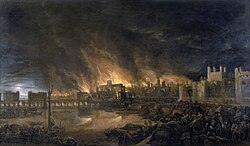
The Great Fire destroyed much of London and exposed the limitations of bucket brigades and inadequate water access. The disaster encouraged improvements in water mains, fire insurance, organized fire brigades, and methods for drawing water from buried supply pipes.
1667 - 1700
Following the Great Fire, London water companies installed or expanded wooden water mains with access points commonly called fire plugs. Firefighters could remove a plug and draw water from the main, an important predecessor of the modern hydrant.
Image source: Great Fire of London
1799 - 1801
Philadelphia developed one of the earliest major American municipal water systems. Its waterworks supplied urban streets through mains and created a setting in which dedicated outlets for firefighting could replace reliance on wells, cisterns, and private water sources.
1842
The Croton Aqueduct began supplying New York City in 1842, providing a dependable municipal water source for a rapidly growing city. The new network supported the spread of fire plugs and hydrants and reduced dependence on wells and reservoirs during urban fires.
1848
The Cochituate Water Works began delivering water to Boston in 1848. Expansion of the system enabled the city to install more reliable fire hydrants and supported a transition from private wells and cisterns to municipal firefighting water.
1801
Philadelphia waterworks engineer Frederick Graff is widely credited with developing an early modern fire hydrant around 1801. His design combined a vertical standpipe, a valve, and hose connections, making it possible for firefighters to access pressurized municipal water directly from the street.
1810 - 1830
During the early nineteenth century, Philadelphia expanded water mains and installed more dedicated street outlets for firefighting. These installations helped establish the basic American pattern of a buried water main connected to a curbside or sidewalk hydrant.
1836
A fire destroyed Philadelphia's Patent Office records in 1836, including documentation associated with Graff's hydrant work. Because the original patent evidence was lost, the precise date and details of the earliest hydrant patent have remained subjects of historical discussion.
1840 - 1855
As New York's water system expanded, underground mains and street fire plugs became increasingly important to the volunteer fire department. Firefighters used plug wrenches and hose connections to draw water quickly from the Croton system.
1850 - 1900
Municipalities increasingly replaced vulnerable wooden water pipes with cast-iron mains during the nineteenth century. Stronger iron mains could withstand pressure and provided more durable connections for hydrants, improving the reliability of urban fire protection.
1860
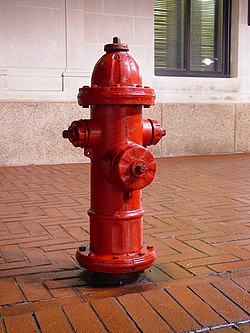
Nineteenth-century manufacturers such as Miller and Company produced improved hydrants with stronger castings, replaceable parts, and valves suited to American municipal water systems. These designs helped establish the dry-barrel form used in regions subject to freezing.
Image source: Fire hydrant
1869
William B. Bresnan received a United States patent for an improved fire hydrant in 1869. Patent activity during this period reflects rapid experimentation with valve arrangements, outlets, operating mechanisms, and protection against leakage and freezing.
1870 - 1900
Municipalities increasingly selected hydrant types according to climate. Wet-barrel hydrants kept the barrel full of water and suited frost-free regions, while dry-barrel hydrants placed the main valve below ground so the exposed barrel could drain in freezing weather.
1853 - 1870
Cities including Cincinnati, Boston, New York, and other American municipalities created or expanded paid professional fire departments during the mid-nineteenth century. Professional crews and steam fire engines increased demand for standardized, accessible hydrants.
Image source: Fire department
1853
Cincinnati established one of the first paid professional fire departments in the United States. Its use of steam fire engines and municipal water infrastructure illustrated how hydrants became central to coordinated urban firefighting.
1859
Boston replaced its volunteer organization with a paid fire department in 1859. The change encouraged systematic placement, maintenance, and mapping of hydrants connected to the city's expanding water network.
Image source: Boston Fire Department
1865
New York City's Metropolitan District fire department became a paid, professional organization in 1865. Professional firefighters relied on the city's growing network of fire plugs and hydrants for faster and more dependable water supply.
1870 - 1900
Companies including A. P. Smith, M. Greenberg's Sons, Ludlow, Kennedy Valve, and others developed specialized hydrant lines in the late nineteenth century. Competition produced recognizable patterns such as compression, gate, dry-barrel, and wet-barrel hydrants.
1880 - 1910
Rapid industrialization, urban growth, and municipal water construction led to widespread hydrant installation across North America. Hydrants were placed at planned intervals and connected to increasingly extensive water-main grids serving dense neighborhoods.
1881
The American Water Works Association was founded in 1881 to advance the management and engineering of public water supplies. Its later technical guidance helped shape hydrant testing, installation, maintenance, and fire-flow practice.
1886 - 1920
The National Board of Fire Underwriters published recommendations concerning water supplies, hydrant spacing, hose outlets, and fire-flow capacity. Insurance-driven standards encouraged cities to improve hydrant networks as part of broader fire-loss prevention.
1890 - 1930
Fire departments increasingly standardized operating nuts, outlet sizes, and hose threads so crews could connect equipment across a city. Although regional variations persisted, common fittings made hydrant operation faster and reduced incompatibility between departments and manufacturers.
1894
Underwriters Laboratories was founded in 1894 and became an important institution in testing and certifying safety equipment. Certification culture contributed to more systematic evaluation of fire-protection components, including valves and hydrant-related equipment.
1930
During the twentieth century, AWWA developed and periodically revised specifications for dry-barrel and wet-barrel fire hydrants. These documents addressed materials, pressure performance, outlets, valves, drainage, and inspection, helping municipalities procure more consistent equipment.
1939 - 1945
World War II expanded industrial production and heightened the need to protect factories, shipyards, military bases, and cities from fire. Hydrant manufacturers and water utilities supported large facilities with higher-capacity mains, additional outlets, and improved fire-flow planning.
Image source: World War II
1950 - 1980
Many water utilities adopted color schemes for hydrant bodies, bonnets, or caps to communicate water-main size, available fire flow, or ownership. Practices varied by jurisdiction, but visual coding helped firefighters identify potentially useful hydrants quickly.
1970
The United States established the Occupational Safety and Health Administration in 1970. Its workplace-safety framework affected municipal water and fire-service operations, including training, traffic protection, confined spaces, and safe handling of hydrant equipment.
Image source: Occupational Safety and Health Administration
1970 - 2000
The National Fire Protection Association expanded guidance relevant to water supplies, fire-flow testing, fire department connections, and hydrant operations. NFPA documents complemented water-industry standards and helped integrate hydrants into modern fire-protection planning.
Image source: National Fire Protection Association
1970 - 2000
Utilities and fire departments increasingly used pitot readings, pressure gauges, and standardized flow tests to measure hydrant performance. Testing revealed blocked mains, closed valves, inadequate pressure, and deterioration before emergencies occurred.
1980 - 2000
Growing attention to drinking-water protection led utilities to control temporary connections, flushing, and unauthorized hydrant use. Hydrant maintenance became part of broader programs addressing contamination, backflow, corrosion, and water-main integrity.
1980 - 2000
Municipalities began transferring hydrant locations and attributes into computerized geographic information systems. Digital maps allowed utilities and fire departments to track coordinates, outlet sizes, inspection dates, flow data, isolation valves, and maintenance history.
Image source: Geographic information system
2000 - 2025
In the twenty-first century, utilities introduced automatic flushing devices, sensor-equipped hydrants, electronic inspection records, and remote monitoring. These tools can help manage stagnant water, detect leaks or unauthorized use, and improve the accuracy of hydrant maintenance programs.
Image source: Internet of things
2000 - 2025
Contemporary hydrant programs address extreme weather, seismic movement, traffic impacts, corrosion, accessibility, and changing fire-flow demands. Utilities increasingly combine standardized installation with asset management, scheduled exercising, post-fire inspection, and digital records.
Build a timeline like this one in minutes, for free. Start Yours →
Or browse the full history timeline directory, with more than 2,500 topics.
This History of Fire Hydrants timeline was generated with the help of AI, using information found on the internet.
We work hard to keep these timelines accurate, but mistakes do get through. If you spot one, email us at [email protected] and we'll fix it for future visitors.
Generate yours with AI or build it from scratch, for free.
Export your timeline, add your own events, edit or remove AI-generated events, and much more
No credit card required.
15-day money-back guarantee.
You can create an unlimited number of timelines with up to 10 events on each one, customize how they look, export them to PDF, PNG, PowerPoint, CSV, and Excel, and share them with a link. Timelines made with Timeline Maker AI keep every event the generator created, and you can add up to 5 events of your own. Paid plans remove the event limit, add spreadsheet imports and hide Preceden's branding, and the higher-priced plan also adds collaborators, a custom logo and a custom domain.
Yes. You can cancel your subscription from your account page at any time, and you will not be charged again. Your subscription stays active for the rest of the period you already paid for.
Yes. We email you a reminder 15 days before your annual renewal, and we email you a receipt after every payment.
Yes. You can email us within 15 days of any payment, and we will issue you a full refund.
Check out our pricing docs or send us an email anytime: [email protected].