-
Use Cases
-
Resources
-
Pricing
1633
% complete
London Bridge, the only physical connection between the City and the south side of the River Thames, had been noted as a deathtrap in the major fire of 1633, the most recent serious blaze before 1666. The bridge's houses and narrow passage made evacuation and firefighting extremely difficult.
Image source: London Bridge
1659
% complete
In 1659, diarist John Evelyn contrasted London unfavourably with the Baroque magnificence of Paris, calling the English capital a 'wooden, northern, and inartificial congestion of Houses'. His criticism highlighted the crowded, flammable nature of the city's medieval building stock, which would prove so disastrous in 1666.
Image source: John Evelyn
1660
% complete
By the late 17th century, the City proper—the area bounded by the city wall and the River Thames—covered some 700 acres and was home to about 80,000 people, roughly a quarter of London's inhabitants. The City was traffic-clogged, polluted, and unhealthy, with densely packed timber buildings creating ideal conditions for a catastrophic fire.
1660 - 1666
% complete
The City of London had been a stronghold of republicanism during the English Civil Wars (1642–1651), and the wealthy and economically dynamic capital still had the potential to be a threat to Charles II, as demonstrated by several republican uprisings in London in the early 1660s. This political tension coloured the king's response to the fire.
Image source: City of London
1661
% complete
In 1661, Charles II issued a proclamation forbidding overhanging windows and jetties, which obstructed airflow and brought upper storeys dangerously close together. However, the proclamation was largely ignored by the local government, and cheap, flammable building practices continued despite centuries-old prohibitions on timber construction and thatched roofs.
1665 - 1666
% complete
The Great Plague epidemic of 1665 is believed to have killed a sixth of London's inhabitants, or 80,000 people. The devastating outbreak of bubonic plague left the already unhealthy City in a dire state, and it is sometimes suggested that the following year's fire saved lives in the long run by burning down unsanitary housing along with the rats and fleas that transmitted plague.
Image source: Great Plague of London
1665
% complete
Charles II issued a sharper message in 1665 warning of the risk of fire from the narrowness of the streets. His proclamation authorised both imprisonment of recalcitrant builders and demolition of dangerous buildings, but like earlier proclamations it was largely ignored by the local government.
Image source: Charles II of England
1666
% complete
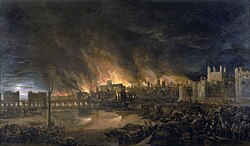
Cultural responses to the Great Fire emerged almost immediately in poetry, 'one of the chief modes of media in seventeenth-century England', as well as in religious sermons. Writers and clergy interpreted the disaster as divine judgement and reflected on the city's destruction and rebirth.
Image source: Great Fire of London
1671 - 1676
% complete
On Charles II's initiative, a Monument to the Great Fire of London was erected near Pudding Lane between 1671 and 1676. Designed by Christopher Wren and Robert Hooke, the Doric column stands 61.5 metres (202 ft) tall and commemorates the devastating blaze.
Image source: Monument to the Great Fire of London
1681
% complete
In 1681, accusations against the Catholics were added to the inscription on the Monument, which read, in part, 'Popish frenzy which wrought such horrors, is not yet quenched'. The inscription reflected the anti-Catholic sentiment stirred by the Popish Plot.
1830
% complete
The Monument's inscription blaming Catholics for the fire remained until after the passage of the Roman Catholic Relief Act 1829, when it was removed in 1830 following a successful campaign by City Solicitor Charles Pearson, ending nearly 150 years of official anti-Catholic blame.
1832
% complete
Confusion between parish and private firefighting efforts led the insurance companies in 1832 to form a combined firefighting unit. This organisation would eventually become the London Fire Brigade, a lasting institutional legacy of the firefighting lessons drawn from the Great Fire.
Image source: London Fire Brigade
1841
% complete
William Harrison Ainsworth's 1841 novel Old St. Paul's was a notable later cultural work featuring the Great Fire, dramatising the catastrophe against the backdrop of the plague year and the destruction of the old cathedral, helping to keep the memory of the fire alive in Victorian popular culture.
Image source: Old St. Paul's (novel)
2006
% complete
Forged in the Fire, a 2006 novel, is among the more recent cultural works featuring the Great Fire of London, continuing a long tradition of literary responses to the catastrophe that began with contemporary poetry and sermons in the seventeenth century.
2014
% complete
The 2014 television drama The Great Fire brought the story of the 1666 blaze to modern audiences, depicting the outbreak and spread of the fire and the efforts of Londoners to combat it, as part of the ongoing cultural legacy of the disaster.
2016
% complete
In 2016, the Royal Mail issued a stamp depicting Christopher Wren presenting his plan for rebuilding London. It was one of six stamps in a set commemorating the 350th anniversary of the Great Fire of London.
Image source: Royal Mail
2016
% complete
The musical Bumblescratch was performed as part of the commemorations of the 350th anniversary of the Great Fire of London, joining other cultural works in marking three and a half centuries since the blaze that reshaped the capital.
Image source: Bumblescratch
1666
% complete
The Rebuilding of London Act 1666 banned wood from the exterior of buildings, regulated the cost of building materials and the wages of workers, and set out a rebuilding period of three years, after which the land could be sold. The act transformed the architectural character of the rebuilt City.
Image source: Rebuilding of London Act 1666
Sep 1666
% complete
The monetary value of the loss caused by the Great Fire was estimated at around 9–10 million pounds, equivalent to £2.03 billion in 2025. The destruction of homes, warehouses, and goods represented an enormous economic blow to the City and the nation.
Oct 1666
% complete
Robert Hubert, a French watchmaker, was convicted of starting the Great Fire despite some misgivings about his fitness to plead. His confession and trial reflected the widespread search for a scapegoat, even though the fire had almost certainly begun accidentally at Farriner's bakery.
Image source: Robert Hubert
Oct 29, 1666
% complete
Robert Hubert was hanged at Tyburn on 29 October 1666 after being convicted of starting the Great Fire. It later became clear that he could not have started the fire, as his ship had not yet reached England when it began, making his execution a tragic miscarriage of justice.
1667
% complete
In 1667 strict new fire regulations were imposed in London to reduce the risk of future fire and allow any fire that did occur to be more easily extinguished. These rules shaped building standards in the capital for generations to come.
Jan 22, 1667
% complete
A parliamentary committee's report on the Great Fire was presented to Parliament on 22 January 1667. The report informed subsequent legislation aimed at rebuilding the devastated City and reducing the risk of future fires.
Feb 1667 - Dec 1668
% complete
A special Fire Court was set up from February 1667 to December 1668 under the Fire of London Disputes Act 1666. The court aimed to deal with disputes between tenants and landlords and to decide who should rebuild, based on ability to pay, enabling reconstruction to proceed smoothly.
1670 - Feb 1676
% complete
The Fire Court sat for a second period from 1670 to February 1676, authorised by the Fire of London Disputes Act 1666 and the Rebuilding of London Act 1670. It continued to resolve disputes between tenants and landlords over rebuilding obligations as the City's reconstruction progressed.
Image source: Fire of London Disputes Act 1666
1671
% complete
Most private rebuilding in the City of London was complete by 1671, just five years after the fire. Approximately 9,000 new houses were built in the area in which over 13,000 had been destroyed, and by 1674 thousands of these remained unoccupied as the city's population had not yet fully returned.
1683
% complete
The City of London Corporation borrowed heavily to fund its rebuilding after the Great Fire, and in 1683 it defaulted on its loans. As a result, the Corporation had its privileges stripped by Charles II, a severe political and financial consequence of the reconstruction effort.
Image source: City of London Corporation
Sep 2, 1666
% complete
A short time after midnight on Sunday, 2 September 1666, a fire broke out at Thomas Farriner's bakery in Pudding Lane. The blaze quickly spread through the densely built, timber-framed City, beginning three days of destruction that would gut the medieval City of London inside the old Roman city wall.
Sep 2, 1666 - Sep 5, 1666
% complete
The Great Fire of London was a major conflagration that burned from Sunday 2 September to Wednesday 5 September 1666. It gutted the medieval City of London inside the old Roman city wall while also extending past the wall to the west, destroying over 13,000 houses and countless other buildings.
Sep 3, 1666
% complete
Hiring a cart had cost a couple of shillings the week before the fire; on Monday, 3 September, it rose to as much as £40, a fortune equivalent to roughly £133,000 in 2021. Desperate Londoners paid exorbitant prices to cart their belongings to safety as the flames advanced.
Or browse the full history timeline directory, with more than 2,000 topics.
This Great Fire of London timeline was generated with the help of AI, using information found on the internet.
We work hard to keep these timelines accurate, but mistakes do get through. If you spot one, email us at [email protected] and we'll fix it for future visitors.
Generate yours with AI or build it from scratch, for free.
Export your timeline, add your own events, edit or remove AI-generated events, and much more
No credit card required.
Cancel anytime.
Cancel anytime.
You can create an unlimited number of timelines with up to 10 events on each one, customize how they look, export them to PDF, PNG, PowerPoint, CSV, and Excel, and share them with a link. Paid plans raise the event limit and add features like spreadsheet imports and collaborators.
Yes. You can cancel your subscription from your account page at any time, and you will not be charged again. Your subscription stays active for the rest of the period you already paid for.
Yes. We will email you a reminder before the annual renewal, and we will also email you a receipt.
Yes. You can email us within 15 days of any payment, and we will issue you a full refund.
Check out our pricing docs or send us an email anytime: [email protected].