-
Resources
-
Pricing
The Great Railroad Strike of 1877 was the first major nationwide labor uprising in the United States, sparked by railroad wage cuts and intensified by economic depression. The strike spread across several states, prompting violent confrontations, military intervention, and renewed debate about workers' rights and labor organization. More Less
Build a timeline like this one in minutes, for free. Start Yours →
1866 - 1873
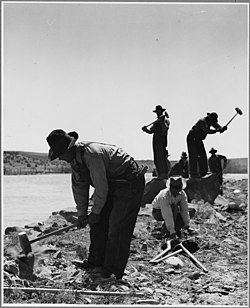
After the Civil War ended, railroad construction entered a major boom. Approximately 35,000 miles of track were laid across the United States between 1866 and 1873.
Image source: History of rail transportation in the United States
1872 - 1875
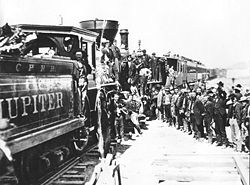
National railroad construction dropped from 7,500 miles of track in 1872 to only 1,600 miles in 1875. Production of iron and steel also fell by as much as 45 percent.
Image source: Long Depression
1873
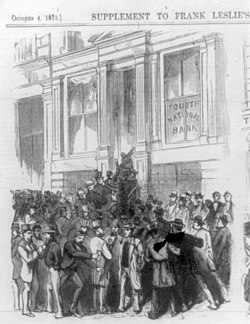
The financial Panic of 1873 marked the beginning of the Long Depression in the United States and contributed to worsening economic conditions for workers and railroads.
Image source: Panic of 1873
1873 - 1878
The Long Depression began in the United States after the Panic of 1873 and lasted 65 months. It became the longest economic contraction in American history, exceeding the duration of the later Great Depression.
1873 - 1874
One in four laborers in New York was out of work during the winter of 1873–1874, illustrating the severity of the economic contraction.
1873 - 1877
In the wake of the Panic of 1873, bitter antagonism developed between workers and industrial leaders as unemployment, wage reductions, and poor conditions intensified.
Image source: Great Railroad Strike of 1877
1876
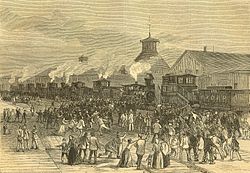
Unemployment rose dramatically during the depression, reaching 14 percent by 1876. Many additional workers were severely underemployed, while wages overall fell to about 45 percent of their previous level.
1877
The violence of 1877 provided impetus for modernizing the National Guard so it could aid civil officers and suppress or prevent riots and insurrections.
Image source: National Guard (United States)
1877
Attempts to use the National Guard to quell violent outbreaks highlighted its ineffectiveness and, in some cases, its propensity to side with strikers and rioters.
1877
Following the court's intervention, strikers were arrested and tried for contempt of court.
1877
Judge Drummond instructed United States marshals to protect the railroads and requested federal troops to enforce his decision.
1877
Judge Thomas Drummond of the United States Court of Appeals for the Seventh Circuit ruled that a strike or other unlawful interference with trains violated United States law and that the court had to enforce the penalty.
Jul 24, 1877
The Statesman of Martinsburg, West Virginia, published “The B&O Railroad Strike of 1877” on July 24, 1877.
Jul 28, 1877
On July 28, authorities took control of the Relay Depot, the command center for the uprising, and arrested approximately seventy strikers.
Aug 11, 1877
Harper's Weekly published an account titled “The Great Strike” on August 11, 1877, documenting the national railroad unrest.
1878
The use of federal troops during the strike prompted bipartisan support for the 1878 Posse Comitatus Act, which limited the president's power to use federal troops for domestic law enforcement.
Image source: Posse Comitatus Act
1878
A publication titled “Report of the Railroad Riots in July 1877” recorded the disturbances associated with the Great Railroad Strike.
1886 - 1895
In the years after 1877, the National Guard increased its forces and put down 328 civil disorders between 1886 and 1895, mostly in Illinois, Pennsylvania, Ohio, and New York. Workers came to view guardsmen as tools of employers.
1978
A historical marker commemorating the strike was placed in Martinsburg in 1978 by the West Virginia Department of Culture and History.
2003
In 2003, the Baltimore and Ohio Railroad Martinsburg Shops, where the strike began, were declared a National Historic Landmark.
Image source: Baltimore and Ohio Railroad Martinsburg Shops
2013
In 2013, the Maryland Historical Trust and Maryland State Highway Administration placed a historical marker commemorating the event in Baltimore.
1877
The violence was described as a horrible scene reminiscent of the bloody Pratt Street Riots of April 1861, which had occurred during the Civil War era.
1877
By 1877, ten-percent wage cuts, distrust of capitalists, and poor working conditions led workers to conduct numerous railroad strikes that prevented trains from moving and produced wider economic effects.
1877
Some local observers feared that workers were rising in revolution similar to the Paris Commune of 1871, while others joined the workers' efforts against the railroads.
1877
Employers and liberals feared the spread of communism through organizations such as the recently founded Workingmen's Party in Chicago and frequently compared such movements with the Paris Commune of 1871.
1877
Engineers had been striking against the Philadelphia and Reading Railway since April 1877. The city contained the railway's engine works and shops.
Jul 14, 1877
At the Martinsburg, West Virginia, station, strikers refused to let freight trains pass, helping turn a local wage dispute into a national railroad strike.
Jul 14, 1877
The Great Railroad Strike of 1877, also called the Great Upheaval, began in Martinsburg, West Virginia, after the Baltimore and Ohio Railroad cut wages for the third time in a year.
Jul 16, 1877
The first national strike began on July 16, 1877, involving Baltimore and Ohio Railroad workers in Martinsburg, West Virginia, and Baltimore, Maryland.
Jul 25, 1877
On July 25, workers gathered at the Van Woert Street Rail Crossing in Albany, adding to the wave of railroad-related unrest.
Aug 1, 1877
In Scranton, one day after railroad workers began a strike, a city posse of 51 men armed with new rifles and commanded by William Walker Scranton returned fire on rioters and strikers.
1880
With public attention focused on workers' wages and conditions, the B&O founded an Employee Relief Association that provided death benefits and some health care.
Image source: Baltimore and Ohio Railroad
1880 - 1888
By the late nineteenth century, the Knights of Labor, a predominantly European and Catholic national organization, had 700,000 members seeking to represent all workers.
Image source: Knights of Labor
May 1, 1880
On May 1, 1880, the Baltimore and Ohio Railroad established the Baltimore and Ohio Employees' Relief Association. It provided coverage for sickness, accidental injury, and death benefits.
1884
In 1884, the Baltimore and Ohio became the first major employer to offer a pension plan.
1884
Congress formed the Bureau of Labor in 1884, creating a federal institution concerned with labor matters in the period after the railroad strike.
Image source: Bureau of Labor Statistics
1886
Samuel Gompers founded the American Federation of Labor in 1886 for skilled craft trades, attracting skilled workers from other organizations.
Image source: American Federation of Labor
1886
Nearly 700,000 workers went on strike in 1886, demonstrating the continuing growth of organized labor after the Great Railroad Strike.
Image source: Labor history of the United States
1888
In 1888, Archbishop James Cardinal Gibbons of Baltimore sympathized with workers and worked with other bishops to lift the prohibition against workers joining the Knights of Labor.
Build a timeline like this one in minutes, for free. Start Yours →
Or browse the full history timeline directory, with more than 2,500 topics.
This Great Railroad Strike of 1877 timeline was generated with the help of AI, using information found on the internet.
We work hard to keep these timelines accurate, but mistakes do get through. If you spot one, email us at [email protected] and we'll fix it for future visitors.
Generate yours with AI or build it from scratch, for free.
Export your timeline, add your own events, edit or remove AI-generated events, and much more
No credit card required.
15-day money-back guarantee.
You can create an unlimited number of timelines with up to 10 events on each one, customize how they look, export them to PDF, PNG, PowerPoint, CSV, and Excel, and share them with a link. Timelines made with Timeline Maker AI keep every event the generator created, and you can add up to 5 events of your own. Paid plans remove the event limit, add spreadsheet imports and hide Preceden's branding, and the higher-priced plan also adds collaborators, a custom logo and a custom domain.
Yes. You can cancel your subscription from your account page at any time, and you will not be charged again. Your subscription stays active for the rest of the period you already paid for.
Yes. We email you a reminder 15 days before your annual renewal, and we email you a receipt after every payment.
Yes. You can email us within 15 days of any payment, and we will issue you a full refund.
Check out our pricing docs or send us an email anytime: [email protected].