
-
Use Cases
-
Resources
-
Pricing
The history of floppy disks traces the development of portable magnetic storage from IBM’s early 8-inch disks to the 3.5-inch disks that became a computing standard before fading from everyday use. More Less
Build a timeline like this one in minutes, for free. Start Yours →
1967
Work began at an IBM facility in San Jose, California, on a drive that would lead to the world's first floppy disk and disk drive.
1971
The floppy disk was introduced commercially in an 8-inch, or 203-millimeter, format.
Image source: Floppy disk
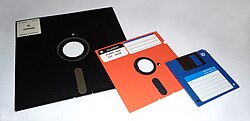
1971
IBM introduced the diskette commercially in 1971.
1971
The new device first shipped as the 23FD, serving as the control-store load device of the 2835 Storage Control Unit. It later became a standard component of many System/370 processing units and other IBM products.
1972
Shugart, then working at Memorex, shipped the Memorex 650, identified as the first commercially available read-write floppy disk drive.
Jul 18, 1972
Floppy Disk Drive Patent No. 3,678,481 was issued, naming inventors L. Warren Dalziel and Jay.
1973
The floppy-disk system was designed to hold approximately the same amount of data as 3,000 punch cards.
1973
Shugart founded Shugart Associates, which became a dominant manufacturer of 8-inch floppy disk drives.
Image source: Shugart Associates

1973
A chance encounter between IBM's Jack Harker and Don Stephenson led to IBM's first read-write floppy disk drive, the 33FD, code-named IGAR.
May 1973
The 33FD first shipped as a component of IBM's 3740 Data Entry System, designed to replace punched-card keypunch data-entry machines.
Build a timeline like this one in minutes, for free. Start Yours →
This History of Floppy Disks timeline was generated with the help of AI, using information found on the internet.
We work hard to keep these timelines accurate, but mistakes do get through. If you spot one, email us at [email protected] and we'll fix it for future visitors.
Generate yours with AI or build it from scratch, for free.


