-
Use Cases
-
Resources
-
Pricing
Florence, capital of Italy's Tuscany region, was founded as a Roman settlement in 59 BCE and rose to prominence in the Middle Ages as a banking and wool-trading powerhouse. The city became the cradle of the Renaissance, flourishing under the patronage of the Medici family, who supported masters such as Michelangelo, Leonardo da Vinci, and Botticelli. Florence's artistic, architectural, and intellectual legacy—including Brunelleschi's Duomo, the Uffizi Gallery, and the birth of humanism—made it one of the most influential cities in European history, later playing a key role in Italy's unification as its capital from 1865 to 1871. More Less
1000 BC - 800 BC
% complete
It is thought that there was already a settlement at the confluence of the Mugnone River with the River Arno between the 10th and 8th centuries BC, marking the earliest known human presence in what would become Florence.
700 BC - 600 BC
% complete
Between the 7th and 6th centuries BC, Etruscans discovered and used the ford of the Arno near the confluence with the Mugnone, closer to the hills to the north and south.
1 AD - 1800 AD
% complete
Even after most of the water had receded, the plain, 50 metres above sea level, was strewn with ponds and marshes that remained until the 18th century, when the land was reclaimed.
300 AD
% complete
The seat of a bishopric from around the beginning of the 4th century CE, the city was ruled alternatively by Byzantine and Ostrogothic potentates as the two powers fought each other for control of the city.
500 AD - 599 AD
% complete
In the sixth century, at the end of this unstable period, the population fell to a low point speculated to be as low as 1,000.
Image source: History of Florence
500 AD
% complete
Peace returned under Lombard rule in the 6th century, bringing an end to the instability caused by fighting between Byzantines and Ostrogoths.
1000 AD
% complete
Margrave Hugh 'the Great' of Tuscany chose Florence as his residence instead of Lucca in about 1000 CE, boosting the city's prominence.
Image source: Hugh of Tuscany
1013 AD
% complete
In 1013, construction was begun on the Basilica di San Miniato al Monte, one of the finest Romanesque churches in Florence.
Image source: San Miniato al Monte
1059 AD - 1128 AD
% complete
The exterior of the baptistry was reworked in Romanesque style between 1059 and 1128.
Image source: Florence Baptistery
1115 AD
% complete
Florence experienced a long period of civic revival beginning in the 10th century and was governed from 1115 by an autonomous medieval commune.
Image source: Republic of Florence

1215 AD
% complete
The period of revival was interrupted when the city was plunged into internal strife by the 13th-century struggle between the Ghibellines, supporters of the German emperor, and the pro-Papal Guelphs after the murder of nobleman Buondelmonte del Buondelmonte for reneging on his agreement to marry one of the daughters of the Amidei family.
Image source: Guelphs and Ghibellines
1252 AD
% complete
The 'fiorino d'oro' of the Republic of Florence, or florin, was introduced in 1252, the first European gold coin struck in sufficient quantities to play a significant commercial role since the 7th century.
Image source: Florin
1257 AD
% complete
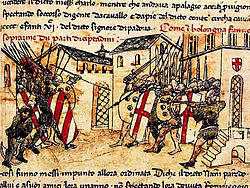
1284 AD
% complete
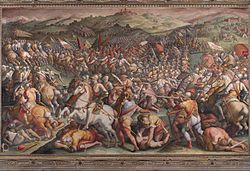
This period also saw the eclipse of Florence's formerly powerful rival Pisa, which was defeated by Genoa in 1284 and later subjugated by Florence in 1406.
Image source: Battle of Meloria (1284)
1293 AD
% complete
Power shifted from the aristocracy to the mercantile elite and members of organized guilds after an anti-aristocratic movement, led by Giano della Bella, enacted the Ordinances of Justice in 1293.
1300 AD
% complete
While visiting the ruins of Rome during the jubilee celebration in 1300, the banker and chronicler Giovanni Villani noted the well-known history of the city and was inspired to write a universal history of his own city of Florence, recording events year-by-year in his Nuova Cronica.
Image source: Nuova Cronica
1338 AD
% complete
In 1338, there were about 17,000 beggars in the city, highlighting stark economic contrasts amid Florentine prosperity.
1345 AD
% complete
Of a population estimated at 80,000 before the Black Death, about 25,000 were engaged in the wool industry. In 1345, Florence was the scene of an attempted strike by wool carders (ciompi).
1348 AD - 1349 AD
% complete
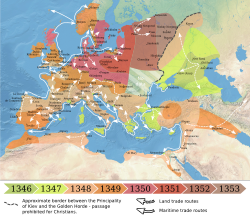
Giovanni Villani succumbed to the Black Death in 1348, which devastated a population estimated at 80,000 before the plague; his brother and nephew continued his Nuova Cronica.
Image source: Black Death
1378 AD
% complete
In 1378, wool carders rose up against oligarchic rule in a brief revolt known as the Revolt of the Ciompi.
Image source: Ciompi Revolt
1382 AD - 1434 AD
% complete
After the suppression of the Ciompi, the city came under the sway of the Albizzi family, bitter rivals of the Medici family, between 1382 and 1434.
Image source: Albizzi
1434 AD - 1464 AD
% complete
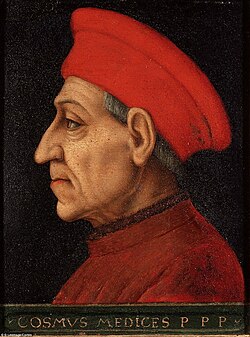
Cosimo de' Medici (1389–1464) was the first Medici family member to govern the city from behind the scenes. The lottery arrangement organizing Florence's political structure lasted until 1434, when the Medici took power.
Image source: Cosimo de' Medici
1465 AD
% complete
In 1465, a movement to reintroduce civic lotteries was halted by an extraordinary commission packed with Medici supporters.
1469 AD - 1492 AD
% complete
Cosimo was succeeded by his son Piero di Cosimo de' Medici, who was shortly thereafter succeeded by Cosimo's grandson Lorenzo in 1469. Florentine family holdings had representatives in all main economic centers of Western Europe, such as Bruges and Geneva (replaced by Lyon after 1460), as well as Constantinople.
Image source: Lorenzo de' Medici
1492 AD
% complete
After Lorenzo's death in 1492, his son Piero the Unfortunate took the reins of government, however his rule was short.
Image source: Piero the Unfortunate
1494 AD
% complete
In 1494, King Charles VIII of France invaded Italy and entered Tuscany on his way to claim the throne of the Kingdom of Naples.
Image source: Italian War of 1494–1495
1498 AD
% complete
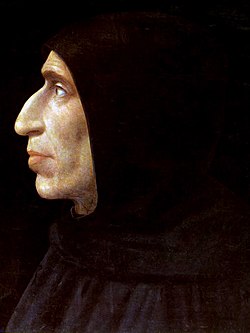
In due time, Savonarola lost support and was hanged in 1498. Medici rule was not restored until 1512.
Image source: Girolamo Savonarola
1513 AD
% complete
Machiavelli was tortured and exiled from Florence by the Medici family in 1513, due to accusations of conspiracy, exacerbated because of his ties to the previous republican government. Commissioned by the Medici, in 1520 he wrote the Florentine Histories.
Image source: Niccolò Machiavelli
May 16, 1527 - Aug 1530
% complete
The Florentines drove out the Medici for a second time and re-established the Republic on May 16, 1527. The 10-month Siege of Florence (1529–1530) by the Spanish ended the Republic and Alessandro de' Medici became ruler of the city.
Image source: Siege of Florence (1529–1530)
1531 AD - 1537 AD
% complete
Alessandro, who ruled from 1531 to 1537, was the first Medici to use the style Duke of Florence, a title arranged for him in 1532 by Holy Roman Emperor Charles V.
Image source: Alessandro de' Medici, Duke of Florence
1554 AD
% complete
After the Battle of Marciano in 1554, the city's historical rival Siena was conquered and the only remaining territory in Tuscany not ruled from Florence was the Republic of Lucca (later a Duchy).
Image source: Battle of Marciano
1569 AD - 1737 AD
% complete
In 1569, Duke Cosimo I was elevated to the rank of Grand Duke of Tuscany by Pope Pius V. The Medici would continue to rule in Tuscany as grand dukes until 1737. The Renaissance thrived locally from about 1434 to 1534, facilitated by Florentines' strong economy based on money, banking, trade, and display of wealth and leisure.
Image source: Grand Duchy of Tuscany
1737 AD - 1859 AD
% complete
The extinction of the Medici line and the accession in 1737 of Francis Stephen, Duke of Lorraine, husband of Maria Theresa of Austria, led to Tuscany's inclusion in the territories of the Austrian crown. Habsburg rule ended in defeat at the hands of France and the Kingdom of Sardinia-Piedmont in 1859, and Tuscany became part of the united Kingdom of Italy in 1861.
Image source: Francis I, Holy Roman Emperor
1865 AD
% complete
Florence replaced Turin as Italy's capital in 1865 and, in an effort to modernise the city, the old market in the Piazza del Mercato Vecchio and many medieval houses were pulled down and replaced by a more formal street plan with newer houses.
1850 AD - 1900 AD
% complete
A foreign community came to represent one-quarter of the population in the second half of the 19th century, and writers such as James Irving and the pre-Raphaelite artists captured a romantic vision of the city in their works. In the 19th century the population doubled to over 230,000.
1943 AD - 1944 AD
% complete
During World War II, the city experienced a year-long German occupation (1943–1944). On September 25, 1943, Allied bombers targeted central Florence, destroying many buildings and killing 215 civilians.
Image source: Operation Achse
Jul 25, 1944 - Aug 4, 1944
% complete
In late July 1944, the British 8th Army closed in as they liberated Tuscany. At 04:00 on August 4, 1944, an armored patrol of the South African Imperial Light Horse and Kimberley Regiments found the Ponte Vecchio intact, crossed it under heavy German shelling and became the first Allied soldiers to enter Florence.
Image source: History of Florence
Nov 4, 1966
% complete
On November 4, 1966, the Arno flooded parts of the city centre, killing at least 40 and damaging millions of art treasures and rare books.
Image source: 1966 flood of the Arno
May 28, 1993
% complete
On May 28, 1993, a powerful car bomb exploded in the via de Georgofili, behind the Uffizi, killing five people, injuring numerous others and seriously damaging the Torre dei Pulci, the museum and parts of its collection.
Image source: Via dei Georgofili bombing
2002 AD
% complete
In 2002, Florence was the seat of the first European Social Forum.
Image source: European Social Forum
Apr 28, 2011
% complete
The theatre was inaugurated on April 28, 2011, in honour of the 150th anniversary of the Italian unification. It hosts a lyrical theatre containing 2000 places, a concert hall for 1000 spectators, a hall with 3000 seats and an open-air amphitheatre with 3000 spaces.
Image source: Museo dell'Opera del Duomo (Florence)
Or browse the full history timeline directory, with more than 2,000 topics.
This History of Florence timeline was generated with the help of AI, using information found on the internet.
We work hard to keep these timelines accurate, but mistakes do get through. If you spot one, email us at [email protected] and we'll fix it for future visitors.
Generate yours with AI or build it from scratch, for free.
Export your timeline, add your own events, edit or remove AI-generated events, and much more
No credit card required.
Cancel anytime.
Cancel anytime.
You can create an unlimited number of timelines with up to 10 events on each one, customize how they look, export them to PDF, PNG, PowerPoint, CSV, and Excel, and share them with a link. Paid plans raise the event limit and add features like spreadsheet imports and collaborators.
Yes. You can cancel your subscription from your account page at any time, and you will not be charged again. Your subscription stays active for the rest of the period you already paid for.
Yes. We will email you a reminder before the annual renewal, and we will also email you a receipt.
Yes. You can email us within 15 days of any payment, and we will issue you a full refund.
Check out our pricing docs or send us an email anytime: [email protected].