-
Use Cases
-
Resources
-
Pricing
Formula 1 is the highest class of international single-seater auto racing, sanctioned by the FIA. Since its first World Championship season in 1950, the sport has evolved from post-war Grand Prix racing into a global spectacle defined by cutting-edge technology, legendary drivers like Juan Manuel Fangio, Ayrton Senna, Michael Schumacher, and Lewis Hamilton, and iconic teams such as Ferrari, McLaren, Mercedes, and Red Bull. More Less
May 13, 1950
% complete
The first World Championship Formula 1 race was held at Silverstone, England, on May 13, 1950. Giuseppe Farina won the inaugural event driving an Alfa Romeo, marking the official beginning of the FIA Formula One World Championship and establishing the sport's modern competitive framework.
Image source: 1950 British Grand Prix
Sep 3, 1950
% complete
Giuseppe 'Nino' Farina became the first Formula One World Drivers' Champion in 1950 after winning three of the season's opening races for Alfa Romeo. His title established the benchmark for championship success in the sport's inaugural season.
Image source: Giuseppe Farina
Jun 11, 1955
% complete
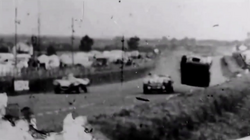
The catastrophic crash at the 24 Hours of Le Mans killed driver Pierre Levegh and over 80 spectators. Though not a Formula 1 event, the tragedy profoundly affected motorsport safety culture, leading to circuit improvements and the temporary withdrawal of several manufacturers from racing.
Image source: 1955 Le Mans disaster
Sep 19, 1958
% complete
The 1958 season introduced the International Cup for Formula One Manufacturers, won by British team Vanwall. Stirling Moss and Tony Brooks drove Vanwall to victory, signaling the rise of British constructors who would come to dominate the sport.
Image source: Vanwall
Apr 7, 1968
% complete
Two-time world champion Jim Clark was killed in a Formula 2 accident at Hockenheimring, Germany. His death shocked the racing world and intensified calls for greater safety measures in the sport.
Image source: Jim Clark
Jan 1, 1978
% complete
As head of FOCA, Bernie Ecclestone negotiated collective television and sponsorship deals, transforming Formula 1 into a global commercial powerhouse. Over subsequent decades he built the sport into a multi-billion dollar enterprise.
Image source: Bernie Ecclestone
May 8, 1982
% complete
Canadian fan favorite Gilles Villeneuve died after a collision during qualifying for the Belgian Grand Prix at Zolder. His death prompted renewed safety reforms and left an enduring legacy of fearless driving.
Image source: Gilles Villeneuve
May 1, 1994
% complete
The 1994 San Marino Grand Prix weekend saw the deaths of Roland Ratzenberger and three-time champion Ayrton Senna. The tragedies triggered sweeping safety reforms led by the FIA, ushering in an era without a driver fatality for two decades.
Image source: 1994 San Marino Grand Prix
Oct 28, 1951
% complete
Argentine driver Juan Manuel Fangio claimed his first of five World Championships in 1951 driving for Alfa Romeo. Widely regarded as one of the greatest drivers in history, Fangio dominated the early era of Formula 1 with titles in 1951, 1954, 1955, 1956, and 1957.
Image source: Juan Manuel Fangio
Sep 10, 1961
% complete
American Phil Hill won the 1961 World Championship driving for Ferrari, becoming the first American to claim the title. His championship came amid the tragic season in which teammates Wolfgang von Trips and others lost their lives.
Image source: Phil Hill
Jul 6, 1963
% complete
Scottish driver Jim Clark won the 1963 World Championship with seven victories out of ten races driving the Lotus 25. Clark repeated as champion in 1965 and was renowned for his smooth, dominant driving style until his death in 1968.
Sep 22, 1969
% complete
Jackie Stewart won the 1969 World Championship driving for Matra-Ford, the first of his three titles (1969, 1971, 1973). The Scottish driver was also a pioneering advocate for improved safety standards in motorsport.
Image source: Jackie Stewart
Aug 1, 1976
% complete
Niki Lauda suffered severe burns in a horrific crash at the Nürburgring during the 1976 German Grand Prix. Remarkably, he returned to racing just six weeks later, narrowly losing that year's title to James Hunt in one of F1's most dramatic seasons.
Image source: 1976 German Grand Prix
Oct 24, 1976
% complete
British driver James Hunt clinched the 1976 World Championship by a single point over Niki Lauda in the season finale at Fuji, Japan. Their rivalry became legendary and was later depicted in the film 'Rush'.
Image source: James Hunt
Oct 30, 1988
% complete
Brazilian Ayrton Senna won the 1988 championship driving the dominant McLaren-Honda MP4/4 alongside Alain Prost. Senna went on to win three titles (1988, 1990, 1991) and is regarded as one of the greatest drivers ever.
Image source: Ayrton Senna
May 13, 1989 - Oct 20, 1991
% complete
The fierce rivalry between Ayrton Senna and Alain Prost defined late-1980s and early-1990s Formula 1. Their infamous collisions at Suzuka in 1989 and 1990 decided championships and remain among the most controversial moments in the sport's history.
Image source: Prost–Senna rivalry
Nov 13, 1994
% complete
Michael Schumacher won the 1994 championship with Benetton in a controversial finale against Damon Hill at Adelaide. He went on to become statistically the most successful driver in history with seven world titles.
Image source: Michael Schumacher
Oct 8, 2000
% complete
Michael Schumacher delivered Ferrari its first drivers' championship since 1979, launching an unprecedented run of five consecutive titles from 2000 to 2004 that cemented his legacy as one of the sport's all-time greats.
Image source: 2000 Formula One World Championship
Sep 25, 2005
% complete
Fernando Alonso won the 2005 championship with Renault, becoming the youngest world champion at the time and ending Michael Schumacher's five-year dominance. He successfully defended his title in 2006.
Image source: Fernando Alonso
Nov 2, 2008
% complete
Lewis Hamilton captured the 2008 championship by overtaking Timo Glock on the final corner of the final lap of the Brazilian Grand Prix, becoming the then-youngest world champion in a finish regarded as one of the most dramatic ever.
Image source: Lewis Hamilton
Nov 14, 2010 - Nov 23, 2013
% complete
German driver Sebastian Vettel won four consecutive world championships from 2010 to 2013 with Red Bull Racing, becoming the youngest quadruple champion and dominating the tail end of the V8 engine era.
Image source: Sebastian Vettel
Nov 15, 2020
% complete
Lewis Hamilton won the 2020 Turkish Grand Prix to secure his seventh World Championship, equaling Michael Schumacher's record. Hamilton also surpassed Schumacher's all-time wins record earlier that year, cementing his place among the sport's legends.
Image source: 2020 Turkish Grand Prix
Jul 4, 1954
% complete
Mercedes-Benz returned to grand prix racing in 1954 with the technologically advanced W196, featuring fuel injection and desmodromic valves. Juan Manuel Fangio drove it to two world championships before Mercedes withdrew from racing following the 1955 Le Mans disaster.
Image source: Mercedes-Benz in Formula One
Jan 1, 1959
% complete
Jack Brabham won the 1959 championship driving Cooper's rear-engined T51, proving the superiority of mid-engine layout. Within a few years, all competitive Formula 1 cars adopted this configuration, fundamentally reshaping car design.
Image source: Cooper Car Company
Jan 1, 1962
% complete
Colin Chapman's Lotus 25 introduced the monocoque chassis to Formula 1, replacing the traditional spaceframe with a stressed-skin structure. This innovation dramatically improved stiffness and weight distribution, becoming the standard for all future F1 cars.
Image source: Lotus 25
Jan 15, 1977
% complete
The Lotus 78 introduced ground effect aerodynamics, using side skirts and shaped underbodies to generate downforce. Mario Andretti refined the concept with the Lotus 79 to win the 1978 championship, transforming F1 car design.
Image source: Lotus 78
Jan 1, 1983 - Dec 31, 1988
% complete
Turbocharged engines rose to dominance between 1983 and 1988, producing over 1,000 horsepower in qualifying trim. BMW, Ferrari, Renault, Honda, and TAG-Porsche powered this era before turbos were banned after 1988 due to escalating speeds and costs.
Image source: Formula One engines
Jan 1, 1998
% complete
For the 1998 season, the FIA mandated grooved tires and narrower track widths to reduce cornering speeds and improve competition. The changes significantly altered car handling dynamics and challenged teams' engineering approaches.
Image source: Formula One tyres
Mar 16, 2014
% complete
Formula 1 introduced turbocharged 1.6-liter V6 hybrid power units combining internal combustion with energy recovery systems. The complex technology shifted the competitive balance toward Mercedes, which dominated the hybrid era's early years.
Jan 23, 2017
% complete
American media company Liberty Media completed its acquisition of Formula 1, ending Bernie Ecclestone's decades-long control. Under CEO Chase Carey, the sport pursued digital expansion, new race venues, and broader fan engagement.
Image source: Formula One Group
Dec 12, 2021
% complete
Max Verstappen claimed his first World Championship in a highly contentious season finale at Abu Dhabi, passing Lewis Hamilton on the final lap under unusual safety car procedures. The controversy led to significant governance reviews within the FIA.
Image source: 2021 Abu Dhabi Grand Prix
May 8, 2022 - Nov 18, 2023
% complete
Under Liberty Media, Formula 1 expanded its American presence with the inaugural Miami Grand Prix in May 2022 and the return of the Las Vegas Grand Prix in November 2023, reflecting the sport's surging popularity in the United States.
Image source: Miami Grand Prix
Or browse the full history timeline directory, with more than 2,000 topics.
This History of Formula 1 timeline was generated with the help of AI, using information found on the internet.
We work hard to keep these timelines accurate, but mistakes do get through. If you spot one, email us at [email protected] and we'll fix it for future visitors.
Generate yours with AI or build it from scratch, for free.
Export your timeline, add your own events, edit or remove AI-generated events, and much more
No credit card required.
Cancel anytime.
Cancel anytime.
You can create an unlimited number of timelines with up to 10 events on each one, customize how they look, export them to PDF, PNG, PowerPoint, CSV, and Excel, and share them with a link. Paid plans raise the event limit and add features like spreadsheet imports and collaborators.
Yes. You can cancel your subscription from your account page at any time, and you will not be charged again. Your subscription stays active for the rest of the period you already paid for.
Yes. We will email you a reminder before the annual renewal, and we will also email you a receipt.
Yes. You can email us within 15 days of any payment, and we will issue you a full refund.
Check out our pricing docs or send us an email anytime: [email protected].