-
Use Cases
-
Resources
-
Pricing
Geneva's history spans over two millennia, from a Celtic settlement conquered by Julius Caesar to an independent republic shaped by John Calvin's Protestant Reformation in the 16th century. It joined the Swiss Confederation in 1815 and became a world center of diplomacy, hosting the League of Nations, the United Nations Office at Geneva, the Red Cross, and numerous international organizations. More Less
300 - 399
% complete
Geneva became an episcopal seat in the 4th century. According to legendary accounts found in the works of Gregorio Leti and Besson, the city was Christianised by Dionysius Areopagita and Paracodus, two of the 72 disciples, in the time of Domitian.
Image source: Diocese of Geneva
888
% complete
In 888 the town became part of the new Kingdom of Burgundy, marking a shift in its political allegiance after the collapse of Carolingian authority.
Image source: History of Geneva
1033
% complete
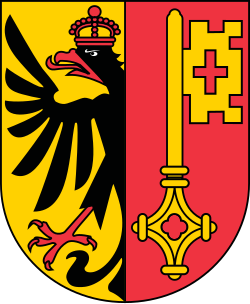
In 1033 the Kingdom of Burgundy was taken over by the Holy Roman Emperor, and with it the town of Geneva came under imperial authority.
1154
% complete
The bishops of Geneva had the status of prince of the Holy Roman Empire from 1154, but had to maintain a long struggle for their independence against the guardians (advocati) of the see, the counts of Geneva and later the counts of the House of Savoy.
Image source: Prince-bishop of Geneva
1219
% complete
It is some time around 1219 that the Counts of Geneva completely quit the city and moved their capital to Annecy, reducing their direct influence over Geneva itself.
Image source: County of Geneva
1290
% complete
In 1290 the House of Savoy obtained the right of installing the vice-dominus of the diocese; the title of 'Vidame of Geneva' was granted by Amadeus V, Count of Savoy in the name of the Holy See to the counts of the House of Candia under count François de Candie of Chambéry-Le-Vieux, a Chatellaine of Savoy. This official exercised minor jurisdiction in the town in the bishop's absence.
Image source: History of Geneva
1387
% complete
In 1387 Bishop Adhémar Fabry granted the town its great charter, the basis of its communal self-government, which every bishop on his accession was expected to confirm.
1394
% complete
The line of the counts of Geneva ended in 1394, and the House of Savoy came into possession of their territory, assuming after 1416 the title of Duke.
1447
% complete
In 1447 Antipope Felix V, who was also Duke of Savoy, appointed himself as bishop of Geneva, and the Savoy dynasty ruled the episcopal see until 1490, when popular pressure compelled the dynasty to renounce the title of bishop.
1457
% complete
In 1457 a major government organ was established in Geneva, known as the Grand Council, which first consisted of 50 deputies and later their number was raised to 200. The Grand Council represented the citizens of Geneva and decided on political matters, and after 1490 it also elected the bishops of Geneva.
1513
% complete
A new cause of friction between the Grand Council and the Duke of Savoy evolved in 1513, when Charles III decided to appoint his cousin John of Savoy as bishop and even secured Papal endorsement.
Image source: Charles III, Duke of Savoy
1519
% complete
In 1519 the Grand Council of Geneva attempted to forge an alliance with Fribourg, but the Duke of Savoy responded with invasion of the republic, which led to the execution of Philibert Berthelier and suspension of the Grand Council's powers.
1521
% complete
In 1521 Jean of Savoy died, and the Grand Council appealed to Pope Leo X to appoint the next bishop, who then appointed Pierre de la Baume.
Image source: Pierre de La Baume
1523
% complete
In addition, the Duke of Savoy tried to reconcile his political ambitions with local Genevan patriotism, and in 1523 marched into Geneva in a ceremony designed to appease its population, and tried to gain the support of the Geneva merchants by promising them a share in trade with the Kingdom of Portugal and its territories in Brazil.
1523
% complete
The first French Protestant refugees arrived in 1523, and their theology quickly gained influence in the city.
Image source: Protestantism in Switzerland
1524
% complete
Another political crisis occurred in 1524, when the treasurer of Geneva, Bernard Boulet, a supporter of Savoy rule, was accused by the Grand Council of embezzlement.
Jan 1525
% complete
In January 1525 the council appealed to the Pope to excommunicate Charles III as tensions between Geneva and the Duke of Savoy escalated.
Sep 1525
% complete
Fearing another rebellion, Charles III in September 1525 made another proposal of power-sharing to the Grand Council of Geneva, which the council endorsed by 53–42. However, the pro-independence faction fled to Fribourg, and in December 1525 the Grand Council acknowledged Charles III as true sovereign of Geneva in a session known as the 'Assembly of Halberds'.
Feb 1526
% complete
Members of the pro-independence faction began their own clandestine campaign to enlist support, and in February 1526 gained the support of bishop Pierre de la Baume.
Feb 20, 1526
% complete
Eventually the Grand Council succeeded in protecting the liberty of its citizens by establishing union with the Old Swiss Confederacy, concluding on February 20, 1526 a treaty of alliance with Bern and Fribourg.
1527
% complete
The power of the Catholic Church weakened after the bishop fled in 1527, leaving the Grand Council free to push reforms.
1529
% complete
Although Duke Charles III of Savoy repeatedly tried to bring Geneva back under Catholic rule—most famously during the 'day of the ladders' in 1529—Bern and Fribourg provided protection, and the city resisted these efforts.
Image source: Ladder
1533
% complete
Conflicts between Catholic and Protestant factions remained fierce, and attempts at compromise, such as the 1533 statute allowing private choice of religion but banning open attacks on Catholic practices, failed to end tensions. Catholic influence waned after Bishop Pierre de La Baume's final flight from Geneva in July 1533, and by 1534 secular authorities had gained the right to try clergy.
1535
% complete
By 1535, mass Catholic emigration and repeated Savoy invasions left Geneva's Protestant faction dominant in the city.
May 21, 1536
% complete
The Genevan Reformation was made official on May 21, 1536, when all citizens swore allegiance to the Lutheran faith, proclaiming Geneva a Protestant republic. John Calvin would become the Protestant leader of the city in the 16th century.
Image source: Reformation in Switzerland
1734 - 1737
% complete
During the 17th and 18th centuries Geneva became increasingly aristocratic and was plagued by strife between the Francophone oligarchy and radical populist opponents. Conflict led to rioting in 1734–1737, settled after diplomatic intervention of France and Geneva's Swiss allies Bern and Zurich.
1757
% complete
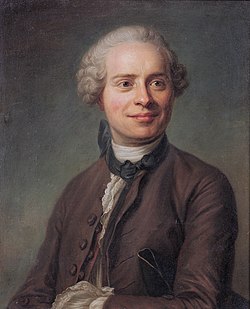
A piece written by Jean le Rond d'Alembert appeared in 1757 in volume 7 of the Encyclopédie criticising the puritanism of Geneva's Calvinist pastors and advocating the adoption of the enlightened arts as in France. In the 1750s the opposition, led by watchmaker Jacques François Deluc, began to call themselves the représentants.
Image source: Jean Le Rond d'Alembert
1767
% complete
Further unrest in 1767 led to another French-brokered agreement between elitists and populists in Geneva.
1782
% complete
Finally, in the abortive Geneva Revolution of 1782, revolutionary ideologues and working-class activists demanding a broader franchise seized the state. Many radical émigrés went on to do great things, such as participating in the French Revolution (1789–1799).
1798
% complete
In 1798 France, then under the Directory, annexed Geneva and its surrounding territory, ending the city's long independence. In 1802 the diocese was united with that of Chambéry.
1813
% complete
The defeat of Napoleonic armies and liberation of Geneva in 1813 by the Austrian general Ferdinand von Bubna und Littitz restored its independence.
Image source: Ferdinand, Graf Bubna von Littitz
1814 - 1815
% complete
At the Congress of Vienna of 1814–15, the territory of Geneva was extended to cover 15 Savoyard and six French parishes, with more than 16,000 Catholics; at the same time it was admitted to the Swiss Confederation. The Congress expressly provided—and the same proviso was included in the Treaty of Turin (16 March 1816)—that Catholic religion was to be protected in these territories.
Image source: Congress of Vienna
1819 - 1822
% complete
Pius VII in 1819 united the city of Geneva and 20 parishes with the Diocese of Lausanne, while the rest of the ancient Diocese of Geneva outside Switzerland was reconstituted in 1822 as the French Diocese of Annecy.
Image source: Diocese of Lausanne, Geneva and Fribourg
Jun 30, 1907
% complete
On 30 June 1907, aided by strong Catholic support, Geneva adopted a separation of church and state.
Nov 11, 1918
% complete
In the wake of World War I, class struggle in Switzerland grew and culminated in a general strike throughout the country—beginning on Armistice Day, 11 November 1918, and directed from the German-speaking part of the nation.
Image source: 1918 Swiss general strike
1919
% complete
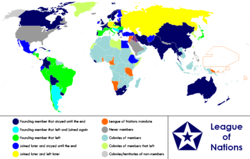
The international status of Geneva was highlighted after World War I when it became the seat of the League of Nations in 1919—notably through the work of Federal Council member Gustav Ador and Swiss diplomat William Rappard, who was one of the founders of the Graduate Institute of International and Development Studies, Europe's oldest graduate school of international and development studies.
Image source: League of Nations
1924
% complete
The International School of Geneva, the oldest currently operating international school in the world, was founded in 1924 by senior members of the League of Nations and the International Labor Office.
Nov 9, 1932
% complete
On 9 November 1932, several small Fascist-inspired political parties, such as the National Union, attacked Socialist leaders, which action led to a later demonstration of the Left against the Fascists.
Or browse the full history timeline directory, with more than 2,000 topics.
This History of Geneva timeline was generated with the help of AI, using information found on the internet.
We work hard to keep these timelines accurate, but mistakes do get through. If you spot one, email us at [email protected] and we'll fix it for future visitors.
Generate yours with AI or build it from scratch, for free.
Export your timeline, add your own events, edit or remove AI-generated events, and much more
No credit card required.
Cancel anytime.
Cancel anytime.
You can create an unlimited number of timelines with up to 10 events on each one, customize how they look, export them to PDF, PNG, PowerPoint, CSV, and Excel, and share them with a link. Paid plans raise the event limit and add features like spreadsheet imports and collaborators.
Yes. You can cancel your subscription from your account page at any time, and you will not be charged again. Your subscription stays active for the rest of the period you already paid for.
Yes. We will email you a reminder before the annual renewal, and we will also email you a receipt.
Yes. You can email us within 15 days of any payment, and we will issue you a full refund.
Check out our pricing docs or send us an email anytime: [email protected].