
-
Use Cases
-
Resources
-
Pricing
The Geneva Conventions are a series of international treaties establishing legal standards for humanitarian treatment during war. First adopted in 1864 following Henry Dunant's efforts after the Battle of Solferino, they have been expanded through multiple revisions, most notably in 1949, and today form the core of international humanitarian law protecting wounded soldiers, prisoners of war, and civilians. More Less
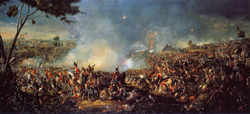
1815
% complete
Between the fall of Napoleon at the Battle of Waterloo in 1815 and the rise of his nephew in the Italian campaign of 1859, the European powers maintained peace in western Europe, setting the stage for later humanitarian reforms.
Image source: Battle of Waterloo
1853 - 1856
% complete
The Crimean conflict brought war back to Europe. Though fought in 'a distant and inaccessible region,' it foreshadowed conflicts closer to home and highlighted the suffering of the wounded in modern warfare.
Image source: Crimean War
1859
% complete
Swiss businessman Henry Dunant from Geneva went to visit wounded soldiers after the Battle of Solferino, beginning the movement for an international set of laws governing the treatment and care for the wounded and prisoners of war.
Image source: Henry Dunant
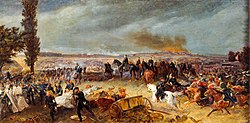
Jun 24, 1859
% complete
Fought between French-Piedmontese and Austrian armies in northern Italy during a critical period in European political and military history, the battle was so accessible that it filled with curious observers; the sight of its bloodshed was unfamiliar and shocking.
Image source: Battle of Solferino
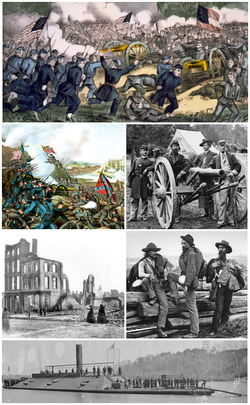
1861 - 1865
% complete
The American Civil War raged while Europe was at relative peace, ultimately claiming between 750,000 and 900,000 lives, underscoring the human cost of industrialized warfare.
Image source: American Civil War
1862
% complete
Dunant returned to Geneva and published his book Un Souvenir de Solferino (A Memory of Solferino), where he detailed the horrors of war and proposed relief organizations for the wounded.
Image source: A Memory of Solferino
1863
% complete
In 1863, Dunant co-founded the International Committee of the Red Cross (ICRC) with Swiss lawyer Gustave Moynier, creating the organization that would champion humanitarian law.
Image source: International Committee of the Red Cross
1901
% complete
For his role in creating the Red Cross and establishing the convention, Henry Dunant became corecipient of the first Nobel Peace Prize in 1901.
Aug 22, 1864
% complete
The conference adopted the first Geneva Convention 'for the Amelioration of the Condition of the Wounded in Armies in the Field', making it the first codified international treaty covering sick and wounded soldiers on the battlefield.
1865
% complete
The United Kingdom signed the first Geneva Convention a year after it was adopted, joining the growing group of ratifying states.
Image source: Geneva Conventions
Jul 5, 1865
% complete
The Ottoman government ratified the 1864 Geneva Convention on 5 July 1865, extending the treaty's reach into the Middle East.
1866
% complete
Following the conclusion of the Austro-Prussian War, the Grand Duchy of Hesse, the Kingdom of Bavaria and the Austrian Empire signed the 1864 convention in 1866.
Image source: Austro-Prussian War
Oct 20, 1868
% complete
On 20 October 1868 the first unsuccessful attempt to expand the 1864 treaty was undertaken with the 'Additional Articles relating to the Condition of the Wounded in War', seeking to clarify rules and extend them to maritime warfare.
1882
% complete
The United States of America signed the Geneva Convention in 1882, more than two decades after its adoption.
1899 - 1907
% complete
The Hague Conventions of 1899 and 1907 addressed the use of conventional weapons in wartime and contained some provisions on the protection of civilians and occupied territory; the third Hague Convention of 1899 realized protections for victims of maritime warfare.
Image source: Hague Conventions of 1899 and 1907
1906
% complete
In 1906, thirty-five states attended a conference convened by the Swiss government to improve upon the original 1864 convention based on experiences from conflicts like the Russo-Japanese War.
Image source: Second Geneva Convention
Jul 6, 1906 - 1970
% complete
On 6 July 1906 the 'Convention for the Amelioration of the Condition of the Wounded and Sick in Armies in the Field' was adopted, improving and supplementing the 1864 Convention for the first time. It remained in force until 1970 when Costa Rica acceded to the 1949 Geneva Conventions.
1925
% complete
The use of biological and chemical weapons in international armed conflicts is addressed by the 1925 Geneva Protocol, complementing the Geneva Conventions' humanitarian framework.
Image source: Geneva Protocol
1929
% complete
The 1929 Geneva Conventions included the Convention for the Amelioration of the Condition of the Wounded and Sick in Armies in the Field, the third version replacing the original 1864 convention, and the Convention relative to the Treatment of Prisoners of War, adopted after World War I exposed deficiencies in prisoner protection under the Hague Conventions.
Aug 12, 1949
% complete
Inspired by postwar humanitarian enthusiasm and outrage over crimes disclosed by the Nuremberg and Tokyo trials, conferences in 1949 resulted in the adoption of four new treaties—two revising the 1929 conventions and two addressing novel subject matter—collectively known as the 'Geneva Conventions of 1949'.
Aug 12, 1949
% complete
The Fourth Geneva Convention protected civilians in time of war, addressing novel subject matter not covered by earlier conventions and building on limited civilian provisions in the Hague Conventions of 1899 and 1907.
Image source: Fourth Geneva Convention
Aug 12, 1949
% complete
The Third Geneva Convention relative to the Treatment of Prisoners of War replaced the 1929 Geneva Convention dealing with prisoners of war, expanding protections for captured combatants.
Image source: Third Geneva Convention
Aug 12, 1949
% complete
The Second Geneva Convention for the Amelioration of the Condition of Wounded, Sick and Shipwrecked Members of Armed Forces at Sea addressed treatment of casualties at sea and replaced the Hague Convention of 1907.
Image source: Second Geneva Convention
Aug 12, 1949
% complete
The First Geneva Convention for the Amelioration of the Condition of the Wounded and Sick in Armed Forces in the Field was the fourth update of the original 1864 convention and replaced the 1929 convention on the same subject matter.
1977
% complete
In light of changing conflicts, two protocols were adopted in 1977 that extended the terms of the 1949 Conventions: Additional Protocol I concerning international armed conflicts and Additional Protocol II concerning non-international armed conflicts.
Image source: Protocol I to the Geneva Conventions
1980
% complete
The use of conventional weapons in wartime came to be addressed by the Hague Conventions of 1899 and 1907 and the 1980 Convention on Certain Conventional Weapons, complementing the Geneva framework.
Image source: Convention on Certain Conventional Weapons
Sep 29, 1989
% complete
Russia ratified Additional Protocol II on 29 September 1989, making its participation in certain internal conflicts subject to Common Article 3 and Protocol II.
Image source: Protocol II to the Geneva Conventions
Dec 8, 2005
% complete
Protocol III (2005), relating to the Adoption of an Additional Distinctive Emblem, established the Red Crystal as an alternative to the Red Cross and Red Crescent emblems for countries that find them objectionable.
Image source: Emblems of the International Red Cross and Red Crescent Movement
1947 - 1991
% complete
With the Cold War, most armed conflicts became internal or asymmetric civil wars, leading many to believe the 1949 Geneva Conventions were addressing a largely extinct reality, even as modern conflicts inflicted increasingly higher tolls on civilians.
1952 - 1958
% complete
The Geneva Conventions of 12 August 1949: Commentary is a series of four volumes published between 1952 and 1958 containing commentaries to each of the four Geneva Conventions.
1999
% complete
In the 1999 Prosecutor v. Tadić case, jurisprudence affirmed the application of the Geneva Conventions' provisions to non-international armed conflicts, shaping how Common Article 3 is understood.
Image source: Duško Tadić
Feb 7, 2002
% complete
On 7 February 2002, President Bush adopted the view that Common Article 3 did not protect al Qaeda prisoners because the United States-al Qaeda conflict was not 'of an international character.'
Image source: Hamdan v. Rumsfeld
Jun 29, 2006
% complete
The Supreme Court of the United States invalidated the Bush Administration's view of Common Article 3 in Hamdan v. Rumsfeld, affirming that the article's protections apply to the conflict.
Oct 17, 2006
% complete
In response to Hamdan, Congress passed the Military Commissions Act of 2006, which President Bush signed into law on 17 October 2006.
Image source: Military Commissions Act of 2006
2007
% complete
Since the fall of the Soviet Union, a High Contracting Party often faces a non-state actor, as argued by General Wesley Clark in 2007, complicating application of the Conventions.
2016
% complete
Regarding Common Article 3, the ICRC's 2016 commentary stated the provision includes foreign military intervention against a non-state armed group only if the territorial state consents to such intervention in its territory.
Image source: Geneva Conventions
Oct 7, 2001 - Dec 17, 2001
% complete
The U.S.-led NATO invasion of Afghanistan from October 7 to December 17, 2001 was initially an international armed conflict because it waged war against the Islamic Emirate of Afghanistan under Taliban rule, engaging the full Geneva Conventions.
Image source: War in Afghanistan (2001–2021)
2014
% complete
The application of the Geneva Conventions in the Russo-Ukrainian War has been troublesome because some personnel who engaged in combat against the Ukrainians wore military-style fatigues but were not identified by insignia, raising questions about prisoner-of-war status.
Image source: Russo-Ukrainian War
Mar 13, 2019
% complete
In a speech at the Graduate Institute of International and Development Studies, ICRC President Peter Maurer argued the collective challenge today is to find ways to ensure greater respect within the changing dynamics of conflict, including more tailor-made rules protecting civilians on increasingly fuzzy battlefields.
Image source: Peter Maurer
2023
% complete
Tilman Rodenhäuser and Mauro Vignati, advisors on legal issues and digital technology at the ICRC, proposed rules of engagement for civilian hackers, extending humanitarian law thinking to digital conflict.
Or browse the full history timeline directory, with more than 2,000 topics.
This Geneva Conventions timeline was generated with the help of AI, using information found on the internet.
We work hard to keep these timelines accurate, but mistakes do get through. If you spot one, email us at [email protected] and we'll fix it for future visitors.
Generate yours with AI or build it from scratch, for free.
Export your timeline, add your own events, edit or remove AI-generated events, and much more
No credit card required.
Cancel anytime.
Cancel anytime.
You can create an unlimited number of timelines with up to 10 events on each one, customize how they look, export them to PDF, PNG, PowerPoint, CSV, and Excel, and share them with a link. Paid plans raise the event limit and add features like spreadsheet imports and collaborators.
Yes. You can cancel your subscription from your account page at any time, and you will not be charged again. Your subscription stays active for the rest of the period you already paid for.
Yes. We will email you a reminder before the annual renewal, and we will also email you a receipt.
Yes. You can email us within 15 days of any payment, and we will issue you a full refund.
Check out our pricing docs or send us an email anytime: [email protected].