-
Use Cases
-
Resources
-
Pricing
1775
The Second Continental Congress convened in present-day Independence Hall in Philadelphia, the colonial capital, and directed the emerging American war effort.
Image source: Second Continental Congress
1776
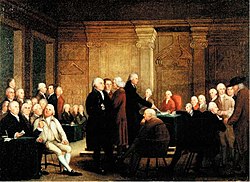
The Second Continental Congress adopted the Declaration of Independence in 1776, formally announcing the colonies' separation from Great Britain.
Image source: United States Declaration of Independence
1776
The thirteen colonial states created a permanent alliance to coordinate American efforts to win the Revolutionary War.
1777
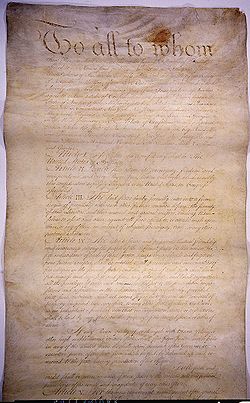
The Second Continental Congress adopted the Articles of Confederation in 1777 as the framework for a union of the states.
1779
Massachusetts popularly elected delegates in 1779 for its constitutional convention, establishing a precedent later associated with the Federal Convention.
Image source: Constitution of Massachusetts
1781
Although adopted in 1777, the Articles of Confederation were not ratified by all the states until 1781.
1782
Rhode Island vetoed an amendment that would have allowed Congress to levy taxes on imports to pay federal debts, highlighting the weaknesses of the Confederation government.
1784
In 1784, Congress proposed an amendment intended to give it powers over foreign trade.
1785
A second attempt was made in 1785 to approve a federal impost, reflecting continuing efforts to give Congress reliable revenue.
Image source: Articles of Confederation
1786 - 1787
When the Massachusetts government refused to enact relief legislation, rural farmers resorted to violence in Shays' Rebellion, which lasted from 1786 into 1787.
Image source: Shays' Rebellion
Sep 1786
In September 1786, delegates from five states met at the Annapolis Convention to discuss commercial and governmental difficulties under the Confederation.
1787
Rhode Island refused to send delegates to the Constitutional Convention and later became the last state to ratify the Constitution, in May 1790.
Image source: Constitutional Convention (United States)
Feb 21, 1787
The Confederation Congress endorsed holding a convention in Philadelphia for the sole and express purpose of revising the Articles of Confederation.
Apr 1787
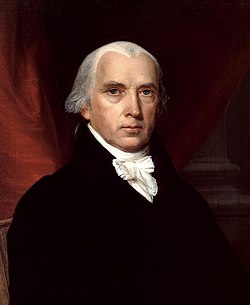
In April 1787, James Madison drafted Vices of the Political System of the United States, a systematic evaluation of the American political system that proposed solutions to its weaknesses.
Image source: James Madison
May 14, 1787
The convention was originally planned to begin on May 14, but it had to be postponed because very few selected delegates were present, partly owing to the difficulty of late-eighteenth-century travel.
1787 - Jul 1787
Robert Yates kept notes on the convention's debates through the first two months, providing an important contemporary record.
1821
Yates' notes on the convention's first two months were published in 1821.
1836
James Madison's Notes of Debates in the Federal Convention of 1787 are likely the most complete first-person record of the convention. Because delegates pledged secrecy, Madison's account was not published until after his death in 1836.
Image source: Notes of Debates in the Federal Convention of 1787
1989
The 1989 film A More Perfect Union portrays events and discussions from the Constitutional Convention and was largely filmed in Independence Hall.
Image source: A More Perfect Union (film)
1787 - Sep 17, 1787
The convention ultimately debated and ratified the Constitution of the United States, making it one of the most significant events in American history.
1787
Northern and southern delegates agreed that Congress could end the international slave trade starting in 1808, making the date an important constitutional compromise.
1787
Madison noted that if the national government did not impose direct taxes, which it rarely did for the next century, representatives could not be assigned on that basis.
1787
The form of the executive, its powers, and its method of selection became sources of constant dispute throughout the summer of 1787.
1787
Most delegates were not questioning the intelligence of voters; they were concerned instead about the slowness with which information spread in the late eighteenth century.
1787
A convention committee helped work out a compromise between northern and southern delegates concerning congressional authority over the international slave trade.
1787
The compromise empowered Congress to ban the international slave trade, but prohibited such action for twenty years, until 1808.
May 25, 1787 - Sep 17, 1787
The Constitutional Convention took place in Philadelphia from May 25 through September 17, 1787.
Sep 17, 1787
On September 17, 1787, the Constitution was voted on by the delegates at the conclusion of the convention.
Sep 17, 1787
Jacob Shallus inscribed the Constitution on parchment, with engraving used for printing.
Sep 17, 1787
Thirty-nine of the convention's fifty-five delegates signed the Constitution on September 17, 1787.
Or browse the full history timeline directory, with more than 2,500 topics.
This Constitutional Convention timeline was generated with the help of AI, using information found on the internet.
We work hard to keep these timelines accurate, but mistakes do get through. If you spot one, email us at [email protected] and we'll fix it for future visitors.
Generate yours with AI or build it from scratch, for free.
Export your timeline, add your own events, edit or remove AI-generated events, and much more
No credit card required.
Cancel anytime.
Cancel anytime.
You can create an unlimited number of timelines with up to 10 events on each one, customize how they look, export them to PDF, PNG, PowerPoint, CSV, and Excel, and share them with a link. Paid plans raise the event limit and add features like spreadsheet imports and collaborators.
Yes. You can cancel your subscription from your account page at any time, and you will not be charged again. Your subscription stays active for the rest of the period you already paid for.
Yes. We will email you a reminder before the annual renewal, and we will also email you a receipt.
Yes. You can email us within 15 days of any payment, and we will issue you a full refund.
Check out our pricing docs or send us an email anytime: [email protected].