-
Use Cases
-
Resources
-
Pricing
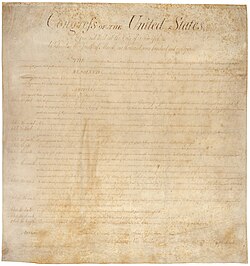
The Bill of Rights is the collective name for the first ten amendments to the United States Constitution, which guarantee essential rights and civil liberties such as freedom of speech, religion, the press, assembly, due process, and protection against unreasonable searches. Proposed by James Madison in response to Anti-Federalist concerns during the Constitution's ratification debates, these amendments define the relationship between American citizens and their government. More Less
Jun 7, 1628
% complete
The Petition of Right of 1628 was a parliamentary document sent to King Charles I that established certain rights in statute. It objected to taxation without parliamentary consent, arbitrary imprisonment, billeting of soldiers, and martial law. Together with later statutes such as the Habeas Corpus Act and the Bill of Rights 1689, it helped lay the statutory foundations for individual liberties in England.
Image source: Petition of Right
May 27, 1679
% complete
The Habeas Corpus Act of 1679 established certain rights in statute by strengthening the ancient writ of habeas corpus, which required authorities to bring detained persons before the court to determine the legality of their imprisonment. It protected subjects against unlawful and indefinite detention and became a cornerstone of civil liberties alongside the Petition of Right and the Bill of Rights 1689.
Image source: Habeas Corpus Act 1679
1689
% complete
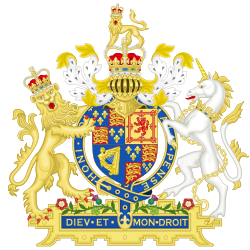
The English Bill of Rights emerged from the political settlement following the Glorious Revolution of 1688, when William of Orange and Mary were invited to take the throne. The draft set out limits on royal power and enumerated the rights of Parliament and individuals, drawing on earlier documents like Magna Carta, the Petition of Right, and the Habeas Corpus Act.
Image source: Bill of Rights 1689
Dec 16, 1689
% complete
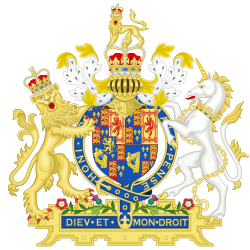
The Bill of Rights 1689 was enacted by the English Parliament, establishing certain rights in statute. It required regular parliaments, free elections, freedom of speech in Parliament, and prohibited cruel and unusual punishment. Along with the Petition of Right 1628 and the Habeas Corpus Act 1679, it formed a key pillar of English constitutional law.
1707
% complete
With the formation of the United Kingdom through the union of England and Scotland, the Bill of Rights 1689 became part of UK law. Unlike many other countries' bills of rights, the UK has no single codified constitution, and this historic statute continues to remain in force as part of the uncodified constitutional framework of the United Kingdom to the present day.
Nov 9, 1998 - Oct 2, 2000
% complete
The Human Rights Act 1998 was passed to incorporate the rights contained in the European Convention on Human Rights into UK law, coming fully into force in October 2000. It allowed British courts to hear human rights cases directly, complementing the long-standing Bill of Rights 1689, which remains part of UK law, and marking a major modernization of Britain's rights framework.
Image source: Human Rights Act 1998
2006 - 2015
% complete
In the 21st century, there were proposals for a British Bill of Rights, with politicians and commissions debating whether a domestic bill should replace or supplement the Human Rights Act 1998. Various bodies examined how a distinctively British instrument might protect rights while preserving the country's constitutional traditions, generating sustained public and political discussion.
Image source: Bill of rights
2022
% complete
The UK Parliament debated a Bill of Rights Bill intended to revise the operation of human rights law in the United Kingdom. After extensive scrutiny and debate, the bill was ultimately withdrawn and was not passed into legislation, meaning that the Human Rights Act 1998 and the historic Bill of Rights 1689 continue to form part of UK law.
Image source: Second Bill of Rights
1720 - 1776
% complete
In the Thirteen Colonies, the English Bill of Rights served as one of the key influences on colonial thinking about rights and governance. Colonists invoked its guarantees of parliamentary liberty, due process, and protection from excessive government power, ideas that shaped colonial charters, protests against British rule, and ultimately the drive toward independence.
Jun 12, 1776
% complete
The Virginia Declaration of Rights was drafted principally by George Mason and adopted by the Virginia Constitutional Convention in 1776. Influenced by the English Bill of Rights, it proclaimed inherent natural rights including life, liberty, property, and the pursuit of happiness. Its influence extended far beyond Virginia, shaping other state declarations and the future United States Bill of Rights.
Jul 4, 1776
% complete
The United States Declaration of Independence, adopted on July 4, 1776, announced the separation of the Thirteen Colonies from Great Britain. Influenced in turn by the Virginia Declaration of Rights, it asserted that all men are created equal with unalienable rights to life, liberty, and the pursuit of happiness, embedding rights-based language at the heart of the new American nation.
Image source: United States Declaration of Independence
Mar 4, 1789
% complete
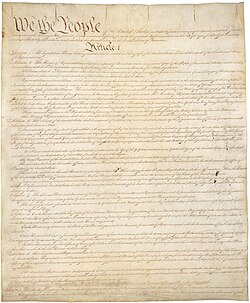
The Constitution of the United States was adopted in 1789, creating the framework of the federal government. Many critics demanded explicit protections for individual rights, prompting promises of amendments. These demands led directly to the drafting and ratification of the United States Bill of Rights, the first ten amendments to the Constitution.
Image source: Constitution of the United States
Sep 25, 1789
% complete
On September 25, 1789, the First Congress proposed twelve amendments to the Constitution, largely drafted by James Madison, to protect fundamental freedoms including speech, religion, assembly, due process, and fair trials. These proposed amendments were sent to the states for ratification, fulfilling the promise made during the Constitution's adoption.
Image source: United States Bill of Rights
Dec 15, 1791
% complete
The United States Bill of Rights was ratified in 1791 after the required number of states approved ten of the twelve proposed amendments. Comprising the first ten amendments to the Constitution, it enshrined core protections for individual liberties and has since become one of the most influential statements of rights in world history, inspiring later rights documents around the globe.
May 5, 1789 - Jul 14, 1789
% complete
The French Revolution erupted in 1789 as financial crisis, social inequality, and Enlightenment ideas fueled popular anger against the monarchy. The storming of the Bastille on July 14, 1789 symbolized the uprising. Revolutionary leaders soon turned to codifying the rights of citizens, setting the stage for a landmark declaration of human and civic rights.
Image source: French Revolution
Jun 17, 1789
% complete
France's National Constituent Assembly was formed in June 1789 from the Estates-General, declaring itself the representative body of the nation. Tasked with writing a constitution, it took up the question of citizens' fundamental rights. Drawing on Enlightenment philosophy and precedents such as the American and English declarations, the Assembly produced the Declaration of the Rights of Man and of the Citizen.
Image source: National Constituent Assembly (France)
Aug 1789
% complete
During the summer of 1789, committees of the National Constituent Assembly debated the principles that should underpin the new French order. Inspired by natural rights theory and influenced by the Virginia Declaration of Rights and the United States Declaration of Independence, they composed a concise declaration proclaiming liberty, equality, property, and popular sovereignty.
Image source: Declaration of the Rights of Man and of the Citizen
Aug 26, 1789
% complete
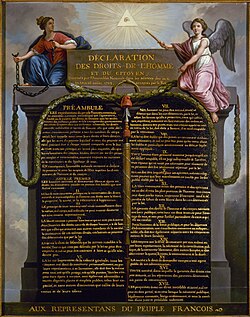
The Declaration of the Rights of Man and of the Citizen was adopted in 1789 by France's National Constituent Assembly during the period of the French Revolution. It proclaimed that men are born and remain free and equal in rights, and defined liberty, property, security, and resistance to oppression as natural rights, becoming a foundational text of modern constitutionalism.
1791 - 1958
% complete
Following its 1789 adoption, the Declaration of the Rights of Man and of the Citizen was incorporated into successive French constitutions, beginning with the Constitution of 1791. Its enduring principles of national sovereignty, equality before the law, and individual liberty remained embedded in French constitutional tradition throughout the nineteenth and twentieth centuries.
1900 - 1948
% complete
Throughout the early 20th century, and especially in the aftermath of two devastating world wars, reformers looked back to Magna Carta, the English Bill of Rights, the United States Bill of Rights, and the French Declaration as models for protecting human dignity. This legacy of earlier documents shaped efforts to create binding international instruments guaranteeing universal rights.
Image source: Universal Declaration of Human Rights
1946 - 1948
% complete
In the years following World War II, different groups drew on earlier documents such as the English, American, and French bills of rights for influence when drafting the Universal Declaration of Human Rights. A UN committee chaired by Eleanor Roosevelt worked from 1946 to synthesize these traditions into a single universal statement of human rights applicable to all peoples.
Dec 10, 1948
% complete
The Universal Declaration of Human Rights was adopted by the United Nations General Assembly in Paris on December 10, 1948. Building on centuries of rights declarations, it proclaimed a comprehensive catalogue of civil, political, economic, social, and cultural rights. It became the foundational document of the modern international human rights movement.
1949 - Nov 4, 1950
% complete
In the wake of the Second World War, the Council of Europe sought to make the rights of the Universal Declaration enforceable in Europe. Drafters drew on the same lineage of historic rights documents to produce the European Convention on Human Rights, creating legally binding guarantees backed by an international court for the signatory states.
Image source: European Convention on Human Rights
Nov 4, 1950
% complete
The European Convention on Human Rights was signed in Rome on November 4, 1950, and entered into force in 1953. Like the Universal Declaration before it, it drew influence from the great bills of rights of history. It established the European Court of Human Rights, giving individuals across Europe a mechanism to challenge violations of their fundamental freedoms.
1979 - 1989
% complete
Beginning around 1979, the United Nations undertook a decade of work drafting a treaty specifically dedicated to children's rights, drawing on the tradition of earlier rights documents including the great bills of rights and the Universal Declaration of Human Rights. Negotiations involved governments and organizations worldwide seeking protections unique to childhood.
Image source: Convention on the Rights of the Child
Nov 20, 1989
% complete
The United Nations Convention on the Rights of the Child was adopted by the General Assembly in 1989, completing the 20th century's extension of the bill-of-rights tradition to children. Influenced by the same lineage of historic documents as the Universal Declaration and the European Convention, it became the most widely ratified human rights treaty in history.
1973
% complete
In 1973, Federal Attorney-General Lionel Murphy introduced a human rights Bill into the Australian parliament, seeking to incorporate protections of fundamental freedoms into Australian law. Although the bill was never passed, it marked a significant attempt to bring a statutory bill of rights to Australia and sparked enduring national debate about entrenched rights protections.
Image source: Bill of Rights 1689
1984
% complete
In 1984, Senator Gareth Evans drafted a Bill of Rights for Australia, reviving the effort begun by Lionel Murphy a decade earlier. The draft aimed to protect civil and political rights through federal legislation. However, it was never formally introduced into parliament, leaving Australia without a national bill or charter of rights at the federal level.
1985
% complete
In 1985, Senator Lionel Bowen introduced a bill of rights into the Australian parliament, continuing the Labor government's push for legislated rights protections. The bill was passed by the House of Representatives but failed to pass the Senate, once again leaving Australia without a national bill of rights despite decades of advocacy.
Or browse the full history timeline directory, with more than 2,000 topics.
This Bill of Rights timeline was generated with the help of AI, using information found on the internet.
We work hard to keep these timelines accurate, but mistakes do get through. If you spot one, email us at [email protected] and we'll fix it for future visitors.
Generate yours with AI or build it from scratch, for free.
Export your timeline, add your own events, edit or remove AI-generated events, and much more
No credit card required.
Cancel anytime.
Cancel anytime.
You can create an unlimited number of timelines with up to 10 events on each one, customize how they look, export them to PDF, PNG, PowerPoint, CSV, and Excel, and share them with a link. Paid plans raise the event limit and add features like spreadsheet imports and collaborators.
Yes. You can cancel your subscription from your account page at any time, and you will not be charged again. Your subscription stays active for the rest of the period you already paid for.
Yes. We will email you a reminder before the annual renewal, and we will also email you a receipt.
Yes. You can email us within 15 days of any payment, and we will issue you a full refund.
Check out our pricing docs or send us an email anytime: [email protected].