-
Use Cases
-
Resources
-
Pricing
The history of Guinea covers the region's role in ancient West African empires like Ghana and Mali, its colonization by France as part of French West Africa, its landmark decision to gain full independence under Ahmed Sékou Touré in 1958, and subsequent periods of authoritarian rule, military coups, democratic transitions, and economic development centered on its vast bauxite resources. More Less
1100 - 1299
% complete
The Sosso kingdom briefly flourished in the region between the 12th and 13th centuries, filling the void left by earlier states before being challenged by the rising Islamic Mandinka Mali Empire.
Image source: Sosso Empire
1200 - 1299
% complete
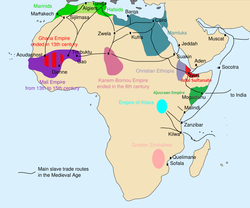
Starting in the 13th century, the Arab slave trade flourished in the region and the Gulf of Guinea, devastating local populations through capture and export of captives.
Image source: Slavery in Africa
1235
% complete
Soundiata Kéïta defeated the Sosso ruler Sumanguru Kanté at the semi-historical Battle of Kirina in c. 1235, bringing the Mali Empire to prominence in the region that is now Guinea.
1324
% complete
Kankou Moussa, the most famous Mansa (Emperor) of the Mali Empire, made a famous hajj to Mecca in 1324, showcasing the empire's immense wealth and Islamic character.
Image source: Mansa Musa
1400 - 1499
% complete
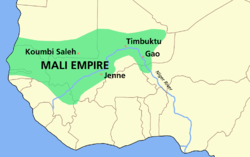
Shortly after Mansa Musa's reign the Mali Empire began to decline and was ultimately supplanted by its vassal states in the 15th century.
Image source: Mali Empire
1460
% complete
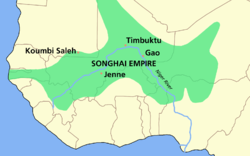
The Songhai Empire expanded its power from about 1460, eventually surpassing the Mali Empire in both territory and wealth as the dominant power in the region.
Image source: Songhai Empire
1582
% complete
A civil war over succession followed the death of Askia Daoud in 1582, weakening the Songhai Empire after its long period of prosperity.
1591
% complete
The weakened Songhai Empire fell to invaders from Morocco in 1591, ending its dominance over the region.
Image source: Battle of Tondibi
1400 - 1499
% complete
The slave trade was greatly expanded when Portugal established a number of trading posts in Guinea, purchasing, exporting, and kidnapping captives as part of the Atlantic slave trade. Other European nations eventually joined, persisting into the mid 19th century.
Image source: Guinea (region)
1735 - 1898
% complete
Fulani Muslims migrated to Futa Jallon in Central Guinea and established an Islamic state from 1735 to 1898, notable for having a written constitution and alternate rulers.
Image source: Imamate of Futa Jallon
1878 - 1898
% complete
The Wassoulou Empire was a short-lived empire led by Samory Touré in the predominantly Malinké area of what is now upper Guinea and southwestern Mali.
Image source: Samorian State
1882 - 1891
% complete
France first administered the territory as part of its Senegalese colony, then established the colony of Rivières du Sud in 1882 before creating the colony of French Guinea.
Image source: Rivières du Sud
1884 - 1885
% complete
The modern boundaries of Guinea were determined by the Berlin Conference (1884–1885) and by the French, who ruled Guinea until 1958.
Image source: Berlin Conference
1891 - 1958
% complete
France formally established the colony of French Guinea in 1891, administering it until independence in 1958.
Image source: French Guinea
1898
% complete
French domination was assured by the defeat in 1898 of the armies of Samori Touré, leader of Malinké descent and ruler of the Ouassoulou state, giving France control of what today is Guinea and adjacent areas.
Image source: Samori Ture
1957
% complete
Ahmed Sékou Touré's Democratic Party of Guinea (PDG) won 56 of 60 seats in the 1957 territorial elections, positioning Touré to lead Guinea toward independence.
1958
% complete
In 1958 the French Fourth Republic collapsed due to political instability and its failures in dealing with its colonies, especially Indochina and Algeria, leading to the founding of a Fifth Republic under Charles de Gaulle.
Image source: French Fourth Republic
Aug 8, 1958
% complete
President Charles de Gaulle made clear on 8 August 1958 that France's colonies faced a stark choice: more autonomy within a new French Community or immediate independence, decided in a referendum on 28 September 1958.
Image source: Charles de Gaulle
Sep 28, 1958
% complete
While other French colonies chose more autonomy, Guinea — under Sékou Touré's leadership — voted overwhelmingly for immediate independence in the referendum.
Oct 2, 1958
% complete
After the French withdrew quickly, destroying infrastructure along the way, Guinea proclaimed itself a sovereign and independent republic on October 2, 1958, with Sékou Touré as president.
Image source: History of Guinea
1960
% complete
By 1960, President Sékou Touré had declared the PDG the only legal party, consolidating one-party rule in the new republic.
1963
% complete
By 1963 Guinea had shifted away from Moscow into a closer friendship with Washington, adjusting its foreign policy alignment during the Cold War.
Image source: Foreign relations of Guinea
Nov 22, 1970
% complete
In November 1970, Portuguese forces from neighboring Portuguese Guinea staged Operation Green Sea, a raid into Guinea with support from exiled Guinean opposition forces.
Image source: Operation Green Sea
1977
% complete
The Guinean Market Women's Revolt in 1977 resulted in the regime's softening of economic restrictions and began a turn away from the radical socialism previously practiced by the government.
Mar 26, 1984
% complete
Sékou Touré died on March 26, 1984, after a heart operation in the United States, and was replaced by Prime Minister Louis Lansana Beavogui as interim president pending elections.
Image source: Ahmed Sékou Touré
Apr 3, 1984
% complete
Just before the PDG was due to elect a new leader on April 3, 1984, Lansana Conté seized power in a military coup, beginning decades of military-influenced rule.
Image source: 1984 Guinean coup d'état
1992
% complete
In 1992 Conté announced a return to civilian rule with presidential polls in 1993 and parliamentary elections in 1995, in which his Unity and Progress Party won 71 of 114 seats, though his grip on power remained tight.
Image source: Lansana Conté
2000 - 2001
% complete
In 2000 Guinea became embroiled in West African instability as rebels crossed the borders with Liberia and Sierra Leone, and for a time the country seemed headed for civil war.
Sep 2001 - 2002
% complete
In September 2001 opposition leader Alpha Condé was imprisoned for endangering state security, though he was pardoned eight months later.
Image source: Alpha Condé
Nov 2001 - Dec 21, 2003
% complete
In 2001 Conté organized and won a referendum to lengthen the presidential term, and in 2003 he began a third term after elections boycotted by the opposition.
2003
% complete
In 2003 Guinea agreed plans with her neighbours to tackle the insurgents who had crossed its borders during the regional instability.
Jan 19, 2005
% complete
In January 2005, Lansana Conté survived a suspected assassination attempt while making a rare public appearance in the capital Conakry.
2007
% complete
In 2007 there were big protests against the government, resulting in the appointment of a new prime minister.
Dec 22, 2008
% complete
Conté remained in power until his death on 22 December 2008, which was followed by a military coup that also dissolved the National Assembly.
Sep 28, 2009
% complete
On 28 September 2009, the junta ordered its soldiers to attack people gathered to protest Captain Moussa Dadis Camara's presumed candidacy in the upcoming presidential elections, killing many protesters.
Image source: 2009 Guinean protests
Dec 3, 2009
% complete
On 3 December 2009, an aide shot Camara during a dispute about the rampage of September 2009; he was flown from Morocco to Burkina Faso on 12 January 2010 for recovery.
Image source: Moussa Dadis Camara
Jan 21, 2010
% complete
On 21 January 2010 the military junta appointed Jean-Marie Doré as Prime Minister of a six-month transition government leading up to elections.
Jun 27, 2010 - Nov 16, 2010
% complete
The presidential election was set for 27 June and 18 July 2010, billed as the first free and fair election since independence in 1958. Cellou Dalein Diallo and Alpha Condé advanced from the first round; fraud allegations postponed the run-off, and on 16 November 2010 Alpha Condé was declared winner of the 7 November run-off.
Image source: 2010 Guinean presidential election
Jul 18, 2011
% complete
On the night of 18 July 2011, President Condé's residence was attacked in an attempted coup, which failed to dislodge him from power.
Image source: List of coups and coup attempts
Apr 2012
% complete
The National Assembly had not met since its dissolution after the December 2008 coup. Elections postponed many times since 2007 and scheduled for 8 July 2012 were indefinitely postponed in April 2012 by Condé, citing the need for transparency.
Feb 2013 - May 2013
% complete
In late February 2013, political violence erupted as protesters voiced concerns over the transparency of upcoming May elections; on 26 March the opposition backed out of negotiations with the government over the 12 May vote.
Feb 11, 2013
% complete
In February 2013, a plane carrying the head of the Guinean armed forces, General Kelefa Diallo, and nine other military officials crashed en route to Monrovia, Liberia.
Jul 2014 - Jun 2016
% complete
Beginning in July 2014, Guinea suffered the most severe recorded outbreak of Ebola in history, which rapidly spread to neighbouring Liberia and Sierra Leone. The epidemic was declared over by June 2016.
Image source: Western African Ebola epidemic
Oct 2020
% complete
In October 2020, president Alpha Condé won presidential elections for a third term, justified by a March 2020 constitutional referendum despite a two-term limit.
Sep 5, 2021
% complete
On September 5, 2021, Alpha Condé was deposed by the military in a coup led by Colonel Mamady Doumbouya, ending his decade-long presidency.
Image source: 2021 Guinean coup d'état
Oct 1, 2021
% complete
On 1 October 2021, Colonel Mamady Doumbouya, who had led the previous month's coup, was sworn in as interim president of Guinea.
Image source: Mamady Doumbouya
Or browse the full history timeline directory, with more than 2,000 topics.
This History of Guinea timeline was generated with the help of AI, using information found on the internet.
We work hard to keep these timelines accurate, but mistakes do get through. If you spot one, email us at [email protected] and we'll fix it for future visitors.
Generate yours with AI or build it from scratch, for free.
Export your timeline, add your own events, edit or remove AI-generated events, and much more
No credit card required.
Cancel anytime.
Cancel anytime.
You can create an unlimited number of timelines with up to 10 events on each one, customize how they look, export them to PDF, PNG, PowerPoint, CSV, and Excel, and share them with a link. Paid plans raise the event limit and add features like spreadsheet imports and collaborators.
Yes. You can cancel your subscription from your account page at any time, and you will not be charged again. Your subscription stays active for the rest of the period you already paid for.
Yes. We will email you a reminder before the annual renewal, and we will also email you a receipt.
Yes. You can email us within 15 days of any payment, and we will issue you a full refund.
Check out our pricing docs or send us an email anytime: [email protected].