-
Use Cases
-
Resources
-
Pricing
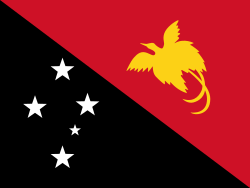
The history of Papua New Guinea spans tens of thousands of years of indigenous Melanesian settlement, followed by European exploration in the 16th century, German and British colonial rule, Japanese occupation during World War II, Australian administration, and eventual independence in 1975. The nation is one of the world's most culturally diverse countries, with over 800 languages spoken among its peoples. More Less
7000 BC
% complete
In the Kuk Valley of the Papua New Guinea Highlands, people independently developed agriculture around 9,000 years ago, cultivating taro and bananas and draining swamplands for cultivation. This is one of the world's few independent centers of plant domestication, recognized today as a UNESCO World Heritage Site.
Image source: Kuk Swamp
1500 BC - 500 BC
% complete
The Lapita people, Austronesian-speaking voyagers known for distinctive dentate-stamped pottery, spread through island Melanesia including parts of coastal Papua New Guinea around 1500 BC. They brought new technologies, pigs, chickens, and horticultural practices that reshaped coastal societies.
Image source: Lapita culture
1000 BC - 1500 AD
% complete
Over centuries, extensive indigenous trade networks such as the kula ring in nearby island groups connected coastal communities, exchanging shells, pottery, timber, and food. These networks fostered cultural exchange among the thousands of linguistically distinct communities across the region.
Image source: History of Papua New Guinea
1526 AD - 1545 AD
% complete
Portuguese navigator Jorge de Menezes landed on the north coast around 1526, followed by Spanish explorer Íñigo Ortiz de Retes in 1545, who named the island 'Nueva Guinea' after reportedly seeing its inhabitants resemble those of West Africa's Guinea coast.
Image source: New Guinea
1828 AD
% complete
The Netherlands formally claimed the western half of New Guinea in 1828, establishing outposts such as Fort du Bus. Dutch control remained largely nominal for decades, but the claim later defined the colonial boundary that persists as the border with Indonesian Papua today.
Image source: Western New Guinea
Nov 3, 1884
% complete
Days before the British declaration, Germany claimed the north-eastern part of the island, creating German New Guinea. German firms developed coconut plantations and recruited labor, while missionaries established themselves along the coast and islands.
Image source: German New Guinea
Nov 6, 1884
% complete
Britain declared a protectorate over the south-eastern portion of New Guinea, raising the Union Jack at Port Moresby. The move responded to fears of German expansion in the Pacific, beginning British administration over what became the Territory of Papua.
Image source: Territory of Papua
1888
% complete
The British protectorate was converted into a formal colony, British New Guinea. Administrators such as William MacGregor worked to suppress intertribal warfare and headhunting while expanding government posts into previously uncontacted interior regions.
1895
% complete
Gold discoveries in the 1890s, notably along the Mambare River in the Northern Division, drew waves of Australian prospectors into the interior. Mining camps accelerated European penetration of highland foothills and intensified contact between colonists and local peoples.
1902 - 1906
% complete
Following Australian federation, Britain transferred British New Guinea to Australia, which administered it from 1906 as the Territory of Papua under the Papua Act. Port Moresby remained the capital, and Australian law gradually replaced colonial institutions.
1930 - 1935
% complete
Gold prospectors Michael, Daniel, and James Leahy led patrols into the densely populated Central Highlands, making sustained first contact with up to a million previously isolated people. Their expeditions revealed vast agricultural societies unknown to the outside world.
Image source: Provinces of Papua New Guinea
Sep 11, 1914
% complete
At the outbreak of World War I, an Australian expeditionary force seized German wireless stations at Bitapaka near Rabaul, ending German rule. Australia then occupied German New Guinea, later receiving it as a League of Nations mandated territory in 1921.
Image source: Australian occupation of German New Guinea
1942 - 1945
% complete
Papua New Guinean carriers and stretcher-bearers, affectionately named 'Fuzzy Wuzzy Angels,' carried supplies forward and evacuated wounded Allied soldiers across treacherous terrain throughout the war. Their compassion earned lasting gratitude and shaped postwar ties with Australia.
Image source: Fuzzy Wuzzy Angels
Jan 23, 1942
% complete
Japanese forces captured Rabaul, the capital of the Australian Mandated Territory of New Guinea, overwhelming a small garrison. Rabaul became Japan's major South Pacific base, and many captured Australian soldiers later died when the ship Montevideo Maru was sunk.
Image source: Battle of Rabaul (1942)
May 4, 1942 - May 8, 1942
% complete
Fought in waters south of New Guinea, this was history's first naval battle fought entirely by carrier aircraft. It checked the Japanese seaborne drive toward Port Moresby, forcing Japan to attempt an overland route across the Kokoda Track instead.
Image source: Battle of the Coral Sea
Jul 21, 1942 - Nov 16, 1942
% complete
Japanese troops advanced over the Owen Stanley Range toward Port Moresby along the rugged Kokoda Track, where they were met by young Australian militiamen and AIF reinforcements in brutal jungle fighting. The Allied victory became a defining national legend for both Australia and Papua New Guinea.
Image source: Kokoda Track campaign
Aug 25, 1942 - Sep 7, 1942
% complete
Japanese marines landed at Milne Bay at the eastern tip of Papua but were decisively defeated by Australian defenders supported by aircraft. It was the first time a full Japanese amphibious landing was repulsed in the Pacific War, boosting Allied morale.
Image source: Battle of Milne Bay
Apr 1943 - Mar 1944
% complete
Australian and American forces, aided by Papuan and New Guinean carriers, drove Japanese forces from Lae, Salamaua, Finschhafen, and the Markham Valley. Combined with victories at Wau and the Bismarck Sea, these campaigns secured airfields and pushed Japan onto the defensive.
Image source: Salamaua–Lae campaign
Nov 1, 1943 - Aug 21, 1945
% complete
US Marines landed on Bougainville and established airbases; Australian forces later took over and fought a long, costly mopping-up campaign against Japanese remnants until the war's end in August 1945, one of the final campaigns of World War II.
Image source: Bougainville campaign
Jan 18, 1951
% complete
The catastrophic eruption of Mount Lamington in Oro Province killed nearly 3,000 people and destroyed the district headquarters at Higaturu. Volcanologist Tony Taylor's heroic work during and after the eruption guided relief efforts and evacuation decisions.
Image source: Mount Lamington
1964
% complete
Under UN trusteeship, the Territory of Papua and New Guinea held its first elections with universal adult suffrage, introducing representative government to a population with no prior electoral experience and beginning the gradual transfer of power toward self-rule.
Image source: Territory of Papua and New Guinea
1967
% complete
Michael Somare and other young leaders founded Pangu Pati, the country's first major political party, campaigning for rapid self-government and independence. The party mobilized emerging nationalist sentiment among educated Papua New Guineans and dominated early politics.
Image source: Pangu Pati
1969
% complete
Conzinc RioTinto opened one of the world's largest open-pit copper mines on Bougainville, generating enormous revenue for the territory. Landowner grievances over environmental damage and inadequate compensation later fueled a decade-long separatist conflict.
Image source: Panguna mine
Sep 1, 1975
% complete
Just before independence, Bougainville leaders declared unilateral secession, resentful of mining impacts and culturally tied to the Solomon Islands. The declaration was not internationally recognized, and negotiations eventually granted limited autonomy, though grievances persisted.
Image source: Autonomous Region of Bougainville
Sep 16, 1975
% complete
Papua New Guinea became an independent nation within the Commonwealth, with Sir Michael Somare as its first Prime Minister and Queen Elizabeth II as head of state. The new country adopted a constitution emphasizing decentralization and unity amid extraordinary linguistic diversity.
Image source: Papua New Guinea
1988 - 1998
% complete
Landowner sabotage of the Panguna mine escalated into a brutal civil war between the Bougainville Revolutionary Army and Papua New Guinea security forces. The blockade and fighting killed up to 20,000 people before a ceasefire and peace process ended hostilities in 1998.
Image source: Bougainville conflict
Jul 17, 1998
% complete
A magnitude 7.0 earthquake offshore triggered devastating tsunamis that swept three villages near Aitape on the Sandaun coast, killing over 2,200 people and leaving thousands homeless in one of the deadliest disasters in Pacific Island history.
Image source: 1998 Papua New Guinea earthquake
Aug 30, 2001
% complete
The peace agreement created the Autonomous Region of Bougainville, disbanded armed factions, and promised a referendum on future political status. It ended the decade-long civil war and set the framework for reconciliation and reconstruction.
May 30, 2019
% complete
James Marape replaced Peter O'Neill as Prime Minister after shifting parliamentary allegiances, pledging to make Papua New Guinea 'the richest black Christian nation.' He has since focused on resource sector reform and navigating Bougainville's independence aspirations.
Image source: James Marape
Nov 23, 2019 - Dec 7, 2019
% complete
Nearly 98 percent of Bougainville voters chose independence from Papua New Guinea in a peaceful referendum. Negotiations on the transition to sovereignty began afterward, potentially creating a new nation in the coming years.
Image source: 2019 Bougainvillean independence referendum
Or browse the full history timeline directory, with more than 2,000 topics.
This History of Papua New Guinea timeline was generated with the help of AI, using information found on the internet.
We work hard to keep these timelines accurate, but mistakes do get through. If you spot one, email us at [email protected] and we'll fix it for future visitors.
Generate yours with AI or build it from scratch, for free.
Export your timeline, add your own events, edit or remove AI-generated events, and much more
No credit card required.
Cancel anytime.
Cancel anytime.
You can create an unlimited number of timelines with up to 10 events on each one, customize how they look, export them to PDF, PNG, PowerPoint, CSV, and Excel, and share them with a link. Paid plans raise the event limit and add features like spreadsheet imports and collaborators.
Yes. You can cancel your subscription from your account page at any time, and you will not be charged again. Your subscription stays active for the rest of the period you already paid for.
Yes. We will email you a reminder before the annual renewal, and we will also email you a receipt.
Yes. You can email us within 15 days of any payment, and we will issue you a full refund.
Check out our pricing docs or send us an email anytime: [email protected].