
-
Use Cases
-
Resources
-
Pricing
The New York City Subway is one of the world's oldest and busiest rapid transit systems. Opened in 1904, it grew from a single line into a vast network of over 470 stations operated by the Interborough Rapid Transit (IRT), Brooklyn-Manhattan Transit (BMT), and Independent Subway System (IND), later unified under city control and now run by the MTA. More Less
Feb 26, 1870
% complete
Alfred Ely Beach built a short pneumatic subway line beneath Broadway, running a single car through a 312-foot tunnel. Though popular as an attraction, it never expanded and was closed by 1873, but it demonstrated public appetite for underground transit in New York City.
Image source: Beach Pneumatic Transit
1894
% complete
The New York State Legislature passed the Rapid Transit Act, enabling the creation of the Board of Rapid Transit Railroad Commissioners and paving the way for the city's first municipally planned underground rapid transit line.
Image source: Interborough Rapid Transit Company
Mar 24, 1900
% complete
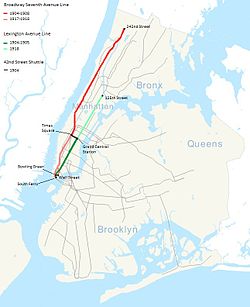
Ground was broken at City Hall for the Interborough Rapid Transit Company's first subway line. Chief engineer William Barclay Parsons oversaw construction of a route from City Hall north to Grand Central, then west to Times Square and up Broadway to 145th Street.
Oct 27, 1904
% complete
Mayor George McClellan Jr. ceremonially took the controls of the first subway train at City Hall station, launching the Interborough Rapid Transit Company's original 9.1-mile line. The system carried over 100,000 passengers on its first day.
Image source: City Hall station (IRT Lexington Avenue Line)
Jun 22, 1915
% complete
The Brooklyn Rapid Transit Company opened its Broadway subway line through the Montague Street Tunnel, connecting Brooklyn with Manhattan and establishing it as a major competitor to the IRT under the Dual Contracts.
Image source: Brooklyn Rapid Transit Company
Mar 1913
% complete
New York City signed agreements with both the IRT and BRT to massively expand the subway network. The contracts funded new lines across Manhattan, Brooklyn, Queens, and the Bronx while freezing fares at five cents.
Image source: Dual Contracts
Jun 15, 1915
% complete
The Steinway Tunnel under the East River opened, carrying trains from Manhattan into Long Island City, Queens. It marked the beginning of rapid transit service to Queens and stimulated development in the borough.
Image source: Steinway Tunnel
May 30, 1931
% complete
The completion of the Nassau Street Loop allowed Brooklyn–Manhattan Transit trains to run through Lower Manhattan without turning around, improving capacity during a period when ridership was at historic highs.
Image source: BMT Nassau Street Line
Sep 10, 1932
% complete
The city-owned Independent Subway System launched its first line along Eighth Avenue, featuring wider cars and longer stations than its competitors. It was the first subway built entirely with municipal funds.
Image source: IND Eighth Avenue Line
Jun 1, 1940
% complete
New York City purchased the privately operated IRT and BMT systems and combined them with the municipal IND, creating one unified subway network operated by the city's Board of Transportation.
Image source: New York City Transit Authority
Dec 15, 1940
% complete
After years of delays partly caused by the need to rebuild elevated rail structures above, the city-operated Sixth Avenue subway opened, providing crosstown and midtown service and completing the IND's core Manhattan network.
Image source: IND Sixth Avenue Line
Jul 1, 1948
% complete
For the first time since 1904, the subway fare doubled from five cents to ten cents. The increase reflected rising operating costs after World War II and ended the famous nickel fare that had shaped the system's finances for decades.
Image source: History of the New York City Subway
Jun 15, 1953
% complete
The New York City Transit Authority was established as the successor to the Board of Transportation, taking over subway and bus operations amid growing financial pressures and deferred maintenance concerns.
1946
% complete
Annual subway ridership peaked at roughly 2 billion trips shortly after World War II, before automobile ownership and suburbanization began drawing passengers away, initiating a decades-long decline in ridership and revenue.
Aug 31, 1958
% complete
The demolition of the Third Avenue El in Manhattan was largely complete, marking the end of most elevated rail operations in Manhattan. The removal reflected the shift toward subway service but eliminated transit access in some neighborhoods.
Image source: IRT Third Avenue Line
1965
% complete
Nelson Rockefeller championed the creation of the Metropolitan Transportation Authority, which absorbed the New York City Transit Authority and suburban commuter railroads, centralizing regional mass transit governance in New York State.
Image source: Metropolitan Transportation Authority
Jul 5, 1966
% complete
As fares rose repeatedly through the 1960s and 1970s, tokens became increasingly cumbersome to manage, foreshadowing the eventual move toward automated fare collection with magnetic-stripe MetroCards two decades later.
Nov 26, 1967
% complete
The Chrystie Street Connection opened, physically linking the former BMT and IND systems and enabling new integrated services such as direct Manhattan Bridge runs, fulfilling long-promised unified operations.
Image source: Chrystie Street Connection
1970 - 1989
% complete
Throughout the 1970s and 1980s, graffiti covered much of the subway fleet, becoming a symbol of urban decay. The MTA eventually waged an aggressive campaign that removed graffiti from nearly all cars by 1989.
Image source: New York City Transit Police
Jan 1, 1975 - 1980
% complete
Facing New York City's fiscal crisis, the MTA cut service dramatically, reduced maintenance, and allowed rolling stock and stations to deteriorate. Ridership fell and crime rose, making this the system's darkest period.
1979
% complete
With crime rates soaring, the subway became internationally notorious as dangerous. The 1979 vigilante film 'The Warriors' and real incidents like the 1984 Bernhard Goetz shooting cemented the system's fearsome reputation.
Image source: History of the New York City Subway
1982
% complete
Under MTA chairman Richard Ravitch, the agency adopted its first five-year capital program, committing billions to replace tracks, signals, cars, and stations, reversing years of neglect and setting the stage for recovery.
May 12, 1989
% complete
The MTA declared victory in its anti-graffiti campaign, having cleaned or retired every vandalized car. Clean cars became a point of pride and symbolized the broader turnaround in subway conditions.
1990 - 2000
% complete
Through the 1990s, increased police presence and enforcement strategies helped reduce subway crime by more than 75 percent, transforming rider perceptions and fueling a resurgence in ridership.
1993
% complete
The magnetic-stripe MetroCard was introduced, replacing tokens and enabling free transfers, unlimited-ride options, and bonuses for bulk purchases. Tokens were phased out completely by 2003.
Sep 11, 2001
% complete
The collapse of the World Trade Center destroyed the 1/9 station beneath the site and damaged surrounding infrastructure. The WTC Cortlandt station remained closed for 17 years before reopening in 2018.
Image source: WTC Cortlandt station
Dec 16, 2001
% complete
The 63rd Street Tunnel's long-delayed connection to the Queens Boulevard Line opened, allowing F trains to use the tunnel and relieving congestion on other East River crossings after decades of planning.
Image source: 63rd Street lines
2005
% complete
Long-standing proposals to connect Staten Island to the subway network, including the proposed Triborough RX line and revived tunnel concepts, continued to be studied, leaving Staten Island dependent on ferries and buses.
Image source: Staten Island Railway
Jan 1, 2017
% complete
Nearly a century after it was first proposed, the Second Avenue Subway opened three new stations on Manhattan's Upper East Side, serving Q trains and providing relief to the overcrowded Lexington Avenue Line.
Image source: Second Avenue Subway
May 31, 2019
% complete
The MTA began piloting OMNY, allowing riders to tap contactless credit cards and smartphones at turnstiles, gradually replacing the MetroCard and modernizing fare payment across the entire subway system.
Image source: OMNY
Or browse the full history timeline directory, with more than 2,000 topics.
This History of the New York Subway timeline was generated with the help of AI, using information found on the internet.
We work hard to keep these timelines accurate, but mistakes do get through. If you spot one, email us at [email protected] and we'll fix it for future visitors.
Generate yours with AI or build it from scratch, for free.
Export your timeline, add your own events, edit or remove AI-generated events, and much more
No credit card required.
Cancel anytime.
Cancel anytime.
You can create an unlimited number of timelines with up to 10 events on each one, customize how they look, export them to PDF, PNG, PowerPoint, CSV, and Excel, and share them with a link. Paid plans raise the event limit and add features like spreadsheet imports and collaborators.
Yes. You can cancel your subscription from your account page at any time, and you will not be charged again. Your subscription stays active for the rest of the period you already paid for.
Yes. We will email you a reminder before the annual renewal, and we will also email you a receipt.
Yes. You can email us within 15 days of any payment, and we will issue you a full refund.
Check out our pricing docs or send us an email anytime: [email protected].