-
Use Cases
-
Resources
-
Pricing
The history of New York City traces the development of one of the world's most influential cities, from its origins as a Dutch fur trading settlement called New Amsterdam, through British colonization, its role as America's first capital, waves of immigration through Ellis Island, industrial growth, urban challenges, and its emergence as a global center of finance, culture, and commerce. More Less
1624
% complete
The Dutch West India Company established a fur-trading outpost in the region, laying the foundations of the first permanent European settlement that would become New York City.
Image source: New Netherland
1625
% complete
The Dutch established the town of New Amsterdam at the southern tip of Manhattan Island, making it the capital of New Netherland and one of the earliest European settlements in North America.
Image source: New Amsterdam
1653
% complete
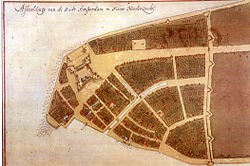
Dutch settlers built a defensive wall across the northern edge of New Amsterdam to protect against attacks; the street along the wall later became famous as Wall Street, the heart of global finance.
Image source: Wall Street
Sep 8, 1664
% complete
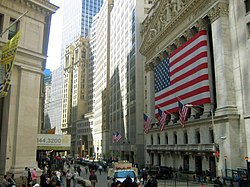
English forces seized the Dutch settlement without significant resistance, renaming it New York in honor of the Duke of York, beginning more than a century of British colonial rule.
Image source: New York City
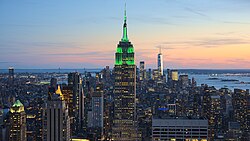
Sep 15, 1776 - Nov 25, 1783
% complete
British forces occupied New York for most of the American Revolution, using it as their military and political headquarters until evacuating on Evacuation Day in 1783.
Image source: New York City
Sep 21, 1776
% complete
A massive fire broke out in the early morning hours, destroying roughly a quarter of the city's structures during the British occupation early in the Revolutionary War.
Image source: Great Fire of New York (1776)
Sep 3, 1783
% complete
The treaty ending the Revolutionary War was signed, securing American independence and setting the stage for New York's brief role as the young nation's capital.
Image source: Treaty of Paris (1783)
1785 - 1790
% complete
New York City served as the first capital of the United States under the new Constitution, hosting the Continental Congress and, later, the first federal government.
Image source: Federal Hall
Apr 30, 1789
% complete
George Washington took the oath of office as the first President of the United States at Federal Hall on Wall Street, marking the birth of the American federal government.
Image source: First inauguration of George Washington
Dec 15, 1791
% complete
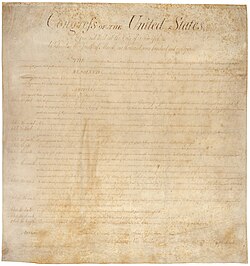
Although ratified by the states nationally, Congress had proposed the first ten amendments while meeting in New York City, cementing its role as the cradle of American constitutional government.
Image source: United States Bill of Rights
Oct 26, 1825
% complete
The completion of the Erie Canal linked New York Harbor to the Great Lakes, transforming the city into the dominant commercial gateway of America and fueling explosive growth.
Image source: Erie Canal
Dec 16, 1835
% complete
A catastrophic fire swept through New York's financial district, destroying hundreds of buildings, but the city rebuilt rapidly and emerged stronger than before.
Image source: Great Fire of New York
May 24, 1883
% complete
The Brooklyn Bridge, the longest suspension bridge of its era, connected Manhattan and Brooklyn across the East River and became an enduring icon of American engineering.
Image source: Brooklyn Bridge
Oct 28, 1886
% complete
France gifted the Statue of Liberty to the United States, dedicating it on Bedloe's Island as a symbol of freedom and welcoming millions of immigrants arriving through New York.
Image source: Statue of Liberty
Jan 1, 1892 - Nov 12, 1954
% complete
Ellis Island processed more than twelve million immigrants entering the United States through New York Harbor, profoundly shaping the city's diverse cultural fabric.
Image source: Ellis Island
Jan 1, 1898
% complete
Manhattan, Brooklyn, Queens, the Bronx, and Staten Island were consolidated into a single city, creating the modern five-borough New York City with over three million residents.
Image source: City of Greater New York
Mar 25, 1911
% complete
One of the deadliest industrial disasters in US history, the fire exposed brutal factory conditions and spurred major reforms in labor laws and workplace safety regulations.
Image source: Triangle Shirtwaist Factory fire
Feb 2, 1913
% complete
The Beaux-Arts masterpiece opened as the largest train terminal in the world, becoming a landmark of Midtown Manhattan and a symbol of the city's rise as a metropolis.
Image source: Grand Central Terminal
1918 - 1937
% complete
A cultural, artistic, and intellectual movement centered in Harlem celebrated African American creativity, producing legendary writers, musicians, and artists who reshaped American culture.
Image source: Harlem Renaissance
May 27, 1930
% complete
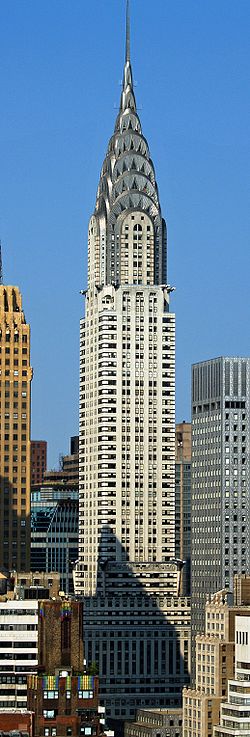
The Art Deco skyscraper briefly held the title of world's tallest building, exemplifying the fierce skyscraper race of late 1920s New York.
Image source: Chrysler Building
May 1, 1931
% complete
Completed ahead of schedule during the Great Depression, the Empire State Building became the tallest building in the world and an enduring symbol of New York City.
Image source: Empire State Building
Apr 30, 1939 - Oct 27, 1940
% complete
Themed 'Building the World of Tomorrow,' the fair showcased futuristic visions of technology and design, drawing tens of millions of visitors to Queens.
Image source: 1939 New York World's Fair
1952
% complete
The United Nations opened its permanent headquarters on Manhattan's East Side, cementing New York's status as a center of international diplomacy.
Image source: Headquarters of the United Nations
Jun 28, 1969 - Jul 3, 1969
% complete
Protests following a police raid on the Stonewall Inn in Greenwich Village galvanized the modern LGBTQ+ rights movement in the United States and worldwide.
Image source: Stonewall riots
1973
% complete
The twin towers rose above Lower Manhattan as the tallest buildings in the world, redefining the skyline and anchoring the city's identity as a global financial hub.
Image source: World Trade Center (1973–2001)
1975
% complete
Facing bankruptcy, the city teetered on the edge of default, prompting federal aid, austerity measures, and a long struggle toward fiscal recovery.
Image source: History of New York City (1946–1977)
Jul 13, 1977 - Jul 14, 1977
% complete
A widespread power failure struck during an economic downturn, triggering looting and arson across the city and exposing deep social strains of the era.
Oct 19, 1987
% complete
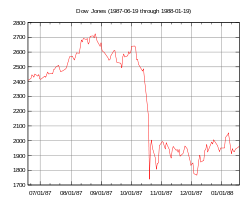
Global stock markets crashed with Wall Street losing over 22% in a single day, the largest one-day percentage drop in history, shaking the city's financial core.
Image source: Black Monday (1987)
Sep 11, 2001
% complete
Terrorists hijacked airliners and crashed them into the World Trade Center's towers, causing their collapse, killing nearly 3,000 people, and profoundly altering the city, nation, and world.
Image source: September 11 attacks
Oct 29, 2012
% complete
Storm surge flooded subway tunnels and neighborhoods, knocked out power across Lower Manhattan, and prompted massive investments in coastal resiliency planning.
Image source: Effects of Hurricane Sandy in New York
Or browse the full history timeline directory, with more than 2,000 topics.
This History of New York City timeline was generated with the help of AI, using information found on the internet.
We work hard to keep these timelines accurate, but mistakes do get through. If you spot one, email us at [email protected] and we'll fix it for future visitors.
Generate yours with AI or build it from scratch, for free.
Export your timeline, add your own events, edit or remove AI-generated events, and much more
No credit card required.
Cancel anytime.
Cancel anytime.
You can create an unlimited number of timelines with up to 10 events on each one, customize how they look, export them to PDF, PNG, PowerPoint, CSV, and Excel, and share them with a link. Paid plans raise the event limit and add features like spreadsheet imports and collaborators.
Yes. You can cancel your subscription from your account page at any time, and you will not be charged again. Your subscription stays active for the rest of the period you already paid for.
Yes. We will email you a reminder before the annual renewal, and we will also email you a receipt.
Yes. You can email us within 15 days of any payment, and we will issue you a full refund.
Check out our pricing docs or send us an email anytime: [email protected].