-
Use Cases
-
Resources
-
Pricing
1200 - 1299
% completado
The earliest known written process to artificially make ice appears not in culinary texts but in the 13th-century writings of Syrian historian Ibn Abi Usaybi'a in his book 'Kitab Uyun al-anba fi tabaqat-al-atibba', where he attributes the process to an older author, Ibn Bakhtawayhi, of whom nothing is known.
Image source: Ice cream
1500 - 1599
% completado
In the 16th century, the Mughal Empire used relays of horsemen to bring ice from the Hindu Kush to its capital, Delhi, where it was used to create kulfi, a popular frozen dairy dessert often described as traditional Indian ice cream.
Image source: Kulfi
1500 - 1599
% completado
The technique of freezing was not known from any European sources prior to the 16th century, making the later development of sorbets and ice creams a significant culinary advance.
1500 - 1599
% completado
During the 16th century, authors made reference to the refrigerant effect that happened when salt was added to ice, a discovery that would become essential to freezing ice cream.
1500 - 1599
% completado
According to L'Isle des Hermaphrodites, the practice of cooling drinks with ice and snow had already emerged in Paris, particularly at court, during the 16th century.
1533
% completado
According to a legend, the Italian duchess Catherine de' Medici introduced flavoured sorbet ices to France when she brought Italian chefs with her upon marrying the Duke of Orléans (Henry II of France) in 1533.
Image source: Catherine de' Medici

1600 - 1699
% completado
By the latter part of the 17th century, sorbets and ice creams were being made using the process of adding salt to ice to achieve freezing temperatures.
Image source: Sorbet
1665
% completado
In 1665, the Catalogue des Marchandises rares..., edited in Montpellier by Jean Fargeon, listed a type of frozen sorbet, documenting its commercial availability in France.
1671
% completado
The first recorded mention of ice cream in England was in 1671. Elias Ashmole described the dishes served at the Feast of St George at Windsor for Charles II that year, which included 'one plate of ice cream'.
1674
% completado
The first recipe in French for flavoured ices appears in 1674, in Nicholas Lemery's Recueil de curiositéz rares et nouvelles de plus admirables effets de la nature.
Image source: Nicolas Lemery
1682
% completado
In 1682, Le Nouveau confiturier françois provided a recipe for a specific type of ice cream called 'neige de fleur d'orange' (orange blossom snow).
1686
% completado
In 1686, Italian Francesco dei Coltelli opened an ice cream café in Paris, and the product became so popular that during the next 50 years another 250 cafés opened in Paris.
Image source: Café Procope
1692
% completado
Recipes for flavoured ices begin to appear in François Massialot's Nouvelle Instruction pour les Confitures, les Liqueurs, et les Fruits, starting with the 1692 edition.
Image source: François Massialot
1694
% completado
Recipes for sorbetti saw publication in the 1694 edition of Antonio Latini's Lo Scalco alla Moderna (The Modern Steward), documenting Italian frozen dessert traditions.
Image source: Antonio Latini
1744
% completado
An early North American reference to ice cream comes from an account in 1744 of a dinner held by governor Thomas Bladen and his wife, after which came 'a Dessert no less Curious'.
1750
% completado
In the Mediterranean, ice cream appears to have been accessible to ordinary people by the mid-18th century, expanding beyond elite circles.
1751
% completado
The 1751 edition of The Art of Cookery made Plain and Easy by Hannah Glasse includes a recipe for ice cream, bringing the treat into British home kitchens.
Image source: Hannah Glasse
1768
% completado
In 1768, Emy published a cookbook devoted entirely to recipes for flavoured ices and ice cream, reflecting the growing sophistication of frozen dessert making.
1769
% completado
In 1769 Domenico Negri, an Italian confectioner, founded a business in Berkeley Square, London, which would become famous for its ice creams.
Image source: Gunter's Tea Shop
1789
% completado
In 1789, Frederick Nutt, who served an apprenticeship at Negri's establishment, first published The Complete Confectioner, spreading ice cream recipes further.
1790
% completado
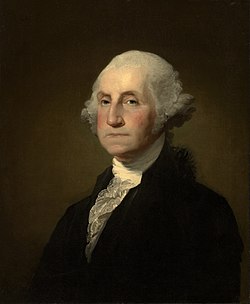
Records kept by a merchant from Chatham Street, New York, show George Washington spending approximately $200 on ice cream in the summer of 1790, demonstrating its popularity among America's elite.
Image source: George Washington
1813
% completado
President James Madison's wife served ice cream at her husband's Inaugural Ball in 1813, cementing the dessert's place at prestigious American events.
Image source: Dolley Madison
1851
% completado
Ice cream became popular and inexpensive in England in the mid-19th century when Swiss émigré Carlo Gatti set up the first stand outside Charing Cross station in 1851.
Image source: Carlo Gatti
1860
% completado
By 1860, Carlo Gatti expanded his business and began importing ice on a large scale from Norway to support his growing ice cream trade.
1866
% completado
In New Zealand, a newspaper advertisement for ice cream appeared in 1866, claiming to be the first time ice cream was available in Wellington.
1874
% completado
The invention of the ice cream soda is attributed to American Robert Green in 1874, although there is no conclusive evidence to prove his claim.
Image source: Ice cream float
1875
% completado
Commercial manufacturing of ice cream was underway by 1875, transforming it from a handmade delicacy into a mass-produced product.
1885 - 1894
% completado
Mrs. Marshall wrote four books: The Book of Ices (1885), Mrs. Marshall's Book of Cookery (1888), Mrs. Marshall's Larger Cookery Book of Extra Recipes (1891) and Fancy Ices (1894), and gave public lectures on cooking. Her Book of Cookery endorsed serving ice cream in cones.
Image source: Agnes Marshall
1890
% completado
The ice cream sundae originated in the late 19th century, becoming one of America's most beloved ice cream treats served with syrups and toppings.
Image source: Sundae
1900
% completado
In the United States in the early 20th century, the ice cream soda was a popular treat at the soda shop, the soda fountain, and the ice cream parlour.
Image source: Soda fountain
1904
% completado
The ice cream cone was popularized in the US at the 1904 World's Fair in St. Louis. Reliable evidence proves cones were served in the 19th century, but their popularity increased greatly at the fair.
Image source: Ice cream cone
1905
% completado
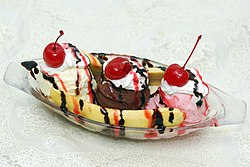
Both the ice cream cone and banana split became popular in the early 20th century, expanding the repertoire of classic ice cream desserts.
Image source: Banana split
1930
% completado
One important development in the 20th century was the introduction of soft ice cream, which has more air mixed in, thereby reducing costs and creating a new style of frozen dessert.
Image source: Soft serve
1950
% completado
Ice cream became popular throughout the world in the second half of the 20th century after cheap refrigeration became common, making frozen treats accessible everywhere.
1996
% completado
In the United Kingdom, the Food Labelling Regulations (1996) set a requirement of at least 5% milk fat and 2.5% milk protein in order to be sold as ice cream within the UK.
Image source: Cream
2006
% completado
In 2006, some commercial ice cream makers began to use liquid nitrogen in the primary freezing of ice cream, thus eliminating the need for a conventional ice cream freezer.
2015
% completado
In 2015, the US produced nearly 900 million US gallons (3.4×10⁹ L) of ice cream, underscoring the scale of the American market.
2015
% completado
In 2015, UK regulations were relaxed so that containing milk fat or protein was no longer necessary for a product to be sold as 'ice cream', though at least 5% milk fat is still required for a product to be labeled 'dairy ice cream'.
2018
% completado
By 2018, exported ice cream products included new flavours such as matcha to cater to Asian markets, following rapid growth in New Zealand's ice cream popularity throughout the 20th century.
2024
% completado
In the United Kingdom, 14 million adults buy ice cream as a treat, in a market worth £1.8 billion according to a report produced in 2024. Vanilla and chocolate remain the most popular flavours with a combined market share of 40% as of 2008.
Or browse the full history timeline directory, with more than 2,000 topics.
This History of Ice Cream timeline was generated with the help of AI, using information found on the internet.
We work hard to keep these timelines accurate, but mistakes do get through. If you spot one, email us at [email protected] and we'll fix it for future visitors.
Generate yours with AI or build it from scratch, for free.
Export your timeline, add your own events, edit or remove AI-generated events, and much more
No credit card required.
Cancel anytime.
Cancel anytime.
You can create an unlimited number of timelines with up to 10 events on each one, customize how they look, export them to PDF, PNG, PowerPoint, CSV, and Excel, and share them with a link. Paid plans raise the event limit and add features like spreadsheet imports and collaborators.
Yes. You can cancel your subscription from your account page at any time, and you will not be charged again. Your subscription stays active for the rest of the period you already paid for.
Yes. We will email you a reminder before the annual renewal, and we will also email you a receipt.
Yes. You can email us within 15 days of any payment, and we will issue you a full refund.
Check out our pricing docs or send us an email anytime: [email protected].