-
Use Cases
-
Resources
-
Pricing
Ice hockey is a fast-paced team sport played on ice, with roots tracing back to stick-and-ball games in Europe and its formal birth in Canada during the 19th century. The first organized indoor game was played in Montreal in 1875, leading to the formation of leagues, the creation of the Stanley Cup in 1893, and the founding of the National Hockey League in 1917. Over the 20th and 21st centuries, ice hockey expanded internationally, becoming an Olympic sport and a professional game followed by millions of fans worldwide. More Less
1680 - 1699
% complete
In England, field hockey developed in the late 17th century, and there is evidence that some games of field hockey took place on the ice.
Image source: History of ice hockey
1700 - 1899
% complete
Ice hockey is believed to have evolved from simple stick and ball games played in the 18th and 19th centuries in Britain, Ireland, and elsewhere, primarily bandy, hurling, and shinty.
1772
% complete
The first known mention of hockey occurred in the 1772 book Juvenile Sports and Pastimes, to Which Are Prefixed, Memoirs of the Author: Including a New Mode of Infant Education, by Richard Johnson. The word 'hockey' was used to designate a stick-and-ball game at least as far back as 1773.
1796
% complete
A 1797 engraving unearthed by Swedish sport historians Carl Gidén and Patrick Houda shows a person on skates with a stick and bung on the River Thames, probably in December 1796.
1800 - 1899
% complete
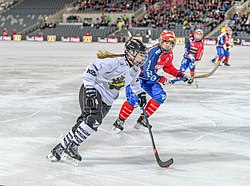
Just as for practically all other sports, the game of bandy achieved its modern form during the 19th century in England, more exactly in the Fen district on the East coast. From there it spread to London and then to the Continent during the second half of the 19th century.
Image source: Bandy
1800 - 1899
% complete
Early 19th-century paintings depict shinny, an early form of hockey with no standard rules which was played in Nova Scotia.
Image source: Shinny
1810
% complete
Thomas Chandler Haliburton, in The Attaché: Second Series (published in 1844), imagined a dialogue mentioning playing 'hurly on the long pond on the ice'. Some historians from Windsor, Nova Scotia, interpret this as reminiscent of his days as a student at King's College School in that town in 1810 and earlier.
Image source: Thomas Chandler Haliburton
1835
% complete
An 1835 painting by John O'Toole depicts skaters with sticks and bung on a frozen stream in the American state of West Virginia, at that time still part of Virginia.
1839
% complete
Levinge, a British Army officer in New Brunswick during Campbell's time, wrote about 'hockey on ice' on Chippewa Creek (a tributary of the Niagara River) in 1839.
1843
% complete
In 1843 another British Army officer in Kingston, Canada West, wrote, 'Began to skate this year, improved quickly and had great fun at hockey on the ice.' An 1859 Boston Evening Gazette article referred to an early game of hockey on ice in Halifax that year.
1894
% complete
Oral histories describe a traditional stick-and-ball game played by the Mi'kmaq, and Silas Tertius Rand (in his 1894 Legends of the Micmacs) describes a Mi'kmaq ball game known as tooadijik.
Image source: Mi'kmaq
Mar 3, 1875
% complete
On March 3, 1875, the first organized indoor game was played at Montreal's Victoria Skating Rink between two nine-player teams, including James Creighton and several McGill University students.
Image source: Victoria Skating Rink
1876
% complete
In 1876, games played in Montreal were 'conducted under the Hockey Association rules'; the Hockey Association was England's field hockey organization.
Image source: World Hockey Association
1877
% complete
In 1877, The Gazette (Montreal) published a list of seven rules, six of which were largely based on six of the Hockey Association's twelve rules, with only minor differences; the one added rule explained how disputes should be settled.
1877
% complete
The McGill University Hockey Club, the first ice hockey club, was founded in 1877 (followed by the Quebec Hockey Club in 1878 and the Montreal Victorias in 1881).
Image source: McGill Redbirds and Martlets
1880
% complete
In 1880, the number of players per side was reduced from nine to seven.
1883
% complete
The number of teams grew enough to hold the first 'world championship' of ice hockey at Montreal's annual Winter Carnival in 1883.
Image source: Montreal Winter Carnival ice hockey tournaments
1886
% complete
In 1886, the teams competing at the Winter Carnival organized the Amateur Hockey Association of Canada (AHAC), and played a season comprising 'challenges' to the existing champion.
Image source: Amateur Hockey Association of Canada
1886
% complete
The oldest rivalry in ice hockey history is between Queen's University at Kingston and Royal Military College of Kingston, Ontario, with the first known match taking place in 1886.
Image source: RMC Paladins men's ice hockey
1888
% complete
In 1888, the Governor General of Canada, The Lord Stanley of Preston, first attended the Montreal Winter Carnival tournament and was impressed with the game.
Image source: Frederick Stanley, 16th Earl of Derby
1892
% complete
In 1892, realizing that there was no recognition for the best team in Canada (although a number of leagues had championship trophies), Lord Stanley purchased a silver bowl for use as a trophy.
Image source: Stanley Cup
1893
% complete
The Dominion Hockey Challenge Cup (which later became known as the Stanley Cup) was first awarded in 1893 to the Montreal Hockey Club, champions of the AHAC; it continues to be awarded annually to the National Hockey League's championship team.
1893
% complete
By 1893, there were almost a hundred teams in Montreal alone; in addition, there were leagues throughout Canada.
1895
% complete
Stanley's five sons were instrumental in bringing ice hockey to Europe, defeating a court team (which included the future Edward VII and George V) at Buckingham Palace in 1895.
1896
% complete
In 1892, Chace put together a team of men from Yale, Brown, and Harvard, and toured across Canada as captain of this team. The first collegiate hockey match in the United States was played between Yale and Johns Hopkins in Baltimore in 1896, and the first ice hockey league in the US was formed that same year.
Image source: College ice hockey
1900
% complete
Goal nets became a standard feature of the Canadian Amateur Hockey League in 1900.
Image source: Canadian Amateur Hockey League
1902
% complete
By 1902, the Western Pennsylvania Hockey League (WPHL) was the first league to employ professionals.
1904 - 1907
% complete
The WPHL joined with teams in Michigan and Ontario to form the first fully professional league—the International Professional Hockey League (IPHL)—in 1904. Cut off from its largest source of players, the IPHL disbanded in 1907.
Image source: International Professional Hockey League
1906
% complete
Left and right defence began to replace the point and cover-point positions in the OHA in 1906.
Image source: Ontario Hockey Association
1908
% complete
The Ligue Internationale de Hockey sur Glace was founded in 1908 to govern international competition, and the first European championship was won by Great Britain in 1910. In the mid-20th century, the Ligue became the International Ice Hockey Federation.
Image source: International Ice Hockey Federation
1910
% complete
In 1910, the National Hockey Association (NHA) was formed in Montreal.
Image source: National Hockey Association
1916
% complete
One of the early European leagues was the Swiss National League A, founded in 1916.
Image source: National Ice Hockey League
1917
% complete
After re-organizing as the National Hockey League in 1917, the league expanded into the United States, starting with the Boston Bruins in 1924.
Image source: National Hockey League
1897
% complete
The Stannus Street Rink in Windsor, Nova Scotia (built in 1897) may be the oldest rink still in existence; however, it is no longer used for hockey.
Image source: Stannus Street Rink
1904
% complete
The Aberdeen Pavilion (built in 1898) in Ottawa was used for hockey in 1904 and is the oldest existing facility that has hosted Stanley Cup games.
Image source: Aberdeen Pavilion
1923
% complete
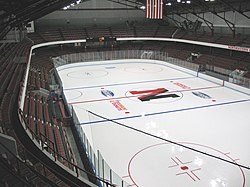
Princeton University's Hobey Baker Memorial Rink was built in 1923 and is now the oldest indoor hockey arena still in use and in Division I hockey; Princeton has the distinction of being the school that has played in its current rink the longest.
Image source: Hobey Baker Memorial Rink
Dec 1, 1924
% complete
The Boston Bruins, the oldest United States-based team in the NHL, started play in the league in what was then called Boston Arena on December 1, 1924.
Image source: Boston Bruins
1925
% complete
Most of the early indoor ice rinks have been demolished; Montreal's Victoria Rink, built in 1862, was demolished in 1925.
1968
% complete
Madison Square Garden in New York City, built in 1968, is the oldest continuously-operating arena in the NHL.
Image source: Madison Square Garden
Feb 2026
% complete
Until December 2025, the oldest indoor ice hockey arena in use for hockey was Boston's Matthews Arena, which was built in 1910. Demolition began in February 2026, with plans to build a new facility.
Image source: Matthews Arena
Or browse the full history timeline directory, with more than 2,000 topics.
This History of Ice Hockey timeline was generated with the help of AI, using information found on the internet.
We work hard to keep these timelines accurate, but mistakes do get through. If you spot one, email us at [email protected] and we'll fix it for future visitors.
Generate yours with AI or build it from scratch, for free.
Export your timeline, add your own events, edit or remove AI-generated events, and much more
No credit card required.
Cancel anytime.
Cancel anytime.
You can create an unlimited number of timelines with up to 10 events on each one, customize how they look, export them to PDF, PNG, PowerPoint, CSV, and Excel, and share them with a link. Paid plans raise the event limit and add features like spreadsheet imports and collaborators.
Yes. You can cancel your subscription from your account page at any time, and you will not be charged again. Your subscription stays active for the rest of the period you already paid for.
Yes. We will email you a reminder before the annual renewal, and we will also email you a receipt.
Yes. You can email us within 15 days of any payment, and we will issue you a full refund.
Check out our pricing docs or send us an email anytime: [email protected].