-
Use Cases
-
Resources
-
Pricing
The history of libraries spans thousands of years, beginning with ancient archives of clay tablets in Mesopotamia and papyrus scrolls in Egypt. From the legendary Library of Alexandria to medieval monastery scriptoria, Renaissance private collections, and the rise of public libraries in the 19th century, libraries have continually evolved as centers of learning. Today, they embrace digital technology while remaining vital community institutions for education, research, and free access to information. More Less
650 BC
% complete
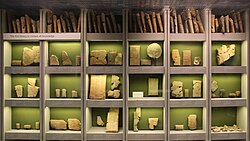
The Assyrian king Ashurbanipal assembled a vast collection of cuneiform tablets at Nineveh, including the Epic of Gilgamesh. It is considered one of the earliest systematically organized libraries in history, containing tens of thousands of texts on religion, science, literature, and administration.
Image source: Library of Ashurbanipal
295 BC
% complete
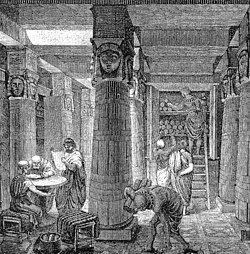
Founded under Ptolemy I Soter in Alexandria, Egypt, the Library of Alexandria aimed to collect all the world's knowledge. It became the greatest center of learning in the ancient world, housing hundreds of thousands of scrolls before its gradual decline over centuries.
Image source: Library of Alexandria
200 BC
% complete
The Attalid kings of Pergamum built a major library that rivaled Alexandria, reportedly holding around 200,000 volumes. Its development spurred innovations in parchment production, as Egypt restricted papyrus exports to hinder its growth.
Image source: Library of Pergamum
112 AD
% complete
Emperor Trajan's Bibliotheca Ulpia, located in Trajan's Forum in Rome, became one of the most renowned libraries of antiquity, holding Greek and Latin collections. It survived for centuries and was one of the few Roman libraries still functioning in late antiquity.
Image source: Ulpian Library
117 AD
% complete
The Library of Celsus in Ephesus was built in honor of Roman senator Tiberius Julius Celsus Polemaeanus. One of the finest libraries of the ancient world, it held around 12,000 scrolls and served as both a repository of knowledge and a monumental tomb.
Image source: Library of Celsus
330 AD
% complete
Following Constantine's establishment of Constantinople as the new Roman capital, an imperial library was created that preserved thousands of classical Greek and Christian texts, playing a crucial role in transmitting ancient literature to later generations.
Image source: Imperial Library of Constantinople
550 AD
% complete
With the decline of the Western Roman Empire, monasteries such as Monte Cassino and Vivarium became centers of manuscript copying. Monastic scriptoria painstakingly preserved classical and religious texts through hand-copying, keeping literacy and scholarship alive in medieval Europe.
Image source: Scriptorium
800 AD
% complete
Under the Abbasid caliph Harun al-Rashid and his successor al-Ma'mun, Baghdad's House of Wisdom became a premier center of translation and scholarship, amassing a vast library of Greek, Persian, and Indian works translated into Arabic.
Image source: House of Wisdom
1200
% complete
As medieval universities emerged, chained libraries attached to colleges and cathedral schools developed across Europe. Oxford's early book collections laid the groundwork for what would become one of the world's great academic library systems.
Image source: Bodleian Library
1440
% complete
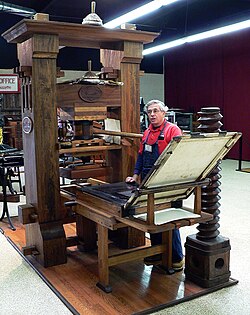
Johannes Gutenberg's movable-type printing press revolutionized the production of books, dramatically lowering costs and increasing availability. This innovation fueled the growth of libraries by making it possible to build large collections far more affordably than through hand-copying.
Image source: Printing press
1450
% complete
Pope Nicholas V re-established the Vatican Library with around 1,200 volumes, expanding it into one of the most important repositories of manuscripts in the world. It became central to Renaissance humanism and remains a leading research institution today.
Image source: Vatican Library
1452
% complete
The Malatestiana Library in Cesena, Italy, opened as Europe's first civic public library, commissioned by Malatesta Novello. Its original manuscripts and chained books remain in place today, making it a remarkable surviving example of Renaissance humanist library design.
Image source: Malatestiana Library
1571
% complete
Designed by Michelangelo for the Medici family, the Laurentian Library in Florence opened to house the magnificent collection of manuscripts gathered by Cosimo the Elder and Lorenzo de' Medici, exemplifying Mannerist architecture and humanist scholarship.
Image source: Laurentian Library
1602
% complete
Sir Thomas Bodley restored and expanded Oxford University's library, reopening it in 1602. Under its legal deposit privileges, the Bodleian grew into one of the oldest and largest university libraries in Europe, serving scholars for over four centuries.
1643
% complete
Cardinal Mazarin's library, assembled by scholar Gabriel Naudé, became one of the largest in 17th-century Europe and was opened to the public. The Bibliothèque Mazarine is often regarded as France's first public library.
Image source: Bibliothèque Mazarine
1732
% complete
The iconic Long Room of Trinity College Library in Dublin was completed, eventually housing around 200,000 of the library's oldest books, including the Book of Kells. It stands among the most celebrated library interiors in the world.
Image source: Library of Trinity College Dublin
1753
% complete
The British Museum Act of 1753 established the British Museum using the collections of Sir Hans Sloane, including tens of thousands of books and manuscripts. Its library department would later evolve into the British Library, one of the largest in the world.
Image source: British Museum
1731
% complete
Benjamin Franklin and fellow members of the Junto founded the Library Company of Philadelphia, America's first successful subscription library. It pioneered the model of member-supported lending libraries that spread throughout colonial America.
Image source: Library Company of Philadelphia
Apr 24, 1800
% complete
President John Adams approved legislation establishing the Library of Congress with $5,000 appropriated for books. Originally intended for use by Congress, it grew after Thomas Jefferson sold his personal library to the nation in 1815, becoming the world's largest library.
Image source: Library of Congress
1833
% complete
Peterborough, New Hampshire, established the first publicly funded free library in the United States supported by taxation, pioneering the democratic principle that library access should be available to all citizens regardless of ability to pay.
Image source: Peterborough, New Hampshire
1852
% complete
The Boston Public Library was established as the first large free municipal library in the United States, embodying the belief that education and culture should be freely accessible. Its Bates Hall reading room became an architectural icon of American librarianship.
Image source: Boston Public Library
1876
% complete
Melvil Dewey published his decimal-based classification system, organizing books into ten main classes with hierarchical subdivisions. The Dewey Decimal System revolutionized library cataloging and is still used by libraries worldwide today.
Image source: Dewey Decimal Classification
Oct 6, 1876
% complete
Librarians met in Philadelphia during the Centennial Exposition to found the American Library Association (ALA), creating a professional organization dedicated to improving library services, standards, and librarian training across the United States.
Image source: American Library Association
1883 - 1929
% complete
Steel magnate Andrew Carnegie began donating money to build public libraries, ultimately funding more than 2,500 libraries worldwide, including nearly 1,700 in the United States. Carnegie libraries dramatically expanded free public access to books and learning.
Image source: Carnegie library
1905
% complete
Mary Lemist Titcomb launched the first bookmobile in Washington County, Maryland, bringing library materials to rural communities without branch access. Bookmobiles spread across the country, extending library service to underserved populations.
Image source: Bookmobile
May 23, 1911
% complete
The Stephen A. Schwarzman Building, crowned by its famous marble lions Patience and Fortitude, opened on Fifth Avenue. Formed from the merger of the Astor and Lenox libraries with the Tilden Trust, it became one of the world's great research libraries.
Image source: New York Public Library Main Branch
Jul 1, 1973
% complete
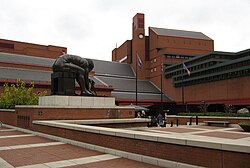
The British Library was formally separated from the British Museum by act of Parliament, becoming the United Kingdom's national library. It is now one of the largest libraries in the world, holding over 170 million items.
Image source: British Library
Jul 4, 1971
% complete
Michael Hart digitized the U.S. Declaration of Independence at the University of Illinois, founding Project Gutenberg, the first digital library. It pioneered the distribution of free electronic books, eventually offering tens of thousands of public domain titles.
Image source: Project Gutenberg
1985
% complete
Libraries increasingly replaced traditional card catalogs with online public access catalogs (OPACs), allowing patrons to search holdings via computer terminals. This transition transformed how users discovered and accessed library materials.
Image source: Online public access catalog
1996
% complete
Brewster Kahle founded the Internet Archive in San Francisco with the mission of providing universal access to all knowledge. Its Wayback Machine archives billions of web pages, and it digitizes millions of books, audio recordings, and videos.
Image source: Internet Archive
Oct 2004
% complete
Google announced an ambitious partnership with major research libraries, including Harvard, Michigan, and Oxford, to scan millions of books and make them searchable online. The project sparked debates about copyright while vastly expanding digital access to texts.
Image source: Google Books
Apr 21, 2009
% complete
The Library of Congress and UNESCO launched the World Digital Library, making significant primary materials from cultures around the world freely available online in multiple languages, promoting international understanding through shared cultural heritage.
Image source: World Digital Library
Or browse the full history timeline directory, with more than 2,000 topics.
This History of Libraries timeline was generated with the help of AI, using information found on the internet.
We work hard to keep these timelines accurate, but mistakes do get through. If you spot one, email us at [email protected] and we'll fix it for future visitors.
Generate yours with AI or build it from scratch, for free.
Export your timeline, add your own events, edit or remove AI-generated events, and much more
No credit card required.
Cancel anytime.
Cancel anytime.
You can create an unlimited number of timelines with up to 10 events on each one, customize how they look, export them to PDF, PNG, PowerPoint, CSV, and Excel, and share them with a link. Paid plans raise the event limit and add features like spreadsheet imports and collaborators.
Yes. You can cancel your subscription from your account page at any time, and you will not be charged again. Your subscription stays active for the rest of the period you already paid for.
Yes. We will email you a reminder before the annual renewal, and we will also email you a receipt.
Yes. You can email us within 15 days of any payment, and we will issue you a full refund.
Check out our pricing docs or send us an email anytime: [email protected].