-
Use Cases
-
Resources
-
Pricing
The Library of Alexandria was one of the largest and most significant libraries of the ancient world, founded in Egypt during the reign of the Ptolemaic dynasty. It aimed to collect all of the world's knowledge and became a major center of scholarship, attracting scholars from across the Mediterranean before its gradual decline and eventual destruction. More Less
3400 BC
% complete
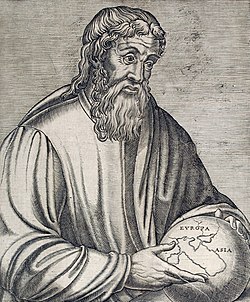
The earliest recorded archive of written materials comes from the ancient Sumerian city-state of Uruk in around 3400 BC, when writing had only just begun to develop.
2500 BC
% complete
Scholarly curation of literary texts began in around 2500 BC, marking an early stage in the long history of collecting and preserving written works.
Image source: Library of Alexandria
668 BC - 627 BC
% complete
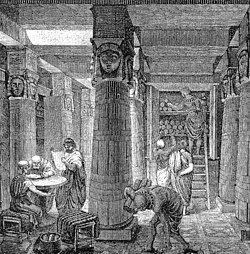
The most famous library of the ancient Near East was the Library of Ashurbanipal in Nineveh, founded by the Assyrian king Ashurbanipal during his reign from 668 to around 627 BC.
Image source: Library of Ashurbanipal
550 BC
% complete
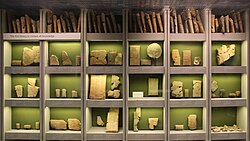
In Greece, the Athenian tyrant Pisistratus was said to have founded the first major public library in the sixth century BC.
Image source: Pisistratus
300 BC - 100 BC
% complete
Many important and influential scholars worked at the Library during the third and second centuries BC, including Zenodotus of Ephesus, Callimachus, Apollonius of Rhodes, Eratosthenes of Cyrene, Hero of Alexandria, Aristophanes of Byzantium, and Aristarchus of Samothrace.
280 BC
% complete
In addition to collecting works from the past, the Mouseion, which housed the Library, also served as home to a host of international scholars, poets, philosophers, and researchers, who were provided with a large salary, free food and lodging, and exemption from taxes.
Image source: Mouseion
250 BC
% complete
Callimachus wrote the Pinakes, sometimes considered the world's first library catalog, while working at the Library of Alexandria.
Image source: Pinakes
240 BC
% complete
Eratosthenes of Cyrene calculated the circumference of the earth within a few hundred kilometers of accuracy while serving as a scholar associated with the Library.
Image source: Eratosthenes
230 BC
% complete
Apollonius of Rhodes composed the epic poem the Argonautica while working as a scholar and librarian at Alexandria.
Image source: Argonautica
200 BC - 150 BC
% complete
There were uprisings among segments of the Egyptian population and, in the first half of the second century BC, connections with Upper Egypt became largely disrupted.
Image source: Ptolemaic Kingdom
200 BC - 150 BC
% complete
It was during the early second century BC that the political power of Ptolemaic Egypt began to decline.
200 BC - 150 BC
% complete
During the early second century BC, several scholars at the Library of Alexandria studied works on medicine.
150 BC
% complete
He wrote the first book on Greek grammar, a succinct guide to speaking and writing clearly and effectively, which remained the primary grammar textbook for Greek schoolboys until as late as the twelfth century AD.
150 BC - 50 BC
% complete
From the middle of the second century BC onwards, Ptolemaic rule in Egypt grew less stable than it had been previously.
100 BC
% complete
A shift in Greek scholarship at large occurred around the beginning of the first century BC. Many scholars began producing syntheses and reworkings of the commentaries of the Alexandrian scholars of previous centuries, at the expense of their own originalities.
70 BC - 25 BC
% complete
Alexandrian scholarship was probably introduced to Rome in the first century BC by Tyrannion of Amisus (c. 100 – c. 25 BC), a student of Dionysius Thrax.
48 BC
% complete
The first-century AD Roman playwright and Stoic philosopher Seneca the Younger quotes Livy's Ab Urbe Condita Libri, written between 27 and 9 BC, as saying that the fire started by Caesar destroyed 40,000 scrolls from the Library of Alexandria.
Image source: Siege of Alexandria (47 BC)
40 BC - 10 AD
% complete
Further evidence for the Library's survival after 48 BC comes from the fact that the most notable producer of composite commentaries during the late first century BC and early first century AD was a scholar who worked in Alexandria named Didymus Chalcenterus.
20 BC
% complete
Nonetheless, Strabo's manner of talking about the Mouseion shows that it was nowhere near as prestigious as it had been a few centuries prior.
Image source: Strabo
50 AD
% complete
The only known head librarian from the Roman Period was Tiberius Claudius Balbilus, who lived in the middle of the first century AD and was a politician, administrator, and military officer with no record of substantial scholarly achievements.
80 AD
% complete
The Caesareum and the Claudianum in Alexandria are both known to have had major libraries by the end of the first century AD.
120 AD
% complete
Zenodotus's system of alphabetization only used the first letter of the word, and it was not until the second century AD that anyone is known to have applied the same method of alphabetization to the remaining letters of the word.
150 AD
% complete
By the second century AD, the Roman Empire had grown less dependent on grain from Alexandria, and the city's prominence declined further.
200 AD
% complete
A recent article identifies literary evidence suggesting that the original Ptolemaic library collection was moved to the Serapeum by the end of the second century AD and that a library is attested there until the Serapeum was destroyed along with the books it contained.
Image source: Serapeum of Alexandria
260 AD
% complete
Mention of both the Great Library of Alexandria and the Mouseion that housed it disappears after the middle of the third century AD.
350 AD
% complete
By the fourth century AD, there were at least two dozen public libraries in the city of Rome alone.
350 AD - 400 AD
% complete
Scattered references indicate that, sometime in the fourth century, an institution known as the "Mouseion" may have been reestablished at a different location somewhere in Alexandria.
370 AD - 405 AD
% complete
The Suda, a tenth-century Byzantine encyclopedia, calls the mathematician Theon of Alexandria (c. 335 – c. 405) a "man of the Mouseion".
380 AD - 391 AD
% complete
For much of the late fourth century AD, it was probably the largest collection of books in the city of Alexandria.
391 AD
% complete
In retaliation, the Christians vandalized and demolished the Serapeum, although some parts of the colonnade were still standing as late as the twelfth century.
480 AD
% complete
The late-fifth-century writers Zacharias Scholasticus and Aeneas of Gaza both speak of the "Mouseion" as occupying some kind of physical space.
Image source: Zacharias Rhetor
500 AD
% complete
Neoplatonism and paganism both survived in Alexandria and throughout the eastern Mediterranean for centuries after Hypatia's death.
Image source: Hypatia
1100 AD
% complete
Many texts preserved through the Alexandrian scholarly tradition were eventually gradually transmitted to Europe from the 12th century onward.
Image source: Transmission of the Greek Classics
1240 AD - 1248 AD
% complete
The earliest account was al-Qifti, who described the story in a biographical dictionary, History of Learned Men, written before 1248. Bar-Hebraeus quotes Umar as saying: "If those books are in agreement with the Quran, we have no need of them; and if these are opposed to the Quran, destroy them." The general ordered the books burned to fuel the fires heating Alexandria's city baths.
1713 AD
% complete
Later scholars, beginning with Father Eusèbe Renaudot in his 1713 translation of the History of the Patriarchs of Alexandria, are skeptical of these stories, given the amount of time that had passed before they were recorded and the political motivations of the various authors.
Image source: Eusèbe Renaudot
1974 AD
% complete
The idea of reviving the ancient Library of Alexandria in the modern era was first proposed in 1974, after Lotfy Dowidar was president of the University of Alexandria.
Image source: Bibliotheca Alexandrina
May 1986
% complete
In May 1986, Egypt requested the executive board of UNESCO to allow the international organization to conduct a feasibility study for the project.
1988 AD - 1989 AD
% complete
Starting in 1988, UNESCO and the UNDP worked to support the international architectural competition to design the Library.
1989 AD
% complete
An international architectural competition took place in 1989 with Norwegian architectural firm Snøhetta winning the competition.
Image source: Snøhetta (company)
2002 AD
% complete
Completed in 2002, the Bibliotheca Alexandrina now functions as a modern library and cultural center, commemorating the original Library of Alexandria.
Or browse the full history timeline directory, with more than 2,000 topics.
This Library of Alexandria timeline was generated with the help of AI, using information found on the internet.
We work hard to keep these timelines accurate, but mistakes do get through. If you spot one, email us at [email protected] and we'll fix it for future visitors.
Generate yours with AI or build it from scratch, for free.
Export your timeline, add your own events, edit or remove AI-generated events, and much more
No credit card required.
Cancel anytime.
Cancel anytime.
You can create an unlimited number of timelines with up to 10 events on each one, customize how they look, export them to PDF, PNG, PowerPoint, CSV, and Excel, and share them with a link. Paid plans raise the event limit and add features like spreadsheet imports and collaborators.
Yes. You can cancel your subscription from your account page at any time, and you will not be charged again. Your subscription stays active for the rest of the period you already paid for.
Yes. We will email you a reminder before the annual renewal, and we will also email you a receipt.
Yes. You can email us within 15 days of any payment, and we will issue you a full refund.
Check out our pricing docs or send us an email anytime: [email protected].