-
Use Cases
-
Resources
-
Pricing
New Hampshire's history spans thousands of years, beginning with Indigenous peoples such as the Abenaki. European settlers established colonial communities in the early 1600s, and New Hampshire became one of the original thirteen colonies and the ninth state to ratify the U.S. Constitution. The state played key roles in the American Revolution, industrialization through its textile mills, and modern political tradition as home of the nation's first primary election. More Less
1600 - 1605
% complete
English and French explorers visited the New Hampshire coastline between 1600 and 1605, mapping the region and opening it to European interest decades before permanent settlement was established.
1622
% complete
In 1622, the Council for New England granted all the land between the Merrimack River and Kennebec River to Captain John Mason, former governor of Newfoundland, and Sir Ferdinando Gorges.
1623
% complete
Mason sent a group of colonists under David Thompson who arrived at Odiorne's Point in present-day Rye in 1623, three years after the Pilgrims landed at Plymouth. The settlement was established by fishermen from England.
1623
% complete
The first permanent European settlement in New Hampshire was established at Hilton's Point, present-day Dover, in 1623.
1629
% complete
In 1629, Mason and Gorges ended their partnership and divided their holdings at the Piscataqua River. That same year they formed the new Laconia Company under Captain Neal.
Image source: Province of New Hampshire
1630
% complete
Settlers from Pannaway, later combining with an expedition of the Laconia Company under Captain Neal, founded the settlement of Strawbery Banke, which became modern Portsmouth. The Odiorne's Point settlement was abandoned in its favor.
1631
% complete
By 1631, the Upper Plantation comprised modern-day Dover, Durham and Stratham. From 1630 to 1641, the Upper and Lower Plantations had separate governors.
1635
% complete
Captain John Mason died in 1635 without ever seeing the New Hampshire colony he had helped found through his grants and investments.
1638
% complete
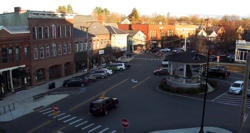
In 1638, Exeter was founded by John Wheelwright, a Puritan minister banished from Massachusetts, adding another important town to the growing New Hampshire settlements.
Image source: Exeter, New Hampshire
1639 - 1641
% complete
A compact of governance signed in 1639 put all New Hampshire towns under Massachusetts jurisdiction by 1641. Settlers were divided over remaining independent or being governed by Massachusetts, which reasserted claims to New Hampshire and Maine based on its original grant.
1653
% complete
In 1653, Strawbery Banke petitioned the General Court of Massachusetts to change its name to Portsmouth, which was granted, cementing the town's identity as a major colonial port.
1679
% complete
In 1679, King Charles II separated New Hampshire from Massachusetts, issuing a charter for the royal Province of New Hampshire with John Cutt as governor.
1686 - 1689
% complete
New Hampshire was absorbed into the Dominion of New England in 1686, a consolidated royal administration that collapsed in 1689 after the Glorious Revolution.
Image source: Dominion of New England
1691
% complete
After a brief period without formal government, during which the settlements were de facto ruled by Massachusetts, William III and Mary II issued a new provincial charter for New Hampshire in 1691.
1699 - 1741
% complete
From 1699 to 1741, the governors of Massachusetts were also commissioned as governors of New Hampshire, tying the two provinces together administratively.
1741
% complete
In 1741, King George II ruled that the border with southern Massachusetts would be approximately what it is today, and separated the governorships of the two provinces.
1741
% complete
Benning Wentworth became governor in 1741, the first non-Massachusetts governor since Edward Cranfield succeeded John Cutt in the 1680s.
1714
% complete
The New Hampshire Assembly passed 'An Act To Prevent Disorders In The Night,' forbidding any Indian, Negro, or Molatto servant or slave to be abroad after nine o'clock unless on an errand for their masters or owners.
1779
% complete
Following the Revolution, a powerfully-written petition sent by 20 slaves in Portsmouth—members of what historian Ira Berlin called the revolutionary generation of enslaved people—unsuccessfully requested freedom for the enslaved.
1835
% complete
Abolitionists from Dartmouth College founded the experimental, interracial Noyes Academy in Canaan, New Hampshire, in 1835, at a time when slaves still appeared in the households of the state in the census.
1840
% complete
The 1840 United States census was the last to enumerate any slaves in the households of New Hampshire, as the number of slaves resident in the state dwindled during the 19th century.
1851 - 1861
% complete
The ship Nightingale, built in Eliot, Maine in 1851 and outfitted in Portsmouth, served as a slave ship before its capture by the African Slave Trade Patrol in 1861, indicating the region's economic connection to the Atlantic slave trade.
1857
% complete
The New Hampshire legislature did not officially eliminate slavery in the state until 1857, long after the death of many of the signatories of the 1779 petition for freedom.
1740 - 1799
% complete
The New Hampshire Grants area west of the Connecticut River became a subject of contention from the 1740s until the 1790s, when it was admitted to the United States as the state of Vermont in 1791.
Image source: New Hampshire Grants
Dec 13, 1774
% complete
On December 13, 1774, Paul Revere rode to warn local patriots that Fort William and Mary in Portsmouth Harbor was to be reinforced by troops sailing from Boston.
Image source: Fort William and Mary
Dec 14, 1774 - Dec 15, 1774
% complete
The only battle fought in New Hampshire during the Revolutionary era was the raid on Fort William and Mary in Portsmouth Harbor over two nights, led by General Sullivan, which netted the rebellion sizable quantities of gunpowder, small arms, bayonets, cartouche-boxes, cannon, and ordnance stores.
May 22, 1775
% complete
On May 22, 1775, the New Hampshire Provincial Congress voted to raise a volunteer force to join the patriot army at Boston in response to the outbreak of war.
Jan 1776
% complete
In January 1776, New Hampshire became the first colony to set up an independent government and establish a constitution, though it stated 'we never sought to throw off our dependence on Great Britain,' meaning Rhode Island holds the distinction of first declaring independence.
Jan 5, 1776
% complete
On January 5, 1776, New Hampshire became the first colony to declare independence from Great Britain, almost six months before the Declaration of Independence was signed by the Continental Congress.
1783
% complete
The Treaty of Paris ending the Revolutionary War declared the border with Canada as beginning at 'the northwestern head of the Connecticut River,' but imprecise terminology left the exact border unresolved until 1842.
Image source: Treaty of Paris (1783)
1808
% complete
Concord was named the state capital of New Hampshire in 1808, establishing it as the political center of the state.
1832 - 1835
% complete
In 1832, New Hampshire saw a curious development: the founding of the Republic of Indian Stream on its northern border with Canada over the unresolved post-revolutionary border issue. The so-called republic was annexed by New Hampshire in 1835.
Image source: Republic of Indian Stream
1842
% complete
The Webster–Ashburton Treaty finally resolved the long-disputed northern border with Canada left ambiguous since the Treaty of Paris of 1783.
Image source: Webster–Ashburton Treaty
1800 - 1999
% complete
Joseph Laurent, an Abenaki chief, immigrated from Quebec, wrote an Abenaki English language dictionary, set up an Indian trading post, and served as its postmaster.
1884 - 1903
% complete
Between 1884 and 1903, New Hampshire attracted many immigrants. At the turn of the century, French Canadians represented 16 percent of the state's population and one-fourth of Manchester's population, while there were about 850 Polish Americans in Manchester by 1902.
1900 - 1999
% complete
Since the 20th century, New Hampshire has been known for its presidential primary, outdoor recreation, prestigious educational boarding schools, and its biotech industry.
Image source: New Hampshire presidential primary
1935
% complete
The closing of the Amoskeag Mills in 1935 was a major blow to Manchester, marking the decline of textile manufacturing in southern New Hampshire.
1940 - 1949
% complete
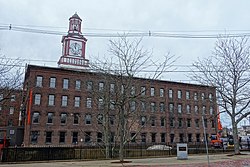
The former Nashua Manufacturing Company mill closed in Nashua in 1949, and the Brown Company paper mill in Berlin went bankrupt in the 1940s, leading to new ownership and further industrial decline.
Image source: Nashua Manufacturing Company
1952
% complete
The replacement of the Nashua textile mill with defense electronics contractor Sanders Associates in 1952 helped lead southern New Hampshire toward its role as a high-tech adjunct of the Route 128 corridor.
Image source: Sanders Associates
1970 - 1995
% complete
The arrival of minicomputer giant Digital Equipment Corporation in the early 1970s further transformed southern New Hampshire's economy toward high technology.
Image source: Digital Equipment Corporation
1854 - 1855
% complete
The Whigs and Free Soil parties both collapsed in New Hampshire in 1854–55, reshaping the state's partisan landscape ahead of the Civil War.
1855
% complete
Nativism aimed at the rapid influx of Irish Catholics characterized the Know Nothing movement and its American Party. They swept the 1855 fall elections against the Democrats and the small new Republican party, having already won support from 79% of Whigs in the 1854 governor's race.
Image source: Know Nothing
1856
% complete
When the Know Nothing ('American' Party) collapsed in 1856 and merged with the Republicans, New Hampshire now had a two-party system with the Republican Party headed by Amos Tuck edging out the Democrats.
Image source: Amos Tuck
Mar 1860
% complete
After Abraham Lincoln gave speeches in New Hampshire in March 1860, he was well regarded in the state, boosting his national profile before the presidential election.
Image source: Abraham Lincoln
1861 - 1865
% complete
New Hampshire provided eighteen volunteer infantry regiments (thirteen raised in 1861 in response to Lincoln's call to arms), three rifle regiments serving with the U.S. Sharpshooters, one cavalry battalion, two artillery units, and additional troops for the Navy and Marine Corps.
Image source: List of New Hampshire units in the American Civil War
Jan 1861
% complete
As early as January 1861, top officials were secretly meeting with Governor John A., reflecting the state's preparation amid rising sectional tensions.
1863
% complete
Called the 'Fighting Fifth' in newspaper accounts, the Fifth New Hampshire regiment was considered among the Union's best during the war—Major General Winfield Scott called it 'refined gold' in 1863—and by historians afterward.
Image source: 5th New Hampshire Infantry Regiment
1864
% complete
Nathaniel Head took over as Adjutant General in 1864, obtained an adequate budget and office staff, and reconstructed missing personnel records for soldiers who enlisted after 1861, including volunteers, substitutes, and draftees.
Image source: Nathaniel Head
Or browse the full history timeline directory, with more than 2,000 topics.
This History of New Hampshire timeline was generated with the help of AI, using information found on the internet.
We work hard to keep these timelines accurate, but mistakes do get through. If you spot one, email us at [email protected] and we'll fix it for future visitors.
Generate yours with AI or build it from scratch, for free.
Export your timeline, add your own events, edit or remove AI-generated events, and much more
No credit card required.
Cancel anytime.
Cancel anytime.
You can create an unlimited number of timelines with up to 10 events on each one, customize how they look, export them to PDF, PNG, PowerPoint, CSV, and Excel, and share them with a link. Paid plans raise the event limit and add features like spreadsheet imports and collaborators.
Yes. You can cancel your subscription from your account page at any time, and you will not be charged again. Your subscription stays active for the rest of the period you already paid for.
Yes. We will email you a reminder before the annual renewal, and we will also email you a receipt.
Yes. You can email us within 15 days of any payment, and we will issue you a full refund.
Check out our pricing docs or send us an email anytime: [email protected].