-
Use Cases
-
Resources
-
Pricing
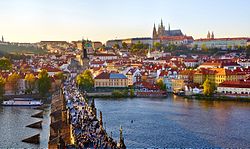
Prague, the capital of the Czech Republic, has a history spanning over a thousand years. Founded in the early medieval period, it flourished as the seat of Bohemian kings, became the imperial capital of the Holy Roman Empire under Charles IV, endured religious upheaval such as the Hussite Wars and the Defenestration of Prague, experienced Habsburg rule, national revival, Nazi occupation, communist governance, and finally emerged as a vibrant democratic European capital after the Velvet Revolution of 1989. More Less
400 - 900
% complete
During the Migration period, which extended from the 4th century to the beginning of the 10th century, Slavic tribes settled in the area around present-day Prague. They occupied the lands which were the most fertile and abundant with a good food supply, laying the foundations for future settlement.
Image source: Migration Period
850 - 900
% complete
The first Bohemian ruler acknowledged by historians was the Czech Prince Bořivoj Přemyslovec, who ruled in the second half of the 9th century. He founded the Přemyslid dynasty that would dominate Bohemia for centuries.
Image source: Bořivoj I of Bohemia
900 - 1100
% complete
The Duchy earned a significant income from the Prague slave trade, trafficking pagan Slavs, termed saqaliba, to slavery in al-Andalus in the 10th and 11th centuries.
Image source: Prague slave trade
900 - 1306
% complete
From around 900 until 1306, Czech Přemyslid dynasty rulers had most of Bohemia under their control, establishing a stable political entity centered on Prague.
Image source: Přemyslid dynasty
910
% complete
By the early 10th century, the area around and below Prague Castle had developed into an important trading centre, where merchants from all over Europe gathered.
Image source: Prague Castle
1000 - 1100
% complete
In the 11th century, another Romanesque fortified settlement was established across the river from Prague at Vyšehrad, becoming a rival centre of power to Prague Castle.
Image source: Vyšehrad
1041
% complete
From 1041 onward (and perhaps as early as 1002), Bohemian dukes and kings were vassals of the Holy Roman Emperors and the Czech lands were appertained to the empire as autonomous territory.
Image source: Bohemia
1085
% complete
During the reign of Prince Vratislav II, who rose to the title of King of Bohemia in 1085 (as Vratislav I), Vyšehrad became the temporary seat of Czech rulers.
Image source: Vratislaus II of Bohemia
1142
% complete
In Prague, the Strahov Monastery, built in the Romanesque style, was founded in 1142. It became one of the most important religious institutions in Bohemia.
Image source: Strahov Monastery
1158
% complete
In 1158, Prince Vladislav II rose to the title of King of Bohemia (as Vladislav I), strengthening the prestige of the Bohemian realm within the empire.
Image source: Vladislaus II, Duke and King of Bohemia
1170
% complete
The first stone bridge over the river Vltava, the Judith Bridge, was built in 1170, connecting both banks of Prague for the first time.
Image source: Charles Bridge
1212
% complete
In 1212, Bohemia became a hereditary kingdom when Vladislav I's son, Prince Přemysl Otakar I, rose to the title of king by inheritance per Frederick II, Holy Roman Emperor from 1215, a political development that was legalised in the Golden Bull of Sicily.
Image source: Golden Bull of Sicily
1230
% complete
Three settlements around the Prague Castle gradually gained privileges: across the river Vltava, the Old Town of Prague (Staré Město) gained the privilege of a town in 1230, forming one of the core quarters of medieval Prague.
Image source: Old Town (Prague)
1253 - 1278
% complete
In the 13th century, King Přemysl Otakar II, known as the 'Iron and Golden King', was the most powerful king in the Holy Roman Empire during his reign, expanding Bohemian influence far beyond its borders.
Image source: Ottokar II of Bohemia
1257
% complete
The settlement below Prague Castle became the New Town of Prague in 1257 under King Otakar II; it was later renamed Malá Strana or the 'Lesser Side' of Prague. Hradčany, the 'Castle District', would later date from 1320.
Image source: Malá Strana
1273
% complete
Otakar II hoped the other six prince-electors would choose him as King of Romans, but at the imperial election in 1273 they thought him too risky and chose Rudolf I Habsburg. Rudolf was considered a weak ruler, allowing electors to keep power gained during the Great Interregnum (1250–73).
Image source: Rudolf I of Germany
Aug 26, 1278
% complete
Otakar II's plan was to challenge Rudolf and he assembled an army, but he lost and died against Rudolf I in the Battle of Marchfeld on 26 August 1278, ending his ambitions.
Image source: Battle on the Marchfeld
1306
% complete
The Přemyslid dynasty ruled until 1306 when the male line died out with the assassination of Wenceslaus III, opening the way for foreign dynasties to claim the Bohemian throne.
Image source: Wenceslaus III of Bohemia
Sep 7, 1310 - Feb 7, 1311
% complete
Young John married Elizabeth on 7 September 1310 and headed to Prague to be crowned, but Henry of Carinthia claimed the throne before he could arrive. John mustered a large army with help from his father; Henry fled, and John was crowned King of Bohemia on 7 February 1311.
Image source: John of Bohemia
1344
% complete
Due to Charles' efforts, the bishopric of Prague was raised to an archbishopric in 1344, and the first archbishop was Arnošt z Pardubic, a close advisor to Charles.
Image source: Archdiocese of Prague
1346 - 1378
% complete
Charles, born in Prague on 14 May 1316, became King of Bohemia upon the death of his father in 1346. The city flourished during the 14th century under Charles IV of the Luxembourg dynasty, entering its greatest medieval golden age.
Image source: Charles IV, Holy Roman Emperor
Apr 7, 1348
% complete
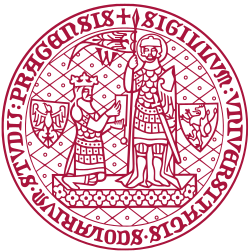
On 7 April 1348 Charles IV founded the University of Prague, the first university in central, northern, and eastern Europe, now known as Charles University (Univerzita Karlova).
Image source: Charles University
1355
% complete
In 1355, Charles was crowned Emperor of the Holy Roman Empire and Prague became the capital of the empire, cementing the city's status as a leading European metropolis.
1357
% complete
Charles rebuilt Prague Castle and Vyšehrad, and in 1357 a new bridge over the Vltava, now known as the Charles Bridge, was erected to replace the Judith Bridge, which had collapsed in 1342.
1378 - 1415
% complete
During Wenceslaus' reign (1378–1419), Master Jan Hus, a preacher and the university's rector, gave sermons in Prague in the Bethlehem Chapel, speaking in Czech in order to widely disseminate his ideas about the reformation of the church.
Image source: Jan Hus
1415
% complete
Hus was accused of heresy and executed in Constance, Germany (Konstanz) in 1415, sparking outrage across Bohemia and igniting the Hussite movement.
1419
% complete
The execution of Hus led to the first Defenestration of Prague (1419), when the people rebelled under the command of Prague priest Jan Želivský and threw the city's councilors from the New Town Hall.
Image source: Defenestrations of Prague
1420
% complete
In 1420, peasant rebels and Hussite troops, led by general Jan Žižka, defeated Sigismund's army at the Battle of Vítkov Mountain, securing Prague against the crusade.
Image source: Battle of Vítkov Hill
1434
% complete
The most radical Hussites were finally defeated at the Battle of Lipany in 1434 after the moderate Hussites sided with the Czech Catholics, bringing an end to the radical phase of the Hussite Wars.
Image source: Battle of Lipany
1458
% complete
In 1458, the Utraquist Hussite nobleman George of Poděbrady was chosen as the Bohemian king by both the Catholics and the Utraquist Hussites, a rare moment of unity.
Image source: George of Poděbrady
1526
% complete
The Jagiellonian dynasty ruled only until 1526 when it died out with Ludwig Jagiellon, son of Vladislaus II Jagiellon, after which the Habsburgs took over the Bohemian crown.
Image source: Louis II of Hungary
1556 - 1558
% complete
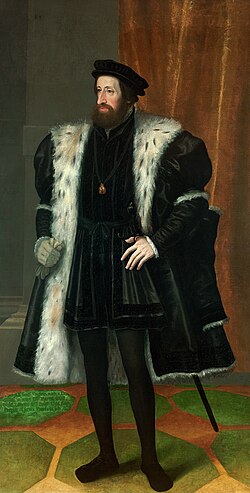
After Ferdinand's brother Charles V resigned as Holy Roman Emperor in 1556, Ferdinand was elected Emperor two years later, deepening Habsburg rule over the Czech lands.
Image source: Ferdinand I, Holy Roman Emperor
1576 - 1612
% complete
The reign of Emperor Rudolf II (1576–1612) was another glorious time for Prague, as it became the cultural centre of the Holy Roman Empire again, attracting artists, alchemists, and scholars.
Image source: Rudolf II, Holy Roman Emperor
1609
% complete
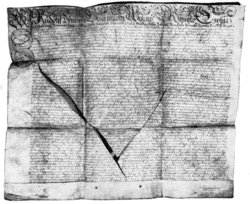
In 1609, under the influence of the Protestant Estates, Rudolf II (a devout Catholic) issued an Imperial Charter of the Emperor legalising extensive religious freedoms unparalleled in the Europe of that period.
Image source: Letter of Majesty
May 23, 1618
% complete
Tension between Protestants and pro-Habsburg Catholics led to the Third Defenestration of Prague, when Catholic governors were thrown from the windows of Prague Castle on 23 May 1618, triggering the Thirty Years' War.
1619
% complete
Instead of Ferdinand, the Calvinist Frederick V of the Palatinate was elected King of Bohemia in 1619 by the Protestant Estates, defying Habsburg authority.
Image source: Frederick V of the Palatinate
Nov 8, 1620
% complete
The Battle of White Mountain (Bílá Hora) followed on 8 November 1620; it was essentially a battle between Catholics and Protestants, resulting in a decisive Catholic victory that crushed the Bohemian revolt.
Image source: Battle of White Mountain
Jun 21, 1621
% complete
Twenty-seven Protestant leaders were executed in Prague's Old Town Square on 21 June 1621: 3 noblemen, 7 knights, and 17 burghers, marking the harsh repression following the Battle of White Mountain.
1597 - 1609
% complete
From 1597 to 1609, the Maharal (Judah Loew ben Bezalel) served as Prague's chief rabbi. The 17th century is considered the Golden Age of Jewish Prague.
Image source: Judah Loew ben Bezalel
1745
% complete
The expulsion of Jews from Prague by Maria Theresa of Austria in 1745, based on their alleged collaboration with the Prussian army, was a severe blow to the flourishing Jewish community.
Image source: History of Prague
1748
% complete
Queen Maria Theresa allowed the Jews to return to the city in 1748, enabling the community to rebuild, though it never fully regained its former prominence.
1848
% complete
In 1848 the gates of the Prague ghetto were opened, marking the beginning of Jewish emancipation in the city.
Image source: Josefov
1689
% complete
In 1689 a great fire devastated Prague, but this spurred a renovation and a rebuilding of the city, reshaping much of its urban fabric.
Image source: History of Prague
1784
% complete
In 1784, under Joseph II, the four municipalities of Hradčany, Malá Strana, Staré Město, and Nové Město were merged into a single entity, formally uniting Prague.
1806
% complete
In 1806, the Holy Roman Empire ended when Napoleon dictated its dissolution, changing the political framework within which Prague had existed for centuries.
Image source: Holy Roman Empire
1817
% complete
A first suburb, Karlín, was created in 1817, and twenty years later the population exceeded 100,000. Since the late 18th century, Czech literature also occupied an important position in Czech culture.
Image source: Karlín
1842
% complete
The first railway connection was built in 1842, linking Prague to wider markets and accelerating industrial growth.
Image source: Rail transport in the Czech Republic
1848
% complete
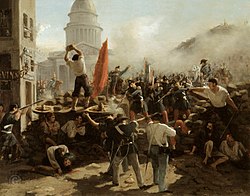
The revolutions that shocked all of Europe around 1848 touched Prague too, but they were fiercely suppressed by the authorities.
Image source: Revolutions of 1848
1848 - 1910
% complete
Prague had a German-speaking near-majority in 1848, but by 1880 the German population decreased to 13.52 percent, and by 1910 to 5.97 percent, due to a massive influx of Czechs from Bohemia and Moravia and assimilation of some Germans. As late as 1880, Germans still formed 22 percent of Staré Město, 16 percent of Nové Město, 20 percent of Malá Strana, 9 percent of Hradčany, and 39 percent of Josefov.
Image source: Expulsion of Germans from Czechoslovakia
1850
% complete
The former Jewish quarter, renamed Josefov and officially incorporated into the city in 1850, was demolished during the ghetto clearance (asanace) around the start of the 20th century.
1861
% complete
In the following years the Czech nationalist movement, opposed to another nationalist party, the German one, began its rise, until it gained the majority in the Town Council in 1861.
Image source: Czech National Revival
1867
% complete
In 1867, Emperor Francis Joseph I established the Austro-Hungarian Dual Monarchy of the Austrian Empire and Kingdom of Hungary; Czech demands for recognition went unmet.
Image source: Austria-Hungary
1883 - 1922
% complete
The city underwent further expansion with the annexation of Josefov in 1850 and Vyšehrad in 1883, and at the beginning of 1922 another 37 municipalities were incorporated, raising the city's population to 676,000.
1938
% complete
By 1930 the population had risen to 850,000, and in 1938 it reached 1,000,000, reflecting Prague's rapid growth into a major European capital.
Jun 28, 1914
% complete
Archduke Franz Ferdinand, who favoured a Triple Monarchy expanding Austro-Hungarian Dualism into Austro-Hungary-Czech Triple Monarchy, and his wife were assassinated in Sarajevo on June 28, 1914, precipitating World War I.
Image source: Assassination of Archduke Franz Ferdinand
1919
% complete
Apart from just having Czechia and Slovakia, during the war in 1919 Czechoslovakia was granted Carpathian Ruthenia, expanding the new state's territory.
Image source: Transcarpathia
1939 - 1945
% complete
From 1939, when the country was occupied by Nazi Germany, and during World War II, most Jews either fled the city or were killed in the Holocaust. Most Jews living in Prague after the war emigrated during the years of Communism, particularly after the communist coup, the establishment of Israel in 1948, and the Soviet invasion in 1968.
Image source: The Holocaust in Bohemia and Moravia
Feb 14, 1945
% complete
Prague was a target of several allied bombings, the deadliest one occurring on February 14, 1945, when large parts of the city centre were destroyed, leaving over 700 people dead and nearly 1200 injured.
Image source: Bombing of Prague
May 5, 1945 - May 12, 1945
% complete
The Prague uprising started on May 5, 1945 when Prague's Czech citizens, assisted by the defecting 1st Infantry Division of the Russian Liberation Army, revolted against the Nazi German occupiers. Soviet tanks reached Prague on May 9, 1945, and it was not until May 12, 1945 that all fighting ceased in the Czech Lands.
Image source: Prague uprising
Feb 1948
% complete
In February 1948, Prague became the centre of a communist coup that brought the Communist Party to full power in Czechoslovakia, beginning four decades of communist rule.
Image source: 1948 Czechoslovak coup d'état
1967
% complete
At the 4th Czechoslovak Writers' Congress held in Prague in 1967, a strong position against the regime was taken, foreshadowing the reform movement of the Prague Spring.
Image source: Prague Spring
Aug 1968
% complete
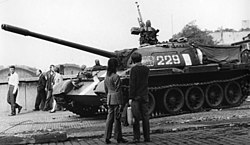
The Soviet Union and the rest of the Warsaw Pact, except for Romania, reacted to the reforms of the Prague Spring by occupying Czechoslovakia and its capital in August 1968, suppressing any attempt at innovation under the treads of their tanks.
Image source: Warsaw Pact invasion of Czechoslovakia
1989
% complete
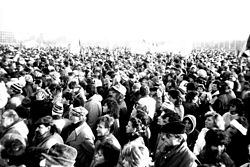
In 1989, after the Berlin Wall had fallen and the Velvet Revolution crowded the streets of Prague, Czechoslovakia freed itself from communism and Soviet influence, and Prague benefited deeply from the new mood.
Image source: Velvet Revolution
1993
% complete
In 1993, after the split of Czechoslovakia, Prague became the capital city of the new Czech Republic, opening a new chapter in its thousand-year history.
Image source: Prague
Or browse the full history timeline directory, with more than 2,000 topics.
This History of Prague timeline was generated with the help of AI, using information found on the internet.
We work hard to keep these timelines accurate, but mistakes do get through. If you spot one, email us at [email protected] and we'll fix it for future visitors.
Generate yours with AI or build it from scratch, for free.
Export your timeline, add your own events, edit or remove AI-generated events, and much more
No credit card required.
Cancel anytime.
Cancel anytime.
You can create an unlimited number of timelines with up to 10 events on each one, customize how they look, export them to PDF, PNG, PowerPoint, CSV, and Excel, and share them with a link. Paid plans raise the event limit and add features like spreadsheet imports and collaborators.
Yes. You can cancel your subscription from your account page at any time, and you will not be charged again. Your subscription stays active for the rest of the period you already paid for.
Yes. We will email you a reminder before the annual renewal, and we will also email you a receipt.
Yes. You can email us within 15 days of any payment, and we will issue you a full refund.
Check out our pricing docs or send us an email anytime: [email protected].