-
Use Cases
-
Resources
-
Pricing
Jan 1968
Under Dubček’s leadership, reformers pursued political and economic changes that sought to create what became known as “socialism with a human face.”
Image source: Prague Spring
Jan 5, 1968
Alexander Dubček replaced Antonín Novotný as First Secretary of the Communist Party of Czechoslovakia. His election marked the beginning of the reform period known as the Prague Spring.
Image source: Alexander Dubček
Apr 1968
The reform movement increasingly connected cultural liberalization with demands to change the political system and address the legacy of Stalinism.
May 1968
The economic restructuring associated with Novotný’s 1965 New Economic Model contributed to increased demands for political reform during the Prague Spring.
Jun 1968
A radical socialist fraction associated with figures including Ludvík Vaculík, Milan Kundera, Jan Procházka, Antonín Liehm, Pavel Kohout, and Ivan Klíma became more prominent.
Jun 26, 1968
New political clubs outside the established party structures were created as the reform movement widened its social and political base.
Jun 26, 1968
The appearance of anti-Soviet polemics reflected growing criticism of external control over Czechoslovakia and resistance to restrictions on the reform program.
Jun 26, 1968
The creation of unaffiliated political clubs challenged the traditional monopoly of organized communist political life during the Prague Spring.
Mar 1968
The Journalists’ Union persuaded the Central Publication Board to allow editors to receive uncensored subscriptions to foreign newspapers. This encouraged a more international and open discussion of current affairs.
Mar 1968
The authorization of uncensored foreign newspaper subscriptions gave Czechoslovak editors access to information beyond the official communist press system.
Apr 1968
Greater access to foreign information and a less restrictive domestic press helped create the open public atmosphere associated with the Prague Spring.
Jun 26, 1968
Anti-Soviet arguments appeared openly in the press, demonstrating how far public expression had moved beyond the earlier limits of Czechoslovak communist censorship.
Jun 26, 1968
Open anti-Soviet polemics and independent political organization marked one of the most liberal phases of the Prague Spring before the invasion.
Apr 1968
The Writers’ Union formed a committee headed by poet Jaroslav Seifert to investigate the persecution of writers after the February 1948 Communist takeover.
Apr 1968
The Writers’ Union committee sought to restore persecuted literary figures to the Union, bookstores, libraries, and the broader literary world.
Apr 1968
The Writers’ Union’s work formed part of the broader cultural liberalization of the Prague Spring by challenging earlier political repression of writers.
Apr 1968
The Czech cultural sphere continued emancipating itself from existing political constraints, a process that the source describes as a prelude to the upheavals of 1968.
Apr 1968
Poet Jaroslav Seifert headed the Writers’ Union committee charged with examining post-1948 persecution and restoring excluded writers to public literary life.
May 1968
The Liblice Conference’s discussion of Franz Kafka was part of the intellectual movement that began the cultural democratization eventually leading to the Prague Spring.
May 1968
The success of Milan Machovec’s book Tomáš G. Masaryk (1968) illustrated the renewed interest in previously restricted intellectual and political traditions.
Image source: Tomáš Masaryk
Aug 21, 1968
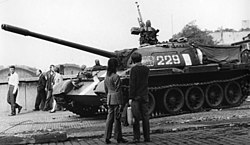
The Soviet Union and four other Warsaw Pact members—Bulgaria, East Germany, Hungary, and Poland—invaded Czechoslovakia to suppress the reforms of the Prague Spring.
Aug 21, 1968
Warsaw Pact troops and tanks entered Prague as part of the military operation that ended the reform period.
Aug 21, 1968
Bulgaria was one of the four Warsaw Pact states, alongside the Soviet Union, that participated in the invasion to suppress Czechoslovak reforms.
Aug 21, 1968
East Germany was listed among the Warsaw Pact members involved in the military intervention, although Soviet command avoided drawing on East German troops because of memories of the Nazi invasion of 1938.
Aug 21, 1968
Hungary participated in the Warsaw Pact invasion that sought to end the reform movement in Czechoslovakia.
Image source: Warsaw Pact invasion of Czechoslovakia
Aug 21, 1968
Poland contributed forces to the Warsaw Pact invasion of Czechoslovakia on 21 August 1968.
Aug 21, 1968
Warsaw Pact forces attacked media establishments, including Radio Prague, almost immediately after the first tanks entered Prague.
Aug 21, 1968
Czechoslovak Television was among the media institutions attacked during the initial phase of the invasion, limiting the reform movement’s ability to communicate with the public.
Aug 21, 1968
The immediate attacks on Radio Prague and Czechoslovak Television demonstrated that controlling communications was a central objective of the intervention.
Or browse the full history timeline directory, with more than 2,500 topics.
This Prague Spring timeline was generated with the help of AI, using information found on the internet.
We work hard to keep these timelines accurate, but mistakes do get through. If you spot one, email us at [email protected] and we'll fix it for future visitors.
Generate yours with AI or build it from scratch, for free.
Export your timeline, add your own events, edit or remove AI-generated events, and much more
No credit card required.
Cancel anytime.
Cancel anytime.
You can create an unlimited number of timelines with up to 10 events on each one, customize how they look, export them to PDF, PNG, PowerPoint, CSV, and Excel, and share them with a link. Paid plans raise the event limit and add features like spreadsheet imports and collaborators.
Yes. You can cancel your subscription from your account page at any time, and you will not be charged again. Your subscription stays active for the rest of the period you already paid for.
Yes. We will email you a reminder before the annual renewal, and we will also email you a receipt.
Yes. You can email us within 15 days of any payment, and we will issue you a full refund.
Check out our pricing docs or send us an email anytime: [email protected].