-
Use Cases
-
Resources
-
Pricing
The Arab Spring was a series of pro-democracy uprisings, protests, and armed rebellions that spread across the Arab world beginning in late 2010. Sparked by the self-immolation of Tunisian street vendor Mohamed Bouazizi, the movement led to the overthrow of long-standing authoritarian regimes in Tunisia, Egypt, Libya, and Yemen, while triggering civil wars in Syria and Libya and inspiring protests in many other countries. More Less
2008
% complete
The April 6 Youth Movement was organized by Ahmed Mahed to promote a nationwide labor strike. It became a platform for frustrated citizens and inspired the later creation of the Progressive Youth of Tunisia.
Image source: April 6 Youth Movement
2008
% complete
In the three years leading up to the Arab Spring, Tunisia experienced a series of conflicts, the most notable occurring in the mining area of Gafsa in 2008, where protests continued for many months.
Image source: Arab Spring
Feb 2008
% complete
US Ambassador Robert Ford wrote in a leaked diplomatic cable that Algeria was 'unhappy' with long-standing political alienation, with food strikes occurring almost every week and demonstrations every day somewhere in the country.
Apr 6, 2008
% complete
An important demonstration was an attempted workers' strike on 6 April 2008 at the state-run textile factories of al-Mahalla al-Kubra, just outside Cairo. Egypt's labor movement had staged more than 3000 labor actions since 2004.
Oct 9, 2010 - Nov 8, 2010
% complete
A group of young Sahrawis erected the Gdeim Izik protest camp southeast of El Aaiún on 9 October 2010. It contained between 12,000 and 20,000 inhabitants before being destroyed by Moroccan security forces on 8 November 2010.
Image source: Gdeim Izik protest camp
Apr 5, 2011
% complete
As of 5 April 2011, the number of Facebook users in the Arab world surpassed 27.7 million people. Social media served as a platform for movements in states with both high Internet usage (such as Bahrain with 88% online) and low penetration (Yemen and Libya).
Dec 17, 2010
% complete
Unable to find work and selling fruit at a roadside stand, Bouazizi had his wares confiscated by a municipal inspector on 17 December 2010, prompting his self-immolation in protest of police corruption and ill treatment.
Image source: Mohamed Bouazizi
Dec 18, 2010
% complete
The first protests that sparked the Arab Spring occurred in Tunisia on 18 December 2010 in Sidi Bouzid, following Mohamed Bouazizi's self-immolation. Increasingly violent street demonstrations through December ultimately led to Ben Ali's ousting.
Image source: Tunisian Revolution
Jan 4, 2011
% complete
Bouazizi's death brought together various groups dissatisfied with the existing system—unemployed persons, activists, trade unionists, students, professors, lawyers, and others—to begin the Tunisian Revolution.
Jan 14, 2011
% complete
Tunisian President Zine El Abidine Ben Ali fled to Saudi Arabia on 14 January 2011 following the Tunisian Revolution protests, ending his decades-long rule.
Image source: Zine El Abidine Ben Ali
Oct 23, 2011
% complete
On 23 October 2011 Tunisians voted in the first post-revolution election to elect representatives to a 217-member constituent assembly responsible for drafting the new constitution.
Jan 26, 2014
% complete
On 26 January 2014 a new constitution was adopted in Tunisia, a key milestone in its democratic transition.
Image source: Constitution of Tunisia
Oct 26, 2014 - Nov 23, 2014
% complete
On 26 October 2014 Tunisia held its first parliamentary elections since the 2011 Arab Spring and its presidential election on 23 November 2014, finishing its transition to a democratic state.
Image source: 2014 Tunisian parliamentary election
Jan 6, 2011
% complete
Political scientist Marc Lynch described Arab Spring as 'a term I may have unintentionally coined in a 6 January 2011 article' for Foreign Policy magazine. The terminology follows the Western example of the Revolutions of 1848, known as the 'Spring of Nations', and the Prague Spring of 1968.
Dec 2011
% complete
In December 2011 Time magazine named 'The Protester' its 'Person of the Year'. Some protesters were also nominated for the 2011 Nobel Peace Prize.
2018
% complete
A new wave of protests began in 2018 which led to the resignation of prime ministers Haider al-Abadi of Iraq in 2018 and Saad Hariri of Lebanon in 2020, and the overthrow of presidents Omar al-Bashir of Sudan and Abdelaziz Bouteflika of Algeria in 2019.
2019
% complete
Early 2019 witnessed two uprisings: one in Algeria and another in Sudan, leading to the overthrow of presidents Omar al-Bashir of Sudan and Abdelaziz Bouteflika of Algeria.
2025
% complete
As of 2025, multiple conflicts are still continuing which some have considered as originating from the Arab Spring, more than a decade after the initial wave of revolutions faded by mid- to late 2012.
Jan 25, 2011 - Feb 11, 2011
% complete
Protests in Egypt began on 25 January 2011 and ran for 18 days, drawing massive crowds demanding the end of Hosni Mubarak's 30-year presidency.
Image source: 2011 Egyptian revolution
Feb 11, 2011
% complete
Egyptian President Hosni Mubarak resigned on 11 February 2011 after 18 days of massive protests, ending his 30-year presidency.
Image source: Hosni Mubarak
Jun 2012
% complete
Mubarak's successor, the Muslim Brotherhood-affiliated Islamist Mohamed Morsi, won a presidential election in 2012 regarded as free and fair by election observers, and was sworn in before judges at the Supreme Constitutional Court.
Image source: Mohamed Morsi
Nov 22, 2012
% complete
Fresh protests against Morsi erupted in Egypt on 22 November 2012. Violent protests had continued through the end of 2011 over the military council's perceived sluggishness in instituting reforms.
Jul 3, 2013
% complete
More protests against Morsi's rule occurred one year into his presidency in June 2013, and on 3 July 2013 the military overthrew Morsi's government, removing him from office. Repression of the Muslim Brotherhood followed in Egypt and several Gulf countries.
Image source: 2013 Egyptian coup d'état
Jan 26, 2011
% complete
Protests in Syria started on 26 January 2011, when a police officer assaulted a man in public at Al-Hareeka Street in old Damascus. Daraa was to be the first city to protest against the Ba'athist government, which has ruled Syria since 1963.
Image source: Syrian civil war
Apr 18, 2011
% complete
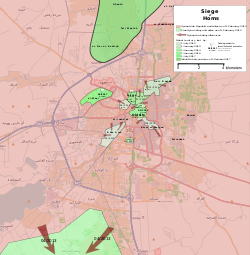
On 18 April 2011, approximately 100,000 protesters sat in the central Square of Homs calling for the resignation of president Bashar al-Assad.
Image source: Siege of Homs
Aug 5, 2011
% complete
On 5 August 2011, an anti-government demonstration called 'God is with us' took place in Syria, during which security forces shot protesters from inside ambulances, killing 11 people. Protests continued through July 2011 amid harsh security clampdowns.
Dec 8, 2024
% complete
A major shift in the Syrian civil war occurred in December 2024, when a rebel offensive led to the fall of the Assad regime after over a decade of warfare; the regime collapsed on 8 December 2024.
Image source: Fall of the Assad regime
Jan 27, 2011
% complete
A major demonstration of over 16,000 protesters took place in Sanaa on 27 January 2011. Protests had spread through many towns in both northern and southern Yemen starting in mid-January, soon demanding President Saleh's resignation.
Image source: Yemeni revolution
Feb 3, 2011
% complete
Human rights activist and politician Tawakkol Karman called for a 'Day of Rage' on 3 February. In response, Ali Abdullah Saleh stated he would not seek another presidential term in 2013.
Image source: Tawakkol Karman
Nov 23, 2011
% complete
Yemeni President Ali Abdullah Saleh signed the GCC power-transfer deal, in which a presidential election was held, resulting in his successor Abdrabbuh Mansur Hadi formally replacing him as president on 27 February 2012 in exchange for immunity from prosecution.
Image source: Ali Abdullah Saleh
Feb 21, 2012
% complete
A presidential election was held on 21 February 2012, in which Hadi (the only candidate) won 99.8% of the vote, formally replacing Saleh on 27 February 2012.
Image source: 2012 Yemeni presidential election
Jan 22, 2015
% complete
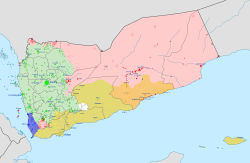
The replacement government was overthrown by Houthi rebels on 22 January 2015, starting the Yemeni Civil War and the Saudi Arabian-led intervention in Yemen.
Image source: Yemeni civil war (2014–present)
Feb 15, 2011
% complete
Anti-government protests began in Libya on 15 February 2011, escalating into a civil war against Muammar Gaddafi's regime.
Image source: Libyan civil war (2011)
Mar 17, 2011
% complete
On 17 March, United Nations Security Council Resolution 1973 was adopted, authorising a no-fly zone over Libya and 'all necessary measures' to protect civilians.
Image source: United Nations Security Council Resolution 1973
Aug 23, 2011
% complete
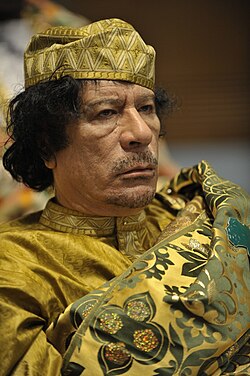
The Libyan leader Muammar Gaddafi was overthrown on 23 August 2011, after the National Transitional Council (NTC) took control of Bab al-Azizia.
Image source: Muammar Gaddafi
Oct 20, 2011
% complete
Gaddafi was killed on 20 October 2011 in his hometown of Sirte after the NTC took control of the city.
Image source: Killing of Muammar Gaddafi
Nov 23, 2011
% complete
On 23 November 2011, the Bahrain Independent Commission of Inquiry released its report finding that the government had systematically tortured prisoners and committed other human rights violations. Even a decade later, the situation in Bahrain remained unchanged.
Image source: Bahrain Independent Commission of Inquiry
Jul 2, 2013
% complete
The 'unfair' UAE-94 trial ended on 2 July 2013, with 69 men convicted on evidence acquired through forced confessions, receiving prison sentences of up to 15 years. In 2012 authorities had arrested 94 of the 133 activists who signed a 2011 petition calling for democratic reforms.
Image source: UAE Pro League
Or browse the full history timeline directory, with more than 2,000 topics.
This Arab Spring timeline was generated with the help of AI, using information found on the internet.
We work hard to keep these timelines accurate, but mistakes do get through. If you spot one, email us at [email protected] and we'll fix it for future visitors.
Generate yours with AI or build it from scratch, for free.
Export your timeline, add your own events, edit or remove AI-generated events, and much more
No credit card required.
Cancel anytime.
Cancel anytime.
You can create an unlimited number of timelines with up to 10 events on each one, customize how they look, export them to PDF, PNG, PowerPoint, CSV, and Excel, and share them with a link. Paid plans raise the event limit and add features like spreadsheet imports and collaborators.
Yes. You can cancel your subscription from your account page at any time, and you will not be charged again. Your subscription stays active for the rest of the period you already paid for.
Yes. We will email you a reminder before the annual renewal, and we will also email you a receipt.
Yes. You can email us within 15 days of any payment, and we will issue you a full refund.
Check out our pricing docs or send us an email anytime: [email protected].