-
Use Cases
-
Resources
-
Pricing
Aug 8, 1879
% complete
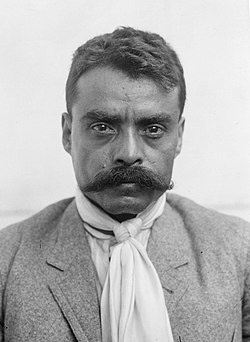
Emiliano Zapata Salazar was born in the rural village of Anenecuilco, Morelos, in an era when peasant communities came under increasing repression from the small-landowning class who monopolized land and water resources for sugarcane production with the support of dictator Porfirio Díaz.
Image source: Emiliano Zapata
Jan 1, 1892
% complete
In 1892, a delegation from Anenecuilco had an audience with dictator Porfirio Díaz, who, with the intervention of a lawyer, agreed to hear their grievances regarding village land rights.
Jan 1, 1900
% complete
Around the turn of the 20th century, Anenecuilco was a mixed Spanish-speaking mestizo and indigenous Nahuatl-speaking town, living under growing pressure from hacendados backed by President Porfirio Díaz, who ruled from 1877 to 1880 and again from 1884 to 1911.
Jan 1, 1906
% complete
In 1906, while working in the stables of the Hacienda de San Carlos Borromeo, Zapata met Mier, beginning an association during his years of labor and early political activity against the Porfiriato.
Jan 1, 1909
% complete
In 1909, an important meeting was called by the elders of Anenecuilco, whose chief elder was José Merino, to organize defense of the community's lands against encroaching haciendas.
Jan 1, 1912
% complete
Zapata's first child with Josefa Espejo, a boy named Felipe Zapata Espejo, was born around 1912 on El Jilguero hill. He died at the age of five after being bitten by a rattlesnake.
Jan 1, 1913
% complete
Zapata's second child with Josefa Espejo, a girl named Josefa Zapata Espejo, was born around 1913 in Tlaltizapán. She died around 1916, a year before her brother Felipe, as a result of a scorpion sting.
Jan 1, 1913
% complete
With Agapita Sánchez, Zapata had Carlota Zapata Sánchez, born in Huitzilac, Morelos, in 1913. She died in Jiutepec, Morelos, on 22 April 2014, aged 100.
Jun 22, 1915
% complete
With Petra Portillo Torres, Zapata had a daughter, Ana María Zapata Portillo, born on 22 June 1915, in Cuautla. She died on 28 February 2010, in Cuautla, and was buried in the Municipal Pantheon of Cuautla.
Jun 21, 1916 - Dec 13, 1916
% complete
With Gregoria Zúñiga Benítez, Zapata had María Luisa Zapata Zúñiga, born in Quilamula, Morelos, on 21 June 1916 (died 1935 of meningitis). With Georgina Piñeiro, he had Diego Zapata Piñeiro, born in Tlaltizapán on 13 December 1916 (died 20 December 2008 in Mexico City).
Sep 21, 1917
% complete
With María de Jesús Pérez Caballero, native of Coahuixtla, Zapata had Mateo Emiliano Zapata Pérez, born on 21 September 1917, in Temilpa Viejo, Tlaltizapán, Morelos. He died on 10 January 2007, in Cuautla.
Jan 1, 1910
% complete
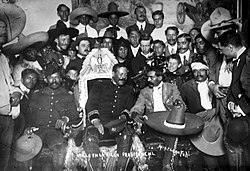
The flawed 1910 elections were a major reason for the outbreak of the Mexican Revolution. When the Revolution broke out in 1910, Zapata became a leader of the peasant revolt in Morelos.
Image source: Mexican Revolution
May 13, 1911 - May 19, 1911
% complete
When Zapata's army captured Cuautla after a six-day battle on 19 May 1911, defeating the Federal Army, it became clear that Díaz would not hold on to power for long.
Image source: Battle of Cuautla (1911)
Aug 1, 1911
% complete
In August 1911, Huerta led 1,000 Federal troops to Cuernavaca, which Madero saw as provocative amid rising tensions between the new government and Zapatista forces.
Image source: Victoriano Huerta
Aug 20, 1911
% complete
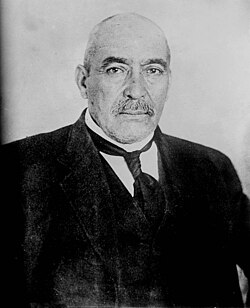
The dictatorship of Porfirio Díaz fell in 1911 after revolutionary victories including the capture of Ciudad Juárez forced his resignation. On 20 August 1911, Zapata married Josefa "La Generala" Espejo Merino, with whom he had two children.
Image source: Porfirio Díaz
Nov 1, 1911
% complete
Compromises between Madero and Zapata failed in November 1911, days after Madero was elected president, deepening the rift between the new government and the Zapatistas.
Nov 28, 1911
% complete
In November 1911, Zapata promulgated the Plan of Ayala, which called for substantial land reforms redistributing lands to the peasants. It declared Madero a traitor and named Pascual Orozco, the general who captured Ciudad Juárez in 1911, as head of the revolution. It called for all lands stolen under Díaz to be immediately returned.
Image source: Plan of Ayala
Feb 1, 1913
% complete
In a coup against Madero in February 1913, Huerta took power in Mexico. A coalition of Constitutionalist forces in northern Mexico, led by Venustiano Carranza, Álvaro Obregón and Francisco "Pancho" Villa, would eventually oust him with the support of Zapata's troops.
Apr 21, 1914
% complete
On 21 April 1914, U.S. forces occupied the port of Veracruz, further destabilizing the Huerta regime as Constitutionalist forces pressed toward victory.
Image source: United States occupation of Veracruz
Jun 15, 1914
% complete
Together the revolutionary factions made short work of Huerta, who resigned and fled in June 1914 after repeated military losses, with the support of Zapata's troops contributing to his ouster in July 1914.
Oct 1, 1914 - Nov 30, 1914
% complete
In the aftermath of the revolutionaries' victory over Huerta, they attempted to sort out power relations in the Convention of Aguascalientes, held from October to November 1914.
Image source: Convention of Aguascalientes
Jan 1, 1915 - Dec 31, 1915
% complete
Through 1915 there was a tentative peace in Morelos. Zapata began reshaping Morelos after the Plan of Ayala, redistributing hacienda lands to the peasants and largely letting village councils run their own local affairs. The peasants had more to eat than they had had in 1910 and at lower prices.
Apr 1, 1915
% complete
Even when Villa was retreating, having lost the Battle of Celaya in 1915, and Obregón took the capital from the Conventionists, who retreated to Toluca, Zapata did not open a second front.
Image source: Battle of Celaya
Jul 1, 1915
% complete
By the summer of 1915, Zapata's forces had taken the southern edge of the Federal District, occupying Milpa Alta and Xochimilco, and were poised to move into the capital.
Jan 1, 1916 - Dec 31, 1916
% complete
Through 1916, Zapata attacked federal forces from Hidalgo to Oaxaca, and Genovevo de la O fought the Carrancistas in Guerrero. Through low-scale attacks on González's positions, Zapata drove González out of Morelos by the end of 1916.
Jan 1, 1917
% complete
Zapata re-took Morelos in 1917 and held most of the state against Carranza's troops until he was killed in an ambush in April 1919.
Feb 5, 1917
% complete
Meanwhile, Carranza mounted national elections in all state capitals except Cuernavaca, and promulgated the 1917 Constitution, which incorporated elements of the Plan of Ayala. Article 27 was drafted in response to Zapata's agrarian demands and codified an agrarian reform program.
Image source: Constitution of Mexico
Sep 1, 1917 - Dec 31, 1917
% complete
In the fall of 1917, a force led by González and ex-Zapatista Sidronio Camacho, who had killed Zapata's brother Eufemio, moved into the eastern part of Morelos, taking Cuautla, Zacualpan, and Jonacatepec.
Image source: Pablo González Garza
Jan 1, 1918 - Dec 31, 1918
% complete
In the winter of 1918, severe cold weather and the onset of the Spanish flu caused the loss of a quarter of the total population of the state, almost as many as had been lost to Huerta in 1914.
Image source: Spanish flu
Dec 1, 1918
% complete
In December 1918, Carrancistas under González undertook an offensive campaign, taking most of the state of Morelos and pushing Zapata to retreat.
Mar 15, 1919
% complete
Unwilling to compromise with domestic foes, Carranza wanted to demonstrate that he was the only viable alternative to anarchy and radicalism. In mid-March 1919, General Pablo González ordered his subordinate Jesús Guajardo to begin operations against the Zapatistas in the mountains around Huautla.
Image source: Emiliano Zapata
Apr 1, 1919
% complete
Zapata answered Guajardo's letter on 1 April 1919, agreeing to all of Guajardo's terms, unaware of the deception being planned.
Apr 10, 1919
% complete
On 10 April 1919, Guajardo invited Zapata to a meeting, intimating that he intended to defect to the revolutionaries. Zapata was killed in the ambush at Chinameca, ending the life of the great revolutionary leader.
Jan 1, 1920
% complete
As Carranza moved to curb his former allies in 1920 to impose Ignacio Bonillas as his successor, Obregón sought to align himself with the Zapatista movement against Carranza. Despite González's attempts to sully Zapata's name during his 1920 campaign, the people of Morelos continued supporting Zapatista generals.
Image source: Álvaro Obregón
May 1, 1920
% complete
Genovevo de la O and Magaña supported Obregón in the coup by former Constitutionalists, fighting in Morelos against Carranza and prompting him to flee Mexico City toward Veracruz in May 1920. In 1920, Zapatistas obtained important positions in the government of Morelos after Carranza's fall, instituting many of the land reforms envisioned by Zapata.
Dec 1, 1934
% complete
A great deal of the significant land distribution which Zapata sought would later be enacted after Mexican President Lázaro Cárdenas took office in 1934, fulfilling much of the agrarian vision of the Plan of Ayala.
Image source: Lázaro Cárdenas
Jan 1, 1952
% complete
Marlon Brando played Emiliano Zapata in the award-winning movie based on his life, Viva Zapata! in 1952.
Image source: Viva Zapata!
Jan 1, 1980
% complete
There was the stage musical Zapata (1980), written by Harry Nilsson and Perry Botkin, with a libretto by Allan Katz, which ran for 16 weeks at the Goodspeed Opera House in East Haddam, Connecticut.
Jan 1, 1983
% complete
Many popular organizations take their name from Zapata, most notably the Zapatista Army of National Liberation (EZLN), the Neozapatismo group that emerged in the state of Chiapas in 1983.
Image source: Zapatista Army of National Liberation
Jan 1, 1994
% complete
The EZLN precipitated the 1994 indigenous Zapatista uprising which still continues in Chiapas, carrying forward the name and ideals of Emiliano Zapata.
Jan 1, 2004
% complete
A movie called Zapata: El sueño de un héroe (Zapata: A Hero's Dream) was produced in 2004, starring Mexican actors Alejandro Fernandez, Jaime Camil, and Lucero.
Jan 1, 2011
% complete
In the 2011 Mexican TV series El Encanto del Aguila, Zapata is played by Mexican actor Tenoch Huerta.
Image source: Tenoch Huerta
Dec 1, 2019
% complete
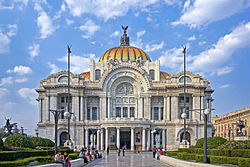
In December 2019, an arts show commemorating the 100 year anniversary of Zapata's death was held at the Palacio de Bellas Artes in Mexico City.
Image source: Palacio de Bellas Artes
Or browse the full history timeline directory, with more than 2,000 topics.
This Emiliano Zapata timeline was generated with the help of AI, using information found on the internet.
We work hard to keep these timelines accurate, but mistakes do get through. If you spot one, email us at [email protected] and we'll fix it for future visitors.
Generate yours with AI or build it from scratch, for free.
Export your timeline, add your own events, edit or remove AI-generated events, and much more
No credit card required.
Cancel anytime.
Cancel anytime.
You can create an unlimited number of timelines with up to 10 events on each one, customize how they look, export them to PDF, PNG, PowerPoint, CSV, and Excel, and share them with a link. Paid plans raise the event limit and add features like spreadsheet imports and collaborators.
Yes. You can cancel your subscription from your account page at any time, and you will not be charged again. Your subscription stays active for the rest of the period you already paid for.
Yes. We will email you a reminder before the annual renewal, and we will also email you a receipt.
Yes. You can email us within 15 days of any payment, and we will issue you a full refund.
Check out our pricing docs or send us an email anytime: [email protected].