-
Use Cases
-
Resources
-
Pricing
Pancho Villa (1878–1923) was one of the most prominent leaders of the Mexican Revolution. Born Doroteo Arango in Durango, he became a skilled military commander leading the División del Norte, famous for victories such as the Battle of Zacatecas and his 1916 raid on Columbus, New Mexico. Villa remains a complex figure—celebrated as a champion of the poor and remembered as a controversial outlaw. More Less
Jun 5, 1878
% complete
Francisco "Pancho" Villa was born as José Doroteo Arango Arámbula on 5 June 1878. He would grow up to become one of the most famous Mexican revolutionary generals and guerrilla leaders of the early 20th century.
Image source: Pancho Villa
Sep 22, 1894
% complete
On September 22, 1894, the young Doroteo Arango shot a man named Negrete in the foot, an early incident in a life marked by violence and banditry before his revolutionary career.
1898
% complete
In 1898, Villa was arrested for gun and mule theft, one of several brushes with the law during his years as an outlaw in northern Mexico.
1902
% complete
In 1902, the rurales, the elite rural police force of President Porfirio Díaz, arrested Pancho for stealing mules and for assault.
1903
% complete
After killing an army officer and stealing his horse in 1903, he was no longer known as Arango but took the name Francisco "Pancho" Villa after his paternal grandfather, Jesús Villa.
May 29, 1911
% complete
On 29 May 1911, Villa married María Luz Corral, described as "the most articulate of his many wives." They wed in a great ceremony attended by his military chiefs and a representative of the governor.
1910
% complete
At the outbreak of the Mexican Revolution in 1910, the 32-year-old Villa joined the armed rebellion that Francisco Madero called for in the Plan de San Luis Potosí to oust President Porfirio Díaz.
Mar 1911
% complete
Villa met Francisco Madero in person in March 1911 while the struggle to oust President Porfirio Díaz was ongoing, beginning their important political relationship.
May 1911
% complete
Villa and Pascual Orozco attacked Ciudad Juárez against orders, capturing the city after two days of fighting and winning the first Battle of Ciudad Juárez in 1911.
Image source: Battle of Ciudad Juárez (1911)
May 25, 1911
% complete
Facing a series of defeats in many places, President Porfirio Díaz resigned on 25 May 1911 and afterward went into exile, marking a major victory for Madero's revolutionaries including Villa.
Image source: Porfirio Díaz
Nov 1911
% complete
Once elected president in November 1911, Madero proved a disastrous politician, dismissing his revolutionary supporters like Villa and relying on the existing power structure.
Image source: Francisco I. Madero
Mar 1912
% complete
Pascual Orozco rebelled in March 1912 over Madero's failure to enact land reform and his feeling of being insufficiently rewarded for helping bring the new president to power.
Image source: Pascual Orozco
Jun 7, 1912 - Dec 25, 1912
% complete
Villa was transferred to the Santiago Tlatelolco Prison on 7 June 1912, accused of insubordination. He escaped on Christmas Day 1912 and crossed into the United States near Nogales, Arizona on 2 January 1913.
1913 - 1914
% complete
In 1913, local military commanders elected Villa provisional governor of Chihuahua against the wishes of First Chief Venustiano Carranza, who wished to name Manuel Chao instead.
Feb 1913
% complete
Madero was murdered during a military coup led by General Victoriano Huerta in February 1913, a period known as the Ten Tragic Days (Decena Trágica). Huerta then became president.
Image source: Ten Tragic Days
Mar 1913
% complete
Huerta had Abraham González, governor of Chihuahua, Madero's ally and Villa's mentor, murdered in March 1913, deepening Villa's resolve against the usurper regime.
Image source: Abraham González (governor)
Apr 1913
% complete
With just seven men, some mules, and limited supplies, Villa returned into Mexico in April 1913 to fight Madero's usurper and his own would-be executioner, President Victoriano Huerta.
Nov 23, 1913 - Nov 24, 1913
% complete
Villa considered Tierra Blanca, fought from 23 to 24 November 1913, his most spectacular victory, although General Talamantes died in the fighting.
Jun 1914
% complete
Carranza ordered 5,000 members of Villa's División del Norte to assist at Zacatecas, but Villa's decisive victory there in June 1914 broke the back of the Huerta regime.
Image source: Battle of Zacatecas (1914)
Jul 14, 1914
% complete
After the defeat of his forces, Huerta left the country on 14 July 1914, ending his presidency and ushering in a power struggle among the revolutionary leaders.
Image source: Victoriano Huerta
Sep 1914
% complete
After Huerta's defeat and exile, Villa broke with Carranza in September 1914 and issued a manifesto, setting the stage for renewed civil war among the revolutionaries.
Oct 1, 1914 - Dec 31, 1914
% complete
In late 1914, Villa was dealt an additional blow with the death from typhus of Toribio Ortega, one of his top generals.
Oct 1, 1914 - 1915
% complete
In late 1914, civil war broke out when Carranza challenged Villa. At the height of his power and popularity in late 1914 and early 1915, the U.S. had supported him, but his fortunes soon declined.
Apr 6, 1915 - Apr 15, 1915
% complete
Meeting at the Battle of Celaya in the Bajío, Villa and Obregón first fought from 6 to 15 April 1915, and Villa's army was defeated badly, suffering 4,000 killed and 6,000 captured.
Image source: Battle of Celaya
Apr 29, 1915 - Jun 5, 1915
% complete
Obregón engaged Villa again at the Battle of Trinidad, fought between 29 April and 5 June 1915, where Villa suffered another huge loss, decisively breaking his military power.
Image source: Second Battle of Agua Prieta
Jun 5, 1916
% complete
During the Punitive Expedition, Carranza's forces captured one of Villa's top generals, Pablo López, and executed him on 5 June 1916.
Jun 1919
% complete
Villa's last major military action was a raid against Ciudad Juárez in 1919. Afterward, Felipe Ángeles left his small remaining militia and was later captured and executed by Carranza's forces on 26 November 1919.
1914
% complete
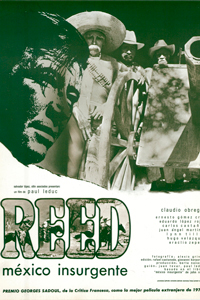
Leftist journalist John Reed wrote influential magazine articles shaping Villa's epic image for Americans; they were collected as Insurgent Mexico and published in 1914.
Image source: Reed: Insurgent Mexico
1914
% complete
Pancho Villa portrayed himself in the 1914 silent docudrama The Life of General Villa, part of his business arrangements with Hollywood that boosted his international fame.
May 21, 1920
% complete
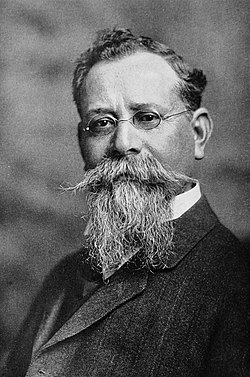
On 21 May 1920, a break came for Villa when Carranza, along with his top advisers and supporters, was assassinated by supporters of Álvaro Obregón.
Image source: Venustiano Carranza
Jul 22, 1920
% complete
On 22 July 1920, Villa sent a telegram to interim President Adolfo de la Huerta recognizing his presidency and requesting amnesty. He received a landed estate at Canutillo on condition he retire from politics.
Jul 20, 1923
% complete
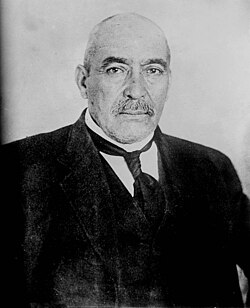
On 20 July 1923, Villa was shot and killed in an ambush while visiting Parral, most likely on the orders of political enemies Plutarco Elías Calles and President Álvaro Obregón, as he talked publicly about re-entering politics ahead of the 1924 elections.
Image source: Pancho Villa
Feb 5, 1926
% complete
Villa's body was stolen from his grave on 5 February 1926, and his head removed. A note said the head would be sent to Columbus, New Mexico, to avenge the 1916 attack by Villa.
1976
% complete
In 1976, Villa's remains were reburied in the Monument to the Revolution in Mexico City in a huge public ceremony. His widow Luz Corral refused to attend; she died on 6 July 1981 at age 89.
Oct 19, 1915
% complete
By late 1915, Villa was on the run and the United States government recognized Carranza, withdrawing its earlier support of Villa and contributing to his growing hostility toward America.
Nov 1, 1915
% complete
Electricity generated across the border in Douglas, Arizona helped repel a Villista night attack on the border town of Agua Prieta, Sonora on 1 November 1915, further angering Villa.
Jan 1916
% complete
In January 1916, a group of Villistas attacked a train on the Mexico North Western Railway near Santa Isabel, Chihuahua, killing a number of U.S. citizens and escalating tensions with America.
Mar 1916 - Feb 1917
% complete
Led by General John J. Pershing, a U.S. force invaded Mexico in pursuit of Villa but fruitlessly pursued him until February 1917, failing to capture the elusive revolutionary.
Image source: Pancho Villa Expedition
Mar 9, 1916
% complete
On 9 March 1916, General Villa ordered nearly 100 Mexican members of his revolutionary group to make a cross-border attack against Columbus, New Mexico, prompting a major U.S. response.
Image source: Battle of Columbus (1916)
Or browse the full history timeline directory, with more than 2,000 topics.
This Pancho Villa timeline was generated with the help of AI, using information found on the internet.
We work hard to keep these timelines accurate, but mistakes do get through. If you spot one, email us at [email protected] and we'll fix it for future visitors.
Generate yours with AI or build it from scratch, for free.
Export your timeline, add your own events, edit or remove AI-generated events, and much more
No credit card required.
Cancel anytime.
Cancel anytime.
You can create an unlimited number of timelines with up to 10 events on each one, customize how they look, export them to PDF, PNG, PowerPoint, CSV, and Excel, and share them with a link. Paid plans raise the event limit and add features like spreadsheet imports and collaborators.
Yes. You can cancel your subscription from your account page at any time, and you will not be charged again. Your subscription stays active for the rest of the period you already paid for.
Yes. We will email you a reminder before the annual renewal, and we will also email you a receipt.
Yes. You can email us within 15 days of any payment, and we will issue you a full refund.
Check out our pricing docs or send us an email anytime: [email protected].