-
Use Cases
-
Resources
-
Pricing
Nov 17, 1939
The 1989 demonstration marked the fiftieth anniversary of the Nazi storming of Prague University in 1939, when 1,200 students were arrested and nine were killed. The anniversary gave the 1989 protest particular historical significance.
1948 - Nov 17, 1989
Until the revolution began in November 1989, the population faced persecution by state authorities and the secret police, contributing to fear, political conformity, and opposition to the regime.
Feb 25, 1948
The Communist Party seized power in Czechoslovakia on 25 February 1948, beginning the period of communist rule whose political repression and restrictions later became central grievances of the Velvet Revolution.
Image source: 1948 Czechoslovak coup d'état
1968 - 1989
After the suppression of the Prague Spring, speaking openly about the reform movement became taboo in Czechoslovakia, illustrating the regime's effort to suppress political debate and historical memory.
Image source: Prague Spring
1985
Mikhail Gorbachev's policies of Glasnost, or openness, and Perestroika, or restructuring, changed the nature of political blacklisting in Czechoslovakia and helped create conditions for more open dissent.
Image source: Mikhail Gorbachev
Jan 1, 1989 - Mar 31, 1989
In early 1989, meetings on Jewish religious freedom, Holocaust memory, and ties between Czechoslovak Jews and the Jewish diaspora signaled the first thawing of relations between communist Czechoslovakia and Israel.
1989
During Václav Havel's imprisonment in 1989, numerous important figures and ordinary workers signed petitions supporting him, demonstrating the breadth of sympathy for dissident voices.
1988 - 1989
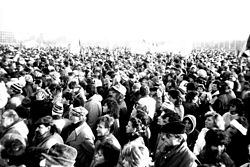
The first anti-government demonstrations occurred in 1988 and 1989, including the Candle Demonstration. Authorities dispersed them and repressed participants, but dissent continued to spread.
Image source: Velvet Revolution
Mar 25, 1988
The Candle Demonstration was one of the first major anti-government demonstrations in the late communist period. Police dispersed the protest and repressed participants, but the event demonstrated growing public opposition.
1989
One of the summer's most widely circulated documents, “The Eight Rules of Dialogue,” advocated truth, understanding, empathy, respectful discussion, avoidance of personal attacks, and an open mind.
1989
A petition circulated in the summer of 1989 calling for an end to censorship and the beginning of fundamental political reform. Its support reflected increasingly reform-minded public attitudes.
1989
By 1989, citizens who had previously been complacent or silent became willing to express their discontent with the communist regime openly.
Nov 1989
The events of November 1989 confirmed that outside factors were significant catalysts in the downfall of communism in Czechoslovakia, alongside the country's internal opposition and public mobilization.
Nov 1989 - Dec 1989
The demonstrations grew beyond the original student protest and became a mass anti-communist movement demanding political change and an end to the existing regime.
Nov 16, 1989
On the eve of International Students' Day, Slovak high school and university students organized a peaceful demonstration in central Bratislava, commemorating the fiftieth anniversary of the Nazi assault on Prague universities.
Nov 17, 1989 - Dec 31, 1989
The police response sparked a series of demonstrations that continued from 17 November through late December. The protests developed into a broad anti-communist movement.
Nov 17, 1989
Riot police violently suppressed the student demonstration in Prague on 17 November 1989. The crackdown became the immediate catalyst for the mass demonstrations that followed.
Nov 17, 1989
On International Students' Day, a student demonstration took place in Prague. The event commemorated the fiftieth anniversary of the violently suppressed 1939 demonstration against the Nazi storming of Prague University.
Nov 17, 1989 - Nov 28, 1989
The Velvet Revolution was a non-violent transition of power in Czechoslovakia that occurred from 17 November to 28 November 1989. Slovaks called the movement the Gentle Revolution.
Dec 10, 1989
President Gustáv Husák appointed the first largely non-communist government in Czechoslovakia since 1948 on 10 December 1989, marking a decisive break with communist political dominance.
Dec 10, 1989
After appointing the largely non-communist government, President Gustáv Husák resigned on 10 December 1989, further accelerating the transfer of power.
Image source: Gustáv Husák
Dec 28, 1989
Alexander Dubček was elected speaker of the federal parliament on 28 December 1989, bringing a prominent reform communist and Prague Spring figure back into a leading national political role.
Image source: Alexander Dubček
Dec 29, 1989
On 29 December 1989, rebel playwright and human rights activist Václav Havel was elected president of Czechoslovakia. His election symbolized the revolution's victory and the end of communist rule.
Jan 1, 1990 - Mar 31, 1990
Despite political transformation, there was broad consensus in early 1990 to move toward a market economy, shaping the new government's economic program.
Jan 1, 1990 - Mar 31, 1990
The president and his top economic advisers decided to liberalize prices, promote de-monopolization, and privatize the economy as part of the post-revolutionary transition.
Image source: Economy of the Czech Republic
Jun 1990
Czechoslovakia held its first democratic elections since 1946 in June 1990. The elections legitimized the new government and created a mandate for addressing the remnants of communist power.
Jun 1990
The free June 1990 elections set the stage for dealing with the remaining political influence of the Communist Party and the broader legacy of the communist period.
Dec 31, 1992
On 31 December 1992, Czechoslovakia peacefully split into two countries: the Czech Republic and the Slovak Republic.
Image source: Dissolution of Czechoslovakia
1993
After the dissolution of Czechoslovakia in 1993, Slovakia used the term Gentle Revolution, or nežná revolúcia, which Slovaks had used for the revolution from the beginning.
Nov 17, 2009
Slovakia issued a commemorative 2 euro coin on 17 November 2009 to mark the twentieth anniversary of the Velvet Revolution.
Or browse the full history timeline directory, with more than 2,500 topics.
This Velvet Revolution timeline was generated with the help of AI, using information found on the internet.
We work hard to keep these timelines accurate, but mistakes do get through. If you spot one, email us at [email protected] and we'll fix it for future visitors.
Generate yours with AI or build it from scratch, for free.
Export your timeline, add your own events, edit or remove AI-generated events, and much more
No credit card required.
Cancel anytime.
Cancel anytime.
You can create an unlimited number of timelines with up to 10 events on each one, customize how they look, export them to PDF, PNG, PowerPoint, CSV, and Excel, and share them with a link. Paid plans raise the event limit and add features like spreadsheet imports and collaborators.
Yes. You can cancel your subscription from your account page at any time, and you will not be charged again. Your subscription stays active for the rest of the period you already paid for.
Yes. We will email you a reminder before the annual renewal, and we will also email you a receipt.
Yes. You can email us within 15 days of any payment, and we will issue you a full refund.
Check out our pricing docs or send us an email anytime: [email protected].