-
Use Cases
-
Resources
-
Pricing
The Iranian Revolution was a series of events culminating in the overthrow of the Pahlavi dynasty under Shah Mohammad Reza Pahlavi and its replacement by an Islamic Republic led by Ayatollah Ruhollah Khomeini. Sparked by widespread discontent over authoritarian rule, economic inequality, and Western influence, mass protests and strikes throughout 1978–1979 forced the Shah to flee Iran, ending 2,500 years of monarchy and transforming Iran into a theocratic state with profound effects on Middle Eastern politics. More Less
Jan 26, 1963
% complete
The Shah launched a sweeping series of modernization reforms known as the White Revolution, including land reform, women's suffrage, and literacy programs. While economically transformative, the reforms alienated the clergy and traditional landowners, who saw them as Westernization and a threat to Islamic values.
Image source: White Revolution
Jun 3, 1963
% complete
Ayatollah Ruhollah Khomeini delivered a fiery speech in Qom attacking the Shah and his policies. His subsequent arrest sparked riots across Iran, which were violently suppressed. The event established Khomeini as a leading opposition figure and marked his emergence as the symbol of resistance to the monarchy.
Image source: Ruhollah Khomeini
Nov 4, 1964
% complete
Khomeini publicly condemned a law granting legal immunity to American military personnel in Iran and was subsequently exiled by the Shah. He first settled in Turkey, then Iraq, where he spent nearly 15 years teaching and developing his doctrine of velayat-e faqih (guardianship of the jurist).
Image source: Ruhollah Khomeini's life in exile
Jan 20, 1977
% complete
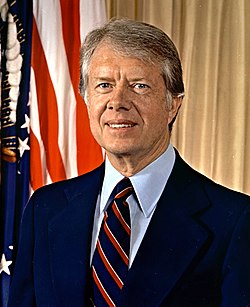
The inauguration of US President Jimmy Carter brought renewed American emphasis on human rights. Under pressure from Washington, the Shah relaxed restrictions on political dissent, inadvertently opening space for opposition groups, intellectuals, and clergy to organize and voice criticism of his regime.
Image source: Jimmy Carter
Jun 19, 1977
% complete
Ali Shariati, a sociologist whose fusion of Shia Islam with leftist political thought inspired many young revolutionaries, died suddenly in London at age 43. His ideas about an 'Islam of the oppressed' had spread widely among Iranian students and contributed to the revolutionary climate.
Image source: Ali Shariati
Nov 2, 1977
% complete
Mostafa Khomeini, Ayatollah Khomeini's eldest son, died unexpectedly in Najaf. Opposition supporters blamed SAVAK, the Shah's secret police, for his death, though this was never proven. Memorial services held for him in Iran turned into mass demonstrations against the government.
Jan 7, 1978 - Jan 9, 1978
% complete
The state newspaper Ettela'at published an article attacking Ayatollah Khomeini as a foreign agent. Seminary students in Qom protested and were violently suppressed by security forces, with several killed according to opposition claims. This incident ignited the cycle of mourning demonstrations that escalated throughout 1978.
Feb 18, 1978
% complete
Forty days after the Qom killings, massive riots erupted in Tabriz, where protesters attacked symbols of the regime. Security forces crushed the uprising with significant casualties, but the pattern of 40-day memorial cycles turning into fresh protests became a defining rhythm of the revolution.
Image source: Iranian Revolution
Aug 19, 1978
% complete
A fire set at the Cinema Rex movie theater in Abadan killed more than 400 people. The public overwhelmingly blamed SAVAK, though Islamist militants were later implicated. The massacre enraged the nation, shattered remaining trust in the government, and dramatically accelerated the revolutionary movement.
Image source: Cinema Rex fire
Sep 8, 1978
% complete
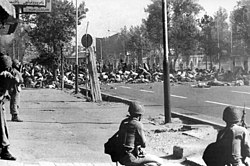
Security forces opened fire on large crowds protesting in Jaleh Square in Tehran, killing dozens or hundreds depending on estimates. Black Friday destroyed any possibility of reconciliation between the opposition and the monarchy, convincing even moderates that the Shah's rule could not continue.
Image source: Black Friday (1978)
Sep 11, 1978
% complete
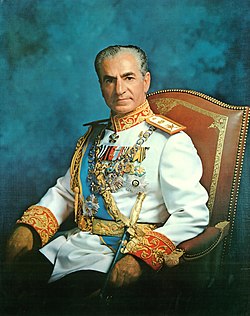
In the wake of Black Friday, the Shah imposed martial law in major cities while simultaneously attempting conciliation, promising free elections and apologizing for past wrongs in a televised address. These belated concessions failed to placate an opposition that now demanded the end of the monarchy itself.
Image source: Mohammad Reza Pahlavi
Sep 17, 1978
% complete
Days after Black Friday, hundreds of thousands marched in Tehran chanting slogans demanding the Shah's removal. The sheer scale of participation demonstrated that the protest movement had grown beyond any single group into a broad-based popular revolution spanning classes and ideologies.
Oct 30, 1978 - Nov 5, 1978
% complete
Massive strikes by oil workers, civil servants, teachers, and journalists paralyzed Iran's economy. The government of Ja'far Sharif-Emami collapsed, and the Shah appointed General Gholam Reza Azhari, a military man, to head a caretaker cabinet — a sign of the regime's deepening desperation.
Oct 3, 1978
% complete
After pressure from Saddam Hussein's Iraqi government, Khomeini left Najaf for Neauphle-le-Château near Paris. From France he could communicate freely with international media and his followers in Iran via cassette tapes and telephone, dramatically amplifying his message and leadership of the revolution.
Image source: Neauphle-le-Château
Jan 16, 1979
% complete
In a bid to save the monarchy or at least preserve constitutional government, Bakhtiar dissolved the hated SAVAK secret police, released political prisoners, and promised free elections. Khomeini rejected his government outright, calling him illegitimate, and continued to call for the monarchy's abolition.
Image source: SAVAK
Jan 16, 1979
% complete
Facing irreversible collapse, the Shah named opposition figure Shapur Bakhtiar prime minister and departed Iran 'for a vacation,' never to return. Crowds celebrated his departure by tearing down statues of the Pahlavi dynasty and celebrating in the streets across the country.
Image source: Shapour Bakhtiar
Feb 1, 1979
% complete
Ayatollah Khomeini returned to Iran aboard Air France Flight 4552 after 14 years in exile. He was greeted by millions of jubilant supporters, one of the largest welcoming crowds in history. In his first speech he declared he would 'slap this government in the mouth,' rejecting the Bakhtiar administration.
Image source: Ruhollah Khomeini's return to Iran
Feb 8, 1979
% complete
Technicians at Tehran's Doshan Tappeh air base mutinied and declared allegiance to Khomeini. The defection of military units, followed by armed clashes between loyalist troops and revolutionaries, signaled the collapse of the armed forces' loyalty and made the fall of the government imminent.
Feb 10, 1979 - Feb 11, 1979
% complete
Fierce street fighting erupted between revolutionary guerrillas and the Imperial Guard. Police stations, military bases, and government buildings fell one by one. On February 11, the army declared neutrality, Bakhtiar went into hiding, and the Pahlavi monarchy effectively ceased to exist after more than 50 years.
Feb 1979
% complete
Revolutionary tribunals headed by figures like Sadegh Khalkhali swiftly tried and executed hundreds of senior officials of the Pahlavi regime, including former prime minister Amir Abbas Hoveyda. The purges eliminated remnants of the old order but drew international criticism for their lack of due process.
Image source: Islamic Revolutionary Court
Mar 1979
% complete
Seeking autonomy after the revolution, Kurds rose up in cities like Mahabad under leaders such as Abdolrahman Ghassemlou of the KDPI. The new government refused their demands, and fighting broke out that would continue intermittently for years, marking the first major internal conflict of the Islamic Republic.
Image source: 1979 Kurdish rebellion in Iran
Mar 8, 1979
% complete
On International Women's Day, tens of thousands of women marched in Tehran against a decree requiring hijab in workplaces. Though the protests were large and vocal, they failed to reverse the policy, and compulsory veiling was gradually enforced, becoming a lasting symbol of post-revolutionary gender politics.
Image source: 1979 International Women's Day protests in Tehran
Nov 4, 1979
% complete
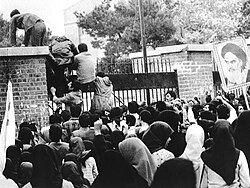
Radical students calling themselves Muslim Student Followers of the Imam's Line stormed the US embassy in Tehran and took 52 Americans hostage. The crisis lasted 444 days, ruptured US–Iran relations permanently, and helped consolidate revolutionary fervor around confrontation with America, branded the 'Great Satan.'
Image source: Iran hostage crisis
Sep 22, 1980
% complete
Iraqi dictator Saddam Hussein invaded Iran, seeking territorial gains and hoping to exploit the chaos of the post-revolutionary period. Rather than destroying the fragile Islamic Republic, the invasion rallied Iranians behind the new regime and initiated eight years of devastating war that defined the revolution's legacy.
Image source: Iran–Iraq War
Feb 11, 1979
% complete
Khomeini appointed Mehdi Bazargan, a moderate liberal nationalist, as prime minister of the provisional government, bypassing the constitutionally designated process. Bazargan's government faced the enormous task of restoring order while revolutionary committees and courts operated independently of state authority.
Image source: Mehdi Bazargan
Mar 30, 1979 - Mar 31, 1979
% complete
Iranians voted overwhelmingly — officially over 98% in favor — to replace the monarchy with an Islamic Republic. The ballot offered only a yes/no question with no alternative options, and the result gave Khomeini a sweeping popular mandate to reshape Iran's political system along religious lines.
Image source: 1979 Iranian Islamic Republic referendum
Apr 1, 1979
% complete
The day after the referendum results were announced, Khomeini formally proclaimed the establishment of the Islamic Republic of Iran. The declaration marked the official birth of a new theocratic state governed according to Islamic law and principles, ending 2,500 years of monarchy in Iran.
Image source: History of the Islamic Republic of Iran
Jul 1979
% complete
An elected Assembly of Experts began drafting Iran's new constitution. Initially conceived as a fairly standard republican document, it was transformed under Khomeini's influence to enshrine the principle of velayat-e faqih, granting sweeping powers to a supreme clerical leader.
Image source: Assembly for the Final Review of the Constitution
Nov 6, 1979
% complete
Prime Minister Mehdi Bazargan resigned following the seizure of the US embassy, protesting that his government had been unable to act effectively amid competing centers of power. His resignation consolidated the dominance of radical Islamists aligned with Khomeini over moderates within the new state.
Dec 2, 1979 - Dec 3, 1979
% complete
A second referendum approved the new constitution, which created the office of Supreme Leader with vast authority over the military, judiciary, and media, alongside institutions like the Guardian Council. Khomeini became the first Supreme Leader, formalizing clerical rule as the foundation of the state.
Image source: Constitution of Iran
Or browse the full history timeline directory, with more than 2,000 topics.
This Iranian Revolution timeline was generated with the help of AI, using information found on the internet.
We work hard to keep these timelines accurate, but mistakes do get through. If you spot one, email us at [email protected] and we'll fix it for future visitors.
Generate yours with AI or build it from scratch, for free.
Export your timeline, add your own events, edit or remove AI-generated events, and much more
No credit card required.
Cancel anytime.
Cancel anytime.
You can create an unlimited number of timelines with up to 10 events on each one, customize how they look, export them to PDF, PNG, PowerPoint, CSV, and Excel, and share them with a link. Paid plans raise the event limit and add features like spreadsheet imports and collaborators.
Yes. You can cancel your subscription from your account page at any time, and you will not be charged again. Your subscription stays active for the rest of the period you already paid for.
Yes. We will email you a reminder before the annual renewal, and we will also email you a receipt.
Yes. You can email us within 15 days of any payment, and we will issue you a full refund.
Check out our pricing docs or send us an email anytime: [email protected].