-
Use Cases
-
Resources
-
Pricing
The History of the United Arab Emirates spans thousands of years, from early Bronze Age settlements along the Persian Gulf through the era of Portuguese influence, British protectorates, and a pearl-diving economy. In 1971, six emirates—Abu Dhabi, Dubai, Sharjah, Ajman, Umm Al Quwain, and Fujairah—united to form an independent federation, joined by Ras Al Khaimah in 1972. Following the discovery of oil, the UAE transformed rapidly into one of the world's wealthiest and most modern nations. More Less
630
% complete
Islam arrived in the region during the lifetime of Prophet Muhammad, with envoys sent to rulers in Oman and the eastern Arabian Peninsula. The area's inhabitants gradually adopted Islam, which became deeply embedded in the social and cultural fabric of the region.
Image source: Islam in the United Arab Emirates
1507 - 1622
% complete
Following Afonso de Albuquerque's campaigns, Portugal seized control of coastal forts including Julfar and Khor Fakkan, dominating Gulf trade for over a century until Safavid and English forces expelled them from Hormuz.
Image source: Portuguese conquest of Hormuz
1761
% complete
The Bani Yas confederation, led by the Al Nahyan family, discovered freshwater on Abu Dhabi island and established the town that would become the capital of the future emirate, laying the foundation for Abu Dhabi's rise.
1790 - 1819
% complete
The Al Qasimi of Sharjah and Ras Al Khaimah built a formidable maritime presence in the lower Gulf. Their conflicts with British vessels led Britain to label them 'pirates', setting the stage for British military intervention.
Image source: Al Qasimi
Nov 1819 - Dec 1819
% complete
A British expeditionary force attacked and destroyed Ras Al Khaimah, crushing Al Qasimi maritime power and forcing the shaikhdoms of the southern Persian Gulf toward treaty relations with Britain.
Image source: Persian Gulf campaign of 1819
1820
% complete
The sheikhdoms of the Trucial Coast signed the General Maritime Treaty with the British Empire, agreeing to suppress piracy and slavery at sea. This began the era of British protection that shaped regional politics for 150 years.
Image source: General Maritime Treaty of 1820
1850 - 1929
% complete
Natural pearls from Gulf waters became the backbone of the regional economy, drawing merchants from India and beyond. The industry collapsed after the Great Depression and Japanese cultured pearl production devastated demand.
Image source: United Arab Emirates
1952
% complete
Britain formalized cooperation among the seven Trucial States by creating the Trucial States Council, an early forum for joint decision-making that foreshadowed the later federal union.
Image source: Trucial States
1958
% complete
Explorers struck oil at Bab-2 well in Abu Dhabi's interior, confirming commercially viable reserves. Exports began in 1963, transforming Abu Dhabi from a poor pearl-diving sheikhdom into one of the world's wealthiest oil producers.
Image source: History of the United Arab Emirates
1963
% complete
Abu Dhabi shipped its first cargo of crude oil from Das Island, launching the hydrocarbon economy that would finance the modern development of the emirate and, later, the entire federation.
Image source: Abu Dhabi
Aug 6, 1966
% complete
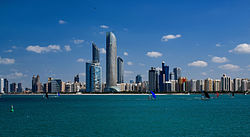
Sheikh Zayed replaced his brother Sheikh Shakhbut as ruler of Abu Dhabi. A visionary leader, he immediately channeled oil revenues into schools, hospitals, roads, and housing, earning widespread respect across the region.
Image source: Zayed bin Sultan Al Nahyan
1968 - 1969
% complete
Talks expanded the proposed union to include Qatar and Bahrain, creating a nine-member federation. Deep disagreements among rulers caused negotiations to collapse, leaving the seven Trucial States to pursue unity alone while Bahrain and Qatar chose independence.
Image source: History of the United Arab Emirates
Jan 16, 1968
% complete
Prime Minister Harold Wilson announced Britain would withdraw its military forces from the Persian Gulf by 1971, ending over 150 years of protection and prompting the Trucial States to plan their political future.
Image source: Gulf War
Feb 18, 1968
% complete
Sheikh Zayed of Abu Dhabi and Sheikh Rashid of Dubai met at Argoub El Sedirah and agreed to merge their two emirates, inviting the other Trucial States to join their union — the decisive first step toward federation.
Sep 1969
% complete
Dubai began exporting oil from the offshore Fateh field, providing Sheikh Rashid with revenue to build ports and infrastructure and strengthening Dubai's position within the emerging federation.
Image source: Emirates National Oil Company
Nov 30, 1971
% complete
On the eve of independence, Iran seized three Gulf islands claimed by Sharjah and Ras Al Khaimah. The dispute remains unresolved and continues to affect UAE–Iran relations to this day.
Image source: Seizure of Abu Musa and the Greater and Lesser Tunbs
Dec 2, 1971
% complete
Six emirates — Abu Dhabi, Dubai, Sharjah, Ajman, Umm Al Quwain, and Fujairah — declared independence from Britain and united as the United Arab Emirates, with Sheikh Zayed elected president and Sheikh Rashid vice-president.
Image source: United Arab Emirates
Dec 9, 1971
% complete
Days after its founding, the new nation was admitted to the United Nations and joined the Arab League, securing international recognition and establishing itself within the global diplomatic community.
Image source: Foreign relations of the United Arab Emirates
Feb 10, 1972
% complete
Ras Al Khaimah, initially hesitant about joining, acceded to the United Arab Emirates two months after independence, completing the seven-emirate federation in its present form.
Image source: Ras Al Khaimah
Dec 2, 1971
% complete
The provisional constitution established a federal structure with a Supreme Council of Rulers, cabinet, and Federal National Council, defining the division of powers between the central government and individual emirates.
1976 - 1979
% complete
Sheikh Rashid ordered construction of the massive man-made Jebel Ali port, the largest in the Middle East, which became the engine of Dubai's trade, logistics, and re-export economy and hosts the surrounding free zone.
Image source: Port of Jebel Ali
1976
% complete
The separate military forces of each emirate were merged into a single federal army headquartered in Abu Dhabi, consolidating national defense capabilities under unified command.
Image source: United Arab Emirates Armed Forces
Jan 1991 - Feb 1991
% complete
The UAE joined the US-led coalition against Iraq following Saddam Hussein's invasion of Kuwait, contributing aircraft and troops and allowing allied forces to use Emirati bases during the liberation of Kuwait.
Image source: Gulf War
Nov 2, 2004 - Jan 4, 2006
% complete
After the death of founding father Sheikh Zayed, who had ruled since independence, Sheikh Maktoum bin Rashid Al Maktoum of Dubai briefly served as president until his own death in January 2006.
Image source: Maktoum bin Rashid Al Maktoum
2006 - 2014
% complete
As crown prince of Abu Dhabi, Sheikh Mohammed bin Zayed drove an assertive foreign policy, expanding the armed forces, deepening ties with Washington, and positioning the UAE as a key regional power broker.
Image source: Mohamed bin Zayed Al Nahyan
Jan 4, 2010
% complete
The 828-meter Burj Khalifa opened in Downtown Dubai, becoming the tallest structure ever built. The tower became a global icon of the UAE's ambitions and a centerpiece of Dubai's tourism-driven diversification strategy.
Image source: Burj Khalifa
Jul 20, 2020
% complete
The UAE launched Al Amal (Hope), the Arab world's first interplanetary mission, from Tanegashima Space Center in Japan. The probe entered Mars orbit in February 2021, marking the UAE as the fifth nation to reach Mars.
Image source: Emirates Mars Mission
Aug 13, 2020
% complete
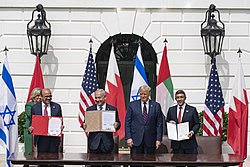
The UAE agreed to full normalization of diplomatic relations with Israel, becoming the first Gulf state to do so. The agreement reshaped Middle Eastern diplomacy and boosted trade, tourism, and technology cooperation.
Image source: Abraham Accords
Dec 2, 2021
% complete
The UAE celebrated its fiftieth anniversary with nationwide festivities and the launch of 'Projects of the 50', announcing ambitious plans for economic expansion, space exploration, and sustainable growth into the next half-century.
Or browse the full history timeline directory, with more than 2,000 topics.
This History of United Arab Emirates timeline was generated with the help of AI, using information found on the internet.
We work hard to keep these timelines accurate, but mistakes do get through. If you spot one, email us at [email protected] and we'll fix it for future visitors.
Generate yours with AI or build it from scratch, for free.
Export your timeline, add your own events, edit or remove AI-generated events, and much more
No credit card required.
Cancel anytime.
Cancel anytime.
You can create an unlimited number of timelines with up to 10 events on each one, customize how they look, export them to PDF, PNG, PowerPoint, CSV, and Excel, and share them with a link. Paid plans raise the event limit and add features like spreadsheet imports and collaborators.
Yes. You can cancel your subscription from your account page at any time, and you will not be charged again. Your subscription stays active for the rest of the period you already paid for.
Yes. We will email you a reminder before the annual renewal, and we will also email you a receipt.
Yes. You can email us within 15 days of any payment, and we will issue you a full refund.
Check out our pricing docs or send us an email anytime: [email protected].