-
Use Cases
-
Resources
-
Pricing
The United Nations (UN) is an international organization founded in 1945 after World War II, dedicated to maintaining international peace and security, promoting human rights, fostering social and economic development, and upholding international law. Headquartered in New York City, it has grown from 51 founding member states to 193 members today. More Less
Jan 1, 1942
% complete
Twenty-six Allied nations, led by the United States, United Kingdom, Soviet Union, and China, signed the Declaration by United Nations in Washington, D.C., pledging to fight the Axis powers together. The document, drafted by President Franklin D. Roosevelt, first used the term 'United Nations' and laid the ideological groundwork for the postwar international organization.
Image source: Declaration by United Nations
Nov 9, 1943 - Jun 30, 1947
% complete
The United Nations Relief and Rehabilitation Administration, founded in 1943 by the Allies, provided billions of dollars in food, shelter, and medical aid to millions displaced by World War II. Its work concluded in 1947, with functions transferred to newly created UN agencies like UNICEF.
Image source: United Nations Relief and Rehabilitation Administration
Aug 21, 1944 - Oct 7, 1944
% complete
Representatives of the United States, United Kingdom, Soviet Union, and China met at Dumbarton Oaks in Washington, D.C., to draft proposals for an international organization to maintain peace and security. The conference produced the blueprint for the United Nations' structure, including the Security Council with permanent members holding veto power.
Image source: Dumbarton Oaks Conference
Feb 4, 1945 - Feb 11, 1945
% complete
Roosevelt, Churchill, and Stalin met at Yalta in Crimea, where they resolved key disputes over the proposed United Nations, including voting procedures in the Security Council and the participation of Poland and other nations. They agreed to convene a conference in San Francisco to establish the organization.
Image source: Yalta Conference
Apr 25, 1945 - Jun 26, 1945
% complete
Delegates from fifty nations gathered in San Francisco to draft the Charter of the United Nations. After two months of intense negotiation, the Charter was signed on June 26, 1945, establishing the UN's purposes: maintaining international peace and security, promoting human rights, and fostering cooperation among nations.
Image source: United Nations Conference on International Organization
Oct 24, 1945
% complete
The United Nations Charter came into force after ratification by the five permanent Security Council members and a majority of other signatories. October 24 is now celebrated annually as United Nations Day, marking the official birth of the organization with 51 founding member states.
Image source: History of the United Nations

Jan 10, 1946 - Jan 17, 1946
% complete
The inaugural session of the UN General Assembly convened in London with representatives from 51 nations. The Assembly established its procedures, elected Trygve Lie of Norway as the first Secretary-General, and created the Security Council's first agenda addressing threats to peace.
Image source: United Nations General Assembly
Dec 14, 1946
% complete
The General Assembly voted to locate the permanent UN headquarters in New York City, thanks largely to a $8.5 million donation from John D. Rockefeller Jr. for the Manhattan site along the East River. Construction began in 1949, and the iconic Secretariat building opened in 1952.
Image source: Headquarters of the United Nations
Apr 10, 1953 - Sep 18, 1961
% complete
Swedish diplomat Dag Hammarskjöld became the second UN Secretary-General, serving until his death in a plane crash in 1961 while on a peace mission to Congo. He expanded the role of the office, developed peacekeeping doctrine, and posthumously received the Nobel Peace Prize.
Image source: Dag Hammarskjöld
Nov 3, 1961 - Dec 31, 1971
% complete
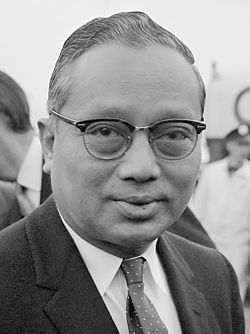
Burmese diplomat U Thant became the third Secretary-General and the first from Asia. During his decade in office he helped defuse the Cuban Missile Crisis, oversaw peacekeeping expansion, and championed decolonization as dozens of new nations joined the UN.
Image source: U Thant
Jan 1, 1972 - Dec 31, 1981
% complete
Austrian diplomat Kurt Waldheim served two terms as Secretary-General during a turbulent era that included the Vietnam War's end, Middle East conflicts, and Cold War tensions. His later election as Austrian president sparked controversy over revelations about his wartime service in the German army.
Image source: Kurt Waldheim
Jan 1, 1982 - Dec 31, 1991
% complete
Peruvian diplomat Javier Pérez de Cuéllar served as Secretary-General during the end of the Cold War, mediating conflicts in Central America, the Iran-Iraq War, and Namibia's independence. His tenure saw renewed great-power cooperation within the Security Council.
Image source: Javier Pérez de Cuéllar
Jan 1, 1997 - Dec 31, 2006
% complete
Ghanaian diplomat Kofi Annan became the seventh Secretary-General and the first to rise from within the UN staff. He prioritized reform, HIV/AIDS awareness, and the Millennium Development Goals, and jointly won the 2001 Nobel Peace Prize with the organization itself.
Image source: Kofi Annan
Jan 1, 2007 - Dec 31, 2016
% complete
South Korean diplomat Ban Ki-moon served two terms as Secretary-General, championing climate action, sustainable development, and response to crises in Syria, Haiti, and elsewhere. He helped secure the Paris Climate Agreement and the adoption of the Sustainable Development Goals.
Image source: Ban Ki-moon
Jan 1, 2017
% complete
Former Portuguese Prime Minister António Guterres became the ninth Secretary-General, prioritizing climate change, humanitarian reform, and conflict prevention. He was reappointed for a second term in 2021, leading the UN through the COVID-19 pandemic and renewed geopolitical divisions.
Image source: António Guterres
Dec 11, 1946
% complete
The United Nations International Children's Emergency Fund was created to provide food, clothing, and healthcare to children affected by World War II. It became a permanent UN agency in 1953, expanding its mission to protect children's rights worldwide and winning the Nobel Peace Prize in 1965.
Image source: UNICEF
Dec 10, 1948
% complete
The General Assembly adopted the Universal Declaration of Human Rights in Paris, drafted under the leadership of Eleanor Roosevelt. The landmark document proclaimed fundamental rights and freedoms for all people regardless of race, sex, language, or religion, becoming the foundation of modern international human rights law.
Image source: Universal Declaration of Human Rights
Dec 16, 1966
% complete
The General Assembly adopted the International Covenant on Civil and Political Rights and the International Covenant on Economic, Social and Cultural Rights, making legally binding many rights proclaimed in the 1948 Universal Declaration. Together they form the core of the International Bill of Human Rights.
Image source: International Covenant on Civil and Political Rights
Sep 8, 2000
% complete
At the Millennium Summit, world leaders adopted eight development goals targeting extreme poverty, child mortality, disease, and education by 2015. The MDGs mobilized unprecedented global resources and measurable progress, shaping development policy for fifteen years.
Image source: Millennium Development Goals
Sep 25, 2015
% complete
All 193 UN member states adopted the 2030 Agenda for Sustainable Development, featuring seventeen goals covering poverty eradication, climate action, gender equality, and more. The SDGs succeeded the Millennium Development Goals with a broader, universal scope applying to all countries.
Image source: Sustainable Development Goals
Oct 9, 2020
% complete
The Norwegian Nobel Committee awarded the Nobel Peace Prize to the World Food Programme for its efforts to combat hunger and its contribution to peace in conflict zones. Founded in 1961, the WFP assists tens of millions of people each year and has become the world's largest humanitarian food agency.
Image source: World Food Programme
Nov 15, 1948
% complete
Following the Arab-Israeli War, the UN established the Truce Supervision Organization to monitor ceasefires in Palestine. This marked the beginning of UN peacekeeping operations, which would grow into one of the organization's most visible and enduring activities around the world.
Image source: United Nations Truce Supervision Organization
Jun 25, 1950 - Jul 27, 1953
% complete
When North Korea invaded South Korea, the Security Council authorized a multinational force led by the United States to defend the South, as the Soviet Union was boycotting the Council at the time. The three-year conflict ended in an armistice but demonstrated the UN's capacity for collective military action.
Image source: Korean War
Oct 29, 1956 - Mar 6, 1957
% complete
After Israel, Britain, and France invaded Egypt following its nationalization of the Suez Canal, the UN pressured the invaders to withdraw and deployed the first large-scale armed peacekeeping force, UNEF, to supervise the ceasefire. The crisis marked a turning point in Cold War power dynamics and UN crisis management.
Image source: Suez Crisis
Jul 14, 1960 - Jun 30, 1964
% complete
The UN deployed its largest peacekeeping mission to date to stabilize the newly independent Congo amid secessionist revolts and political chaos. The operation, which cost the life of Secretary-General Hammarskjöld, tested the limits of UN intervention in internal conflicts.
Image source: United Nations Operation in the Congo
Oct 16, 1962 - Oct 28, 1962
% complete
During the thirteen-day standoff between the United States and the Soviet Union over Soviet missiles in Cuba, U Thant mediated between the superpowers and appealed for restraint. His diplomatic efforts helped create space for negotiations that peacefully resolved the confrontation.
Image source: Cuban Missile Crisis
Nov 22, 1967
% complete
Following the Six-Day War between Israel and its Arab neighbors, the Security Council adopted Resolution 242, calling for Israeli withdrawal from occupied territories and recognition of every state's right to live in peace. It became the cornerstone of subsequent Middle East peace diplomacy.
Image source: United Nations Security Council Resolution 242
Mar 21, 1990
% complete
After decades of occupation and a UN-supervised transition process, Namibia became independent from South African rule. The successful UNTAG mission, which monitored elections and the withdrawal of foreign forces, became a model for future UN electoral assistance operations.
Image source: United Nations Transition Assistance Group
Nov 29, 1990 - Feb 28, 1991
% complete
The Security Council authorized the use of force to expel Iraqi troops from Kuwait, marking an unprecedented moment of unity among the permanent members after the Cold War. The coalition victory restored Kuwaiti sovereignty and briefly raised hopes for a new era of collective security.
Image source: Gulf War
Jul 11, 1995 - Jul 22, 1995
% complete
Bosnian Serb forces overran the UN-declared 'safe area' of Srebrenica and murdered more than 8,000 Bosniak men and boys while Dutch peacekeepers were unable to prevent the atrocity. The massacre became a profound failure for the UN and prompted major reforms in peacekeeping doctrine.
Image source: Srebrenica massacre
Sep 1, 1961
% complete
Founded in Belgrade by leaders including Nehru, Nasser, Tito, Sukarno, and Nkrumah, the Non-Aligned Movement gave newly independent nations a collective voice at the UN. Its growing bloc transformed General Assembly politics and pushed issues of decolonization and economic justice onto the global agenda.
Image source: Non-Aligned Movement
Oct 25, 1971
% complete
General Assembly Resolution 2758 recognized the People's Republic of China as the legitimate representative of China, transferring the seat held by the Republic of China (Taiwan). The shift dramatically altered the balance of power within the UN during the Cold War.
Image source: China and the United Nations
Jun 5, 1972 - Jun 16, 1972
% complete
The Stockholm Conference was the first major UN gathering devoted to the environment, establishing the UN Environment Programme and placing environmental protection on the international agenda. June 5, its opening day, is now celebrated annually as World Environment Day.
Jun 17, 1992
% complete
Secretary-General Boutros Boutros-Ghali issued 'An Agenda for Peace,' a landmark report proposing preventive diplomacy, peacemaking, peacekeeping, and post-conflict peacebuilding. It reshaped thinking about the UN's role in a post-Cold War world of internal conflicts.
Sep 28, 2001
% complete
In response to the September 11 terrorist attacks, the Security Council adopted Resolution 1373, obligating all states to combat terrorism financing and support. The UN subsequently expanded its counterterrorism architecture, including the Counter-Terrorism Committee.
Image source: United Nations Security Council Resolution 1373
Nov 30, 2015 - Dec 12, 2015
% complete
At COP21 in Paris, 196 parties adopted a binding framework agreement to limit global warming to well below 2 degrees Celsius above pre-industrial levels. Negotiated through the UN Framework Convention on Climate Change, it represents the most comprehensive global climate accord to date.
Image source: Paris Agreement
Mar 11, 2020 - May 5, 2023
% complete
As COVID-19 spread worldwide, the UN and its agencies, particularly the World Health Organization, coordinated global health responses, vaccine equity initiatives through COVAX, and humanitarian appeals. The pandemic exposed both the importance and limitations of multilateral cooperation.
Image source: COVID-19 pandemic
Or browse the full history timeline directory, with more than 2,000 topics.
This United Nations timeline was generated with the help of AI, using information found on the internet.
We work hard to keep these timelines accurate, but mistakes do get through. If you spot one, email us at [email protected] and we'll fix it for future visitors.
Generate yours with AI or build it from scratch, for free.
Export your timeline, add your own events, edit or remove AI-generated events, and much more
No credit card required.
Cancel anytime.
Cancel anytime.
You can create an unlimited number of timelines with up to 10 events on each one, customize how they look, export them to PDF, PNG, PowerPoint, CSV, and Excel, and share them with a link. Paid plans raise the event limit and add features like spreadsheet imports and collaborators.
Yes. You can cancel your subscription from your account page at any time, and you will not be charged again. Your subscription stays active for the rest of the period you already paid for.
Yes. We will email you a reminder before the annual renewal, and we will also email you a receipt.
Yes. You can email us within 15 days of any payment, and we will issue you a full refund.
Check out our pricing docs or send us an email anytime: [email protected].