
-
Use Cases
-
Resources
-
Pricing
1400 - 1600
Osage communities occupied and traveled across portions of present-day Missouri, Arkansas, Kansas, and Oklahoma. Their control of hunting territories and river corridors made them a major regional power.
1673
French exploration of the Mississippi Valley brought the Osage into sustained contact with European colonial networks. Trade in furs and manufactured goods began to influence diplomacy and regional competition.
1700 - 1750
Through trade, warfare, diplomacy, and control of extensive hunting grounds, the Osage became one of the most powerful Indigenous nations in the central Plains and lower Missouri Valley.
Image source: Osage Nation
1803
The United States acquired Louisiana from France, placing Osage homelands within expanding U.S. claims. The change intensified American pressure for land cessions and formal treaties.
Image source: Louisiana Purchase
Jun 10, 1808
The Osage signed a treaty with the United States at Fort Clark, ceding a large portion of their traditional territory. The agreement marked a major early reduction of Osage lands under U.S. expansion.
1825 - 1830
Osage families and villages relocated westward to the reservation created by the 1825 treaty. The move disrupted established economies and exposed the Nation to increasing pressure from settlers and neighboring tribes.
Jun 2, 1825
The Osage ceded most of their remaining lands in Missouri and Arkansas to the United States. In exchange, they were promised a reservation in what is now southeastern Kansas, along with payments and other provisions.
Sep 29, 1837
The Osage ceded additional lands in Kansas to the United States. The treaty reduced the reservation and contributed to the continuing concentration of Osage people on a smaller territorial base.
1865
After the Civil War, the Osage sold their Kansas reservation to the United States and purchased a new reservation in Indian Territory. Unlike many tribes, they retained ownership of the mineral estate beneath the new lands.
1872
The Osage moved to their new reservation in present-day Osage County, Oklahoma. The reservation became the territorial and political center of the Osage Nation.
1906 - 1907
The Osage Allotment Act divided the surface land of the reservation into individual allotments while preserving communal ownership of the mineral estate. Headrights connected to mineral revenues became inheritable property.
1881
The Osage adopted a written form of government under federal oversight, including elected representatives. The reorganization altered older forms of governance while preserving the Nation's political continuity.
Nov 16, 1907
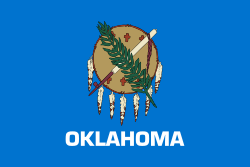
Oklahoma entered the Union, and the Osage reservation became Osage County within the new state. Statehood brought expanded settlement and governmental pressure while the Osage mineral estate remained federally protected.
Image source: Oklahoma
1930 - 1970
Despite boarding-school pressures, land loss, and assimilation policies, Osage families and ceremonial societies continued transmitting language, songs, dances, kinship practices, and religious traditions.
1994
Osage voters approved a constitution creating a modern tripartite government with executive, legislative, and judicial branches. The constitution strengthened self-government and replaced earlier federally imposed political structures.
1997
The Osage Nation established its own supreme court under the 1994 constitutional framework. The court became a central institution for exercising tribal jurisdiction and interpreting Osage law.
2000 - 2010
The Osage Nation expanded language documentation, teaching, and revitalization programs. Elders, educators, and cultural institutions worked to increase the number of speakers and preserve ceremonial vocabulary.
2005
The Osage Nation entered the framework for tribal gaming in Oklahoma through a compact with the state. Gaming became one element of the Nation's economic development and governmental revenue strategy.
2006
Osage voters approved constitutional amendments that reorganized governmental powers and clarified the structure of the Nation's modern administration. The changes reflected continuing efforts to strengthen sovereignty.
2010 - 2020
The Nation continued asserting its authority over the Osage mineral estate and managing revenues, leases, and environmental responsibilities. Mineral rights remained a major foundation of Osage governmental finances.
2014
The Osage Nation Museum in Pawhuska, Oklahoma, expanded its role as a center for Osage history, art, and contemporary cultural expression. Its exhibitions present Osage perspectives on sovereignty, memory, and identity.
2017
David Grann's nonfiction book brought broad public attention to the Osage murders, the oil wealth system, and the failures of law enforcement. Osage scholars and citizens also emphasized the need to center Osage voices beyond the crime narrative.
Image source: Killers of the Flower Moon (film)
Oct 20, 2023
Martin Scorsese's film adaptation premiered in 2023 and dramatized the Osage murders and their investigation. The production generated renewed discussion about representation, historical memory, sovereignty, and collaboration with Osage communities.
1897 - 1910
Commercial petroleum discoveries on Osage lands transformed the Nation's economy. Revenue from headrights made many Osage citizens extraordinarily wealthy, attracting speculators, guardians, and criminals.
1920 - 1923
A dramatic oil boom generated large payments to Osage headright owners. Federal restrictions often placed Osage citizens under court-appointed guardians, creating opportunities for financial exploitation.
1921 - 1926
A conspiracy of murders, suspicious deaths, and financial crimes targeted Osage people and others connected to headrights. The killings sought control of oil wealth and exposed the racial violence surrounding the allotment system.
May 22, 1921
Osage woman Anna Brown was found dead near Fairfax, Oklahoma. Her unsolved death became one of the early cases in the series of murders later known as the Osage Reign of Terror.
1925
The newly established Bureau of Investigation, later the FBI, took up major Osage murder cases after local investigations failed. Agents uncovered a conspiracy involving guardians, killings, and the transfer of headrights.
1925 - 1931
Public investigations into the murders contributed to reforms governing Osage headrights, guardianships, and inheritance. Congress and federal agencies tightened controls, though these measures also restricted Osage economic and legal autonomy.
Jan 1929
Authorities arrested William King Hale, a wealthy rancher and political figure accused of orchestrating murders to obtain Osage headrights. His prosecution became the most prominent federal response to the Reign of Terror.
1929
Hale was convicted in federal court for arranging the murder of Osage man Henry Roan. The conviction helped establish the existence of a conspiracy targeting Osage wealth, although many deaths were never fully prosecuted.
Or browse the full history timeline directory, with more than 2,500 topics.
This Osage Nation History timeline was generated with the help of AI, using information found on the internet.
We work hard to keep these timelines accurate, but mistakes do get through. If you spot one, email us at [email protected] and we'll fix it for future visitors.
Generate yours with AI or build it from scratch, for free.
Export your timeline, add your own events, edit or remove AI-generated events, and much more
No credit card required.
Cancel anytime.
Cancel anytime.
You can create an unlimited number of timelines with up to 10 events on each one, customize how they look, export them to PDF, PNG, PowerPoint, CSV, and Excel, and share them with a link. Paid plans raise the event limit and add features like spreadsheet imports and collaborators.
Yes. You can cancel your subscription from your account page at any time, and you will not be charged again. Your subscription stays active for the rest of the period you already paid for.
Yes. We will email you a reminder before the annual renewal, and we will also email you a receipt.
Yes. You can email us within 15 days of any payment, and we will issue you a full refund.
Check out our pricing docs or send us an email anytime: [email protected].