-
Use Cases
-
Resources
-
Pricing
1550
The Ojibwe and Cree drove the Crow westward toward the Upper Missouri River, beginning a major relocation across the northern Plains.
1600 - 1700
Later, the Crow moved into the Devil's Lake region of present-day North Dakota before separating from the Hidatsa and moving westward.
1600 - 1700
According to Crow oral history, the leader No Intestines received a vision and led his band on a long search for sacred tobacco before settling in southeastern Montana.
1650 - 1700
Apsaalooke oral history describes a fourth group, the Bilapiluutche, or Beaver Dries its Fur, which may have merged with the Kiowa during the second half of the 17th century.
1675 - 1700
A group of Crow left Hidatsa earth-lodge villages in the Knife River and Heart River area around 1675–1700, moving west into the northern Plains.
1700
By the early 18th century, the Crow had established themselves in the region that became their historic homeland in southeastern Montana.
1700 - 1800
Pressure from the Saulteaux and Cree, who had earlier access to firearms through the fur trade, contributed to Crow movement from the Ohio Eastern Woodland area toward the Lake Winnipeg region and beyond.
Image source: Cree
1700 - 1900
After the Kiowa and Plains Apache bands migrated southward, the Crow remained dominant in their established area through the 18th and 19th centuries, including the era of the fur trade.
1700 - 1870
The place known as Where Buffaloes are Driven Over Cliffs at Long Ridge was a favored Crow source of meat for more than a century, until modern weapons changed hunting practices around 1870.
1730
From about 1730, the Crow and other Plains tribes rapidly adopted the horse, enabling faster movement onto the Plains and more effective buffalo hunting.
1878
In spring 1878, seven hundred Crow tipis were pitched at the confluence of the Bighorn and Yellowstone rivers.
1914
In 1914, the Crow had approximately thirty to forty thousand horses, among the largest horse herds owned by any Plains Indian nation.
1918
In 1918, the Crow organized a gathering to display their culture and invited members of other tribes.
1921
By 1921, the number of Crow horses had fallen dramatically to about one thousand mounts.
2007
In 2007, an estimated 3,000 of the 14,000 enrolled Crow tribal citizens spoke the Crow language.
2009
In 2009, Dr. Joseph Medicine Crow was one of sixteen people awarded the Presidential Medal of Freedom.
1800
Hostility between the Crow and Lakota was reasserted at the beginning of the 19th century as Lakota expansion increasingly challenged Crow territory.
1800 - 1801
According to two Lakota winter counts, the Crow killed at least thirty Lakota during 1800–1801.
1805
In the summer of 1805, a Crow camp traded at Hidatsa villages on the Knife River in present-day North Dakota.
1807
The first trading post in Crow country was constructed in 1807. It was known as Fort Raymond and Fort Lisa and stood near the confluence of the Yellowstone and Bighorn rivers.
1813
In 1813, a force of Blood warriors set out to raid the Crow in the Bighorn area.
1819
A Crow camp neutralized thirty Cheyenne who were attempting to capture horses in 1819.
1825
In 1825, the Crows placed 300 tipis near a Mandan village on the Missouri River.
1829
In 1829, seven Crow warriors were killed or otherwise neutralized by Blood Blackfoot Indians led by Spotted Bear west of Chinook, Montana.
1832 - 1838
Fort Cass operated near the confluence of the Yellowstone and Bighorn rivers from 1832 to 1838 as part of the trading network connected to Crow country.
1834
In the summer of 1834, the Crow, possibly led by chief Arapooish, attempted to shut down Fort McKenzie in Blackfeet country on the Missouri River.
Sep 17, 1834
The death of Crow chief Arapooish was recorded on September 17, 1834. The Fort McKenzie episode was later described as the worst armed conflict between the Crow and whites until the Sword Bearer uprising of 1887.
1837
A smallpox epidemic spread along the Missouri in 1837. One source reported that it had little impact on the Crow.
1839 - 1842
Fort Van Buren was a short-lived trading post that operated from 1839 to 1842.
1840
In the summer of 1840, a Crow camp in the Bighorn Valley received the Jesuit missionary Pierre-Jean De Smet.
Image source: Pierre-Jean De Smet
1842 - 1852
From 1842 to about 1852, the Crow traded at Fort Alexander, located opposite the mouth of the Rosebud River.
1845
The River Crows charged a moving Blackfeet camp near Judith Gap in 1845.
1851
In 1851, the Crow leader Woman Chief and River Crow chief Twines His Tail, also known as Rotten Tail, visited the fort.
1857 - 1860
From 1857 to 1860, many Crow traded surplus robes and skins at Fort Sarpy II near the mouth of the Bighorn River.
Image source: Peter A. Sarpy
Dec 21, 1866
On December 21, 1866, Sioux, Cheyenne, and Arapaho forces defeated Captain William J. Fetterman and his men from Fort Phil Kearny.
Image source: Fetterman Fight
1870
In the summer of 1870, Sioux warriors attacked a Crow reservation camp in the Bighorn and Little Bighorn area.
Apr 1870
In April 1870, Sioux forces overpowered a barricaded Crow war group of thirty people in the Big Dry area.
1871
The Crow reported Sioux Indians in the Bighorn and Little Bighorn area again in 1871.
Aug 1873
In August 1873, visiting Nez Perce and a Crow reservation camp at Pryor Creek faced a Sioux force in a prolonged confrontation.
Jul 1875
In early July 1875, Crow chief Long Horse was killed in a suicidal attack on Sioux warriors who had previously killed three soldiers from Camp Lewis on the upper Judith River.
1851
By 1851, the more numerous Lakota and Cheyenne were established south and east of Crow territory in Montana, increasing pressure on Crow lands.
1851
The Crow, Sioux, and six other nations signed the Fort Laramie treaty with the United States. It recognized a large Crow area centered on the Bighorn Mountains, extending from the Bighorn Basin to the Musselshell River and east to the Powder River.
Image source: Treaty of Fort Laramie (1851)
1860
Around 1860, the Crow lost control of the western Powder River area as neighboring Lakota expansion continued.
1866 - 1868
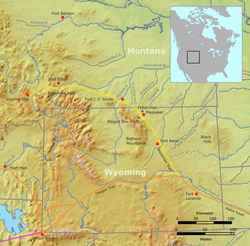
Red Cloud's War challenged the United States military presence on the Bozeman Trail along the eastern edge of the Bighorn Mountains. The conflict reflected Lakota resistance to U.S. expansion through contested Crow country.
Image source: Red Cloud's War
1868
The 1868 Treaty of Fort Laramie between the Sioux and the United States turned the Crow Powder River area recognized in 1851 into unceded Indian territory of the Sioux.
Image source: Treaty of Fort Laramie (1868)
Apr 10, 1876
On April 10, 1876, twenty-three Crow enlisted as Army scouts, siding with the United States during the Great Sioux War.
Jun 25, 1876
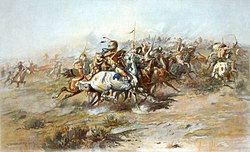
On June 25, 1876, Lakota Sioux and Cheyenne forces defeated troops under Lieutenant Colonel George Armstrong Custer at the Battle of the Little Bighorn, fought within the Crow reservation. The Great Sioux War ended with the defeat of the Sioux and their Cheyenne allies.
Image source: Battle of the Little Bighorn
Jan 8, 1877
On January 8, 1877, three Crow participated in the last battle of the Great Sioux War at the Wolf Mountains.
1882
During the cattle boom, the United States government responded to ranchers' demand for land and pressured the Crow to cede the western part of their reservation.
1882
Despite territorial losses, the Crow retained a reservation of more than 9,300 square kilometers, partly because of their cooperation with the federal government against traditional Sioux and Blackfoot enemies.
Image source: Crow Indian Reservation
1887
The Sword Bearer uprising of 1887 became the most serious armed conflict between the Crow and whites after the 1834 confrontation at Fort McKenzie.
1948
Before the constitutional changes of 2001, the Crow Tribe of Montana was governed by its 1948 constitution.
2000
The 2000 census reported a total population of 6,894 on Crow reservation lands.
2001
The Crow Tribe established a three-branch government through actions taken at a 2001 council meeting and adopted a new constitution. The changes extended the chairperson's term from two years to four.
2001
Although the general council theoretically remained the Crow Tribe's governing body, it had not convened since the establishment of the 2001 constitution. The executive branch officials also served as officials within the general council.
Jul 15, 2001
The quarterly council meeting on July 15, 2001, passed resolutions by voice vote, including repeal of the existing constitution and approval of a new one. Critics noted that the 1948 constitution and Resolution 63-01 required secret-ballot or referendum approval and a specially called election.
May 19, 2008
On May 19, 2008, Hartford and Mary Black Eagle of the Crow Tribe adopted U.S. Senator and later President Barack Obama into the tribe during his first visit as a U.S. presidential candidate to the Crow Nation.
Image source: Barack Obama
2013
During the 2013 United States federal government shutdown, the Crow Tribe furloughed 316 employees and suspended health care, bus services, and irrigation-improvement programs.
Image source: 2013 United States federal government shutdown
2020
In 2020, Tribal Chairman AJ Not Afraid Jr. endorsed President Donald Trump's reelection and supported Republican candidates Steve Daines, Greg Gianforte, and Matt Rosendale.
Or browse the full history timeline directory, with more than 2,500 topics.
This Crow Nation History timeline was generated with the help of AI, using information found on the internet.
We work hard to keep these timelines accurate, but mistakes do get through. If you spot one, email us at [email protected] and we'll fix it for future visitors.
Generate yours with AI or build it from scratch, for free.
Export your timeline, add your own events, edit or remove AI-generated events, and much more
No credit card required.
Cancel anytime.
Cancel anytime.
You can create an unlimited number of timelines with up to 10 events on each one, customize how they look, export them to PDF, PNG, PowerPoint, CSV, and Excel, and share them with a link. Paid plans raise the event limit and add features like spreadsheet imports and collaborators.
Yes. You can cancel your subscription from your account page at any time, and you will not be charged again. Your subscription stays active for the rest of the period you already paid for.
Yes. We will email you a reminder before the annual renewal, and we will also email you a receipt.
Yes. You can email us within 15 days of any payment, and we will issue you a full refund.
Check out our pricing docs or send us an email anytime: [email protected].