-
Use Cases
-
Resources
-
Pricing
Nationalism is a political ideology that emphasizes loyalty and devotion to a nation or nation-state, holding that each nation should govern itself. Emerging prominently during the late 18th century, nationalism fueled revolutions, wars of independence, the unification of countries like Italy and Germany, decolonization movements, and continues to shape global politics today. More Less
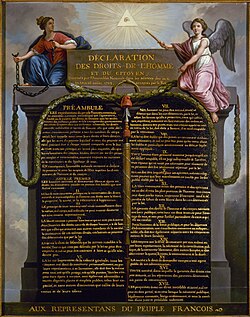
Aug 26, 1789
The Declaration of the Rights of Man and of the Citizen was adopted during the French Revolution, proclaiming that sovereignty resides in the nation. It helped shift political legitimacy from monarchs to the people, laying ideological foundations for modern nationalism across Europe.
Image source: Declaration of the Rights of Man and of the Citizen
Sep 21, 1792
The French Revolution abolished the monarchy and declared France a republic, redefining the nation as a community of equal citizens rather than subjects of a king. Mass conscription (the levée en masse) fused citizen and soldier, making popular nationalism a powerful political force.
Image source: French Revolution

May 18, 1803 - Nov 20, 1815
French conquests under Napoleon spread revolutionary ideals of national self-determination while provoking patriotic resistance in Spain, Germany, and Russia. The wars awakened national consciousness among subjugated peoples who mobilized against foreign rule.
Image source: Napoleonic Wars

Mar 17, 1813 - May 30, 1814
Prussia and other German states rose against Napoleonic domination, framing the struggle as a fight for the German nation. Writers like Fichte promoted a cultural nationalism based on language and shared heritage, fueling later unification movements.
Image source: German campaign of 1813

Mar 25, 1821
Greeks revolted against Ottoman rule, inspired by Enlightenment ideals and classical heritage. The successful war, ending in 1832 with Greek independence, became a model for nationalist movements seeking self-determination from multinational empires.
Image source: Greek War of Independence

Jul 27, 1830 - Aug 2, 1830
The July Revolution overthrew the Bourbon restoration in France and brought Louis Philippe to power. Its success inspired nationalist uprisings elsewhere, including the Belgian Revolution, which soon produced an independent Belgian nation-state.
Image source: July Revolution

Aug 25, 1830 - Jul 21, 1831
Belgians rebelled against Dutch rule of the United Kingdom of the Netherlands, asserting linguistic and religious distinctiveness. Belgium's independence in 1831 demonstrated that European powers would accept new nation-states carved from existing kingdoms.
Image source: Belgian Revolution
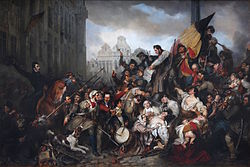
Jan 12, 1848 - Oct 31, 1849
A wave of liberal and nationalist revolutions erupted across Europe, from Paris to Vienna, Berlin, Budapest, and Milan. Though most were suppressed, the 'Springtime of Nations' established nationalism as an unstoppable force demanding constitutional government and national unity.
Image source: Revolutions of 1848
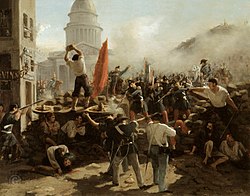
Mar 15, 1848 - Oct 13, 1849
Hungarians under Lajos Kossuth demanded autonomy and constitutional rights within the Austrian Empire. Although crushed with Russian help, the revolution made Hungary a symbol of national resistance and led to the 1867 Austro-Hungarian Compromise.
Image source: Hungarian Revolution of 1848
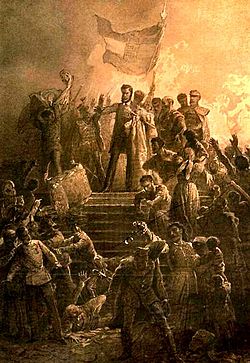
May 18, 1848 - May 29, 1849
Liberal nationalists convened in Frankfurt's St. Paul's Church to draft a constitution for a unified Germany. The effort failed when Prussian king Frederick William IV refused the imperial crown, but it set the template for unification achieved 'from above' by Prussia.
Image source: Frankfurt Parliament

This Nationalism timeline was generated with the help of AI, using information found on the internet.
We work hard to keep these timelines accurate, but mistakes do get through. If you spot one, email us at [email protected] and we'll fix it for future visitors.
Generate yours with AI or build it from scratch, for free.