-
Use Cases
-
Resources
-
Pricing
The Jim Crow Era was a period in American history, primarily in the Southern United States, during which state and local laws enforced racial segregation and disenfranchised African Americans. Named after a racist minstrel character, these 'Jim Crow' laws mandated separate public facilities, schools, transportation, and services for Black and white Americans, institutionalizing discrimination until dismantled by the Civil Rights Movement. More Less
1828
% complete
Thomas D. Rice's blackface character 'Jim Crow', first performed in 1828, became a popular minstrel show caricature of black people. The name later came to signify the social separation of the races, giving its name to the segregation laws of the American South.
1837
% complete
The name 'Jim Crow' also appears on the last line of Richard Harris Barham's 1837 poem 'The Jackaw of Rheims', an early literary use of the phrase that would later become synonymous with racial segregation.
Jan 1865 - Dec 18, 1865
% complete
In January 1865, Congress proposed an amendment to the Constitution abolishing slavery in the United States. It was ratified on December 18, 1865, ending legal slavery but setting the stage for new struggles over the rights of freed African Americans.
Image source: Thirteenth Amendment to the United States Constitution
1865 - 1877
% complete
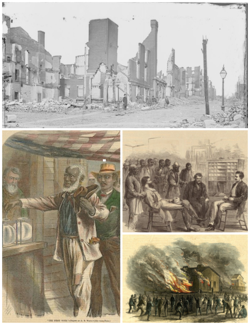
During the Reconstruction era of 1865–1877, federal laws provided civil rights protections in the United States. Public education had essentially been segregated since it began during this period after 1863, laying groundwork for later segregated schooling.
Image source: Reconstruction era
1868
% complete
Gubernatorial elections were close and had been disputed in Louisiana for years, with increasing violence against black Americans during campaigns from 1868 onward, foreshadowing the collapse of Reconstruction protections.
Image source: Compromise of 1877
1875
% complete
Introduced by Charles Sumner and Benjamin Butler, the Civil Rights Act of 1875 stipulated that everyone, regardless of race, color, or previous condition of servitude, was entitled to the same treatment in public accommodations such as inns, public transportation, theaters, and other places of recreation.
Image source: Civil Rights Act of 1875
1877
% complete
The Compromise of 1877, made to gain Southern support in the presidential election, resulted in the government withdrawing the last of the federal troops from the South. This opened the door for Southern states to roll back civil rights protections and enact Jim Crow laws.
1883
% complete
An 1883 Supreme Court decision ruled that the Civil Rights Act of 1875 was unconstitutional in some respects, saying Congress was not afforded control over private persons or corporations, weakening federal protection against private discrimination.
1884
% complete
The earliest known use of the phrase 'Jim Crow law' can be dated to 1884 in a newspaper article summarizing congressional debate, marking the entry of the term into political discourse.
1892
% complete
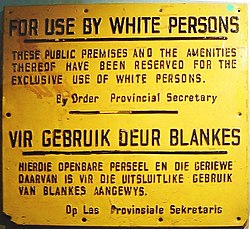
The term appears in 1892 in the title of a New York Times article about Louisiana requiring segregated railroad cars, further popularizing the phrase 'Jim Crow'.
Image source: Jim Crow laws
1890 - 1910
% complete
Between 1890 and 1910, ten of the eleven former Confederate states, beginning with Mississippi, passed new constitutions or amendments that effectively disenfranchised most black people and tens of thousands of poor white people through poll taxes, literacy and comprehension tests, and residency and record-keeping requirements.
Image source: Disfranchisement after the Reconstruction era
1890
% complete
In 1890, Louisiana passed a law requiring separate accommodations for colored and white passengers on railroads. The law had already specified that black people could not ride with white people, but colored people could ride with white people before 1890.
Image source: Plessy v. Ferguson
1892
% complete
In 1892, Homer Plessy bought a first-class ticket from New Orleans on the East Louisiana Railway, deliberately challenging Louisiana's segregated railroad cars law. His arrest led to the landmark Supreme Court case Plessy v. Ferguson.
1896
% complete
Jim Crow laws were upheld in 1896 in the case of Plessy v. Ferguson (163 U.S. 537), in which the Supreme Court ruled that 'separate but equal' facilities were constitutional, providing legal cover for decades of segregation.
1896 - 1904
% complete
The cumulative effect of disenfranchising measures in North Carolina meant that black voters were eliminated from voter rolls during the period from 1896 to 1904, demonstrating the effectiveness of the new state constitutions.
1900 - 1910
% complete
In Louisiana, by 1900, black voters were reduced to 5,320 on the rolls although they comprised the majority of the state's population; by 1910, only 730 black people were registered, less than 0.5% of eligible black men. In 27 of the state's 60 parishes, not a single black voter was registered any longer.
1901 - 1910
% complete
These facilities were not introduced for African Americans in the South until the first decade of the 20th century. Prior to the 20th century, most libraries established for African Americans were school-library combinations.
1910 - 1929
% complete
In Texas, several towns adopted residential segregation laws between 1910 and the 1920s, extending Jim Crow segregation into housing and neighborhood composition.
1912
% complete
In the Jim Crow context, the presidential election of 1912 was steeply slanted against the interests of African Americans, with disenfranchisement across the South muting their political voice.
1913
% complete
In 1913, Secretary of the Treasury William Gibbs McAdoo, an appointee of President Wilson, expressed his opinion of black and white women working together in one government office, reflecting the Wilson administration's segregation of the federal workforce.
Image source: Woodrow Wilson and race
Jul 1913
% complete
Historian David Blight observed that the 'Peace Jubilee' at which President Wilson presided at Gettysburg in 1913 'was a Jim Crow reunion, and white supremacy might be said to have been the silent, invisible master of ceremonies.' A Washington Bee editorial questioned whether the reunion honored those who fought for or against slavery.
Image source: 1913 Gettysburg reunion
1908 - 1949
% complete
The boxers Jack Johnson and Joe Louis, both of whom became world heavyweight boxing champions, gained prominence during the Jim Crow era, challenging racial stereotypes and becoming symbols of black achievement.
Image source: Jack Johnson (boxer)
1908
% complete
In 1908, Congress defeated an attempt to introduce segregated streetcars into the capital, one of several instances where federal legislators resisted the spread of Jim Crow practices.
1909
% complete
After the National Association for the Advancement of Colored People (NAACP) was founded in 1909, it became involved in a sustained public protest and campaigns against the Jim Crow laws and the so-called 'separate but equal' doctrine, including litigation cases begun in the early 20th century to combat disenfranchisement across the South.
Image source: NAACP
1936
% complete
Track and field athlete Jesse Owens won four gold medals at the 1936 Summer Olympics in Berlin, gaining prominence during the Jim Crow era despite facing discrimination at home in the United States.
Image source: Jesse Owens
1944
% complete
In 1944, Associate Justice Frank Murphy introduced the word 'racism' into the lexicon of U.S. Supreme Court opinions, using it twice in a concurring opinion in Steele v. Louisville & Nashville Railway Co. issued that day.
Image source: Steele v. Louisville & Nashville Railway Co.
Feb 12, 1946
% complete
The 1946 police beating and blinding of World War II veteran Isaac Woodard while he was in U.S. Army uniform energized the civil rights movement, becoming one of the flashpoints that galvanized national attention to racial injustice.
Image source: Isaac Woodard
Apr 15, 1947
% complete
A major breakthrough occurred in 1947 when Jackie Robinson was hired as the first African American to play in Major League Baseball; he permanently broke the color bar in professional sports.
Image source: Jackie Robinson
Jul 26, 1948
% complete
In 1948, President Harry S. Truman issued Executive Order 9981, ending racial discrimination in the armed services, a significant federal step against institutionalized segregation.
Image source: Executive Order 9981
Dec 1, 1955
% complete
In 1955, Rosa Parks refused to give up her seat on a city bus to a white man in Montgomery, Alabama. Inspired partly by Claudette Colvin's similar action nine months earlier, Parks's act of civil disobedience became a catalyst for the Montgomery bus boycott, which lasted more than a year and resulted in desegregation of the city's buses.
Image source: Rosa Parks
Jun 1963 - Aug 1963
% complete
In summer 1963, there were 800 demonstrations in 200 southern cities and towns, with over 100,000 participants and 15,000 arrests. In June 1963, Governor George Wallace escalated the crisis in Alabama by defying court orders to admit the first two black students to the University of Alabama.
Image source: Civil rights movement
Aug 28, 1963
% complete
Martin Luther King launched a huge march on Washington in August 1963, bringing out 200,000 demonstrators in front of the Lincoln Memorial, at the time the largest political assembly in the nation's history.
Image source: March on Washington for Jobs and Freedom
1935 - 1936
% complete
During sessions culminating in the Nuremberg Laws, Nazi officials discussed a memorandum by Heinrich Krieger, a former graduate student at the University of Arkansas, based on research into the history of United States immigration and Jim Crow laws. It became the basis for his book Race Law in the United States (1936).
Image source: Nuremberg Laws
2013
% complete
In Shelby County v. Holder (2013), the Supreme Court removed the federal preclearance requirement for any Southern state alteration in voting policies, weakening a key protection of the Voting Rights Act of 1965.
Nov 6, 2018 - 2019
% complete
Louisiana's law was amended in 2018 to require a unanimous jury for criminal convictions, effective in 2019, undoing a Jim Crow-era legacy provision that had allowed split verdicts, a rule rooted in the state's 1890 constitution.
2020
% complete
Mississippi Today discusses the present-day Jim Crow legacy of felony disenfranchisement, noting that part of Mississippi's 1890 constitution was not erased by the Civil Rights Movement during the 1960s and continues to affect voting rights today.
Image source: Felony disenfranchisement in the United States
2026
% complete
In Callais (2026), the Supreme Court ruled that the interpretation of section 2 of the Voting Rights Act as requiring the creation of majority-minority districts was unconstitutional, and that plaintiffs must prove a state intentionally redistricted based on race.
Image source: Redistricting
May 17, 1954
% complete
In its pivotal 1954 decision, Brown v. Board of Education (347 U.S. 483), the Warren Court unanimously (9–0) overturned the 1896 Plessy decision, declaring state-sponsored segregation of public schools unconstitutional.
Jun 1964
% complete
The disappearance and murder of three voting-rights activists in Mississippi in 1964 captured national attention, and the ensuing outrage was used by President Johnson and civil rights activists to build a coalition pushing Congress to pass the Civil Rights Act of 1964.
Image source: Murders of Chaney, Goodman, and Schwerner
Jul 2, 1964
% complete
President Lyndon Johnson formed a coalition with Northern Republicans that led to passage in the House, and with Republican Senate leader Everett Dirksen's help, passage in the Senate early in 1964. On July 2, 1964, Johnson signed the historic Civil Rights Act of 1964, the most powerful affirmation of equal rights ever made by Congress, which was widely accepted across the nation.
Dec 14, 1964
% complete
United States 379 US 241 (1964): the Supreme Court case Heart of Atlanta Motel v. United States upheld the constitutionality of the Civil Rights Act of 1964's public accommodations provisions, ensuring federal enforcement against segregation.
Mar 7, 1965
% complete
On March 7, 1965, county and state troopers launched an unprovoked attack on peaceful Alabama marchers crossing the Edmund Pettus Bridge en route from Selma to Montgomery. The event persuaded the President and Congress to overcome Southern resistance to effective voting rights enforcement legislation.
Image source: Selma to Montgomery marches
Aug 6, 1965
% complete
The Voting Rights Act of 1965 ended legally sanctioned state barriers to voting for all federal, state and local elections. Together with the Civil Rights Act of 1964, it overturned most remaining Jim Crow laws.
Jun 12, 1967
% complete
Anti-miscegenation laws were not repealed by the Civil Rights Act of 1964, but were declared unconstitutional by the U.S. Supreme Court in the 1967 case of Loving v. Virginia, overturning Southern states' bans on interracial marriage.
Or browse the full history timeline directory, with more than 2,000 topics.
This Jim Crow Era timeline was generated with the help of AI, using information found on the internet.
We work hard to keep these timelines accurate, but mistakes do get through. If you spot one, email us at [email protected] and we'll fix it for future visitors.
Generate yours with AI or build it from scratch, for free.
Export your timeline, add your own events, edit or remove AI-generated events, and much more
No credit card required.
Cancel anytime.
Cancel anytime.
You can create an unlimited number of timelines with up to 10 events on each one, customize how they look, export them to PDF, PNG, PowerPoint, CSV, and Excel, and share them with a link. Paid plans raise the event limit and add features like spreadsheet imports and collaborators.
Yes. You can cancel your subscription from your account page at any time, and you will not be charged again. Your subscription stays active for the rest of the period you already paid for.
Yes. We will email you a reminder before the annual renewal, and we will also email you a receipt.
Yes. You can email us within 15 days of any payment, and we will issue you a full refund.
Check out our pricing docs or send us an email anytime: [email protected].