-
Use Cases
-
Resources
-
Pricing
The Post-War Era refers to the period following World War II, roughly from 1945 to 1991, marked by the rise of two superpowers—the United States and the Soviet Union—and the ideological struggle of the Cold War. This period saw unprecedented economic growth in Western nations, the Marshall Plan's rebuilding of Europe, widespread decolonization across Asia and Africa, the formation of institutions like the United Nations and NATO, and major social transformations including civil rights movements. It ended with the dissolution of the Soviet Union in 1991. More Less
1947
% complete
The Cold War began around 1947 with the second Red Scare, as underlying geopolitical and ideological differences between recent wartime allies led to mutual suspicions and confrontation between the United States and the Soviet Union that lasted until about 1991.
Image source: Red Scare
1974
% complete
In 1974, India tested its first nuclear weapon under Operation Smiling Buddha, becoming one of the few nations with nuclear capabilities. The test marked a major milestone in South Asian security dynamics and set the stage for a regional nuclear rivalry.
1980
% complete
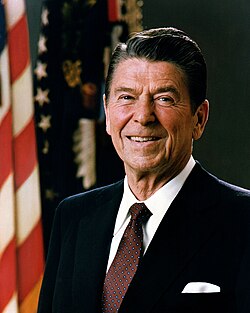
Reagan's presidency beginning in 1980 was focused on the rebuilding of the country, emphasizing economic recovery, renewed military strength, and a more assertive stance against the Soviet Union during the final phase of the Cold War.
Image source: Presidency of Ronald Reagan
1998
% complete
Having acquired uranium-enriching centrifuges in the 1980s, Pakistan conducted several underground nuclear tests in 1998 in response to India's tests, formally establishing South Asia as a region of nuclear rivalry.
Image source: Chagai-I
1978
% complete
The People's Republic of China started to move towards capitalism in the late 1970s, initiating market-oriented reforms that would accelerate dramatically over subsequent decades and transform its economy into a mixed system framed as 'socialism with Chinese characteristics'.
Image source: Chinese economic reform
1987
% complete
Kentucky Fried Chicken entered China in 1987, becoming the first American fast food chain to operate in the country and symbolizing China's growing openness to Western commerce and investment.
Image source: KFC in China
1989
% complete
After facing public anger following the 1989 Tiananmen Square protests and massacre in Beijing, China moved even more quickly towards free-market economics in the 1990s, framing this mixed economy as 'socialism with Chinese characteristics' to sustain growth while maintaining political control.
Image source: 1989 Tiananmen Square protests and massacre
1990
% complete
Restrictions on car ownership were loosened in China in the early 1990s, fueling a boom in personal automobile purchases that caused the bicycle to decline as a form of transport by 2000 and reshaped urban life.
Image source: Automotive industry in China
1990
% complete
Stock markets were established in Shenzhen and Shanghai in late 1990, a landmark step in China's transition toward free-market economics and a crucial component of building its modern capitalist financial infrastructure.
Image source: Shanghai Stock Exchange
1990
% complete
McDonald's and Pizza Hut both entered China in the second half of 1990, becoming the first American chains in the country aside from Kentucky Fried Chicken and signaling accelerating Western commercial influence in the Chinese market.
Image source: Fast food in China
1995
% complete
In 1995, only about 20 million people — less than 0.5 percent of the world's population at the time — were online, mostly in the United States and several other Western countries, highlighting how nascent the digital revolution still was.
Image source: History of the Internet
1995
% complete
In 1995, the last restrictions on commercial enterprise online were lifted, opening the Internet to business and helping launch the dot-com boom that transformed the global economy.
2000
% complete
By 2000, the bicycle had declined as a form of transport in China as loosened restrictions on car ownership in the early 1990s fueled rapid motorization, transforming Chinese cities and consumption patterns.
Image source: Cycling in China
1987
% complete
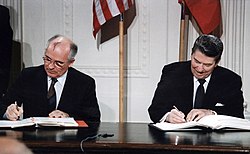
The signing of the world's first nuclear disarmament treaty occurred in 1987, an agreement some historians date as marking the end of the Cold War. It eliminated an entire class of nuclear missiles and signaled a thaw in superpower relations.
Image source: Intermediate-Range Nuclear Forces Treaty
1988 - 1991
% complete
The dissolution of the Soviet Union began in 1988 and marked the end of the Cold War by 1991, leaving the United States as the world's sole superpower and inaugurating the post–Cold War era of history.
Image source: Dissolution of the Soviet Union
1993
% complete
The establishment of the European Union in 1993 effectively reversed Europe's Cold War divide by absorbing most of Eastern Europe and integrating it with Western Europe over the course of three enlargements, creating a powerful economic and political bloc.
Image source: European Union
Dec 20, 1989 - Jan 31, 1990
% complete
The United States invaded Panama in December 1989, deposing dictator Manuel Noriega. It was one of the major military conflicts generally associated with the post–Cold War era and demonstrated continued American interventionism in Latin America.
Image source: United States invasion of Panama
Aug 2, 1990 - Feb 28, 1991
% complete
The Gulf War erupted when Iraq invaded Kuwait in 1990, prompting a U.S.-led coalition to launch Operation Desert Storm in early 1991. The swift liberation of Kuwait showcased American military dominance in the newly unipolar world.
Image source: Gulf War
1991 - 2001
% complete
The Yugoslav Wars were a series of brutal conflicts in the Balkans during the 1990s following Yugoslavia's breakup, including devastating ethnic cleansing and NATO intervention. They were among the deadliest European conflicts since World War II.
Image source: Yugoslav Wars
1994 - 1996
% complete
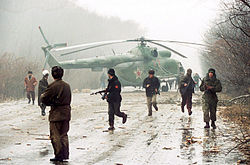
The First Chechen War saw Russian forces battle separatists in the breakaway republic of Chechnya from 1994 to 1996, resulting in heavy casualties and ultimately a Russian withdrawal after the humiliating Khasavyurt Accord.
Image source: First Chechen War
1999 - 2009
% complete
The Second Chechen War began in 1999 when Russia reasserted control over Chechnya following incursions by Islamist militants. The conflict featured intense urban combat in Grozny and restored Russian authority at enormous humanitarian cost.
Image source: Second Chechen War
Sep 11, 2001
% complete
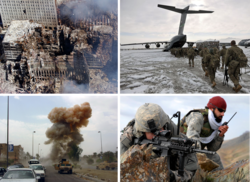
The September 11 attacks prompted the initiation of the war on terror in 2001. Following the peace dividend of the 1990s, U.S. defense expenditure rose again to comparable Cold War-era heights as America embarked on global counterterrorism campaigns.
Image source: War on terror
Oct 7, 2001 - 2021
% complete
The War in Afghanistan began in October 2001 with a U.S.-led invasion to topple the Taliban regime harboring al-Qaeda. It became America's longest war, spanning two decades before the Taliban retook power upon the 2021 withdrawal.
Image source: War in Afghanistan (2001–2021)
Mar 20, 2003 - 2011
% complete
The Iraq War began with the 2003 U.S.-led invasion that toppled Saddam Hussein's regime. Years of insurgency and instability followed, making it one of the defining and most controversial conflicts of the post–Cold War era.
Image source: Iraq War
Dec 11, 2006
% complete
The Mexican drug war began in late 2006 when the government launched a crackdown against drug cartels. The ensuing violence between cartels and security forces caused tens of thousands of deaths and remains a major security crisis.
Image source: Mexican drug war
Aug 7, 2008 - Aug 12, 2008
% complete
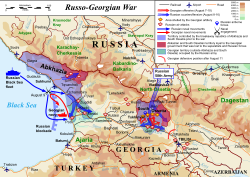
The Russo-Georgian War broke out in August 2008 when Russia and Georgia fought a five-day conflict over South Ossetia and Abkhazia. Russia recognized both regions afterward, foreshadowing renewed tensions between Russia and the West.
Image source: Russo-Georgian War
Dec 18, 2010
% complete
The Arab Spring began in late 2010 as pro-democracy uprisings swept across the Middle East and North Africa, toppling long-standing dictators in Tunisia, Egypt, Libya, and Yemen while sparking civil wars and regional instability.
Image source: Arab Spring
Mar 15, 2011
% complete
The Syrian civil war erupted in March 2011 from protests during the Arab Spring, escalating into a devastating multi-sided conflict involving foreign powers, jihadist groups, and massive displacement of civilians.
Image source: Syrian civil war
2014
% complete
The Russo-Ukrainian War began in 2014 with Russia's annexation of Crimea and support for separatists in eastern Ukraine, later escalating into a full-scale invasion in 2022 that became Europe's largest conflict since World War II.
Image source: Russo-Ukrainian War
Oct 7, 2023
% complete
The Gaza War and its associated Middle Eastern crisis erupted in October 2023, triggering regional escalation involving multiple state and non-state actors and drawing international attention to the Red Sea crisis that followed.
Image source: Middle Eastern crisis (2023–present)
2025
% complete
Operation Southern Spear was a U.S. military operation in the Caribbean region targeting drug trafficking networks amid heightened tensions with Venezuela, reflecting renewed American assertiveness in Latin America.
Image source: Operation Southern Spear
2026
% complete
The 2026 United States intervention in Venezuela marked a major American military involvement in Latin America, continuing a pattern of post–Cold War interventions and significantly reshaping regional geopolitics.
Image source: 2026 United States intervention in Venezuela
2026
% complete
The 2026 Iran war represented a major escalation of Middle Eastern conflict, drawing in global powers and further destabilizing a region already strained by the Gaza War and its broader crisis.
1990
% complete
In 1990, Nelson Mandela was freed from prison after 27 years of incarceration, and the South African regime began steps to end apartheid, setting the nation on a path toward democracy and racial reconciliation.
Image source: Nelson Mandela
Apr 26, 1994
% complete
South Africa's first democratic elections in April 1994 culminated the process of ending apartheid, resulting in Nelson Mandela being elected as President of South Africa and inaugurating a new era of multiracial democracy.
Image source: 1994 South African general election
2023
% complete
As of 2023, only five countries in the world are still ruled as communist states: China, Cuba, North Korea, Laos, and Vietnam, a dramatic contraction from the height of communist rule during the Cold War.
Image source: Communist state
Or browse the full history timeline directory, with more than 2,000 topics.
This Post-War Era timeline was generated with the help of AI, using information found on the internet.
We work hard to keep these timelines accurate, but mistakes do get through. If you spot one, email us at [email protected] and we'll fix it for future visitors.
Generate yours with AI or build it from scratch, for free.
Export your timeline, add your own events, edit or remove AI-generated events, and much more
No credit card required.
Cancel anytime.
Cancel anytime.
You can create an unlimited number of timelines with up to 10 events on each one, customize how they look, export them to PDF, PNG, PowerPoint, CSV, and Excel, and share them with a link. Paid plans raise the event limit and add features like spreadsheet imports and collaborators.
Yes. You can cancel your subscription from your account page at any time, and you will not be charged again. Your subscription stays active for the rest of the period you already paid for.
Yes. We will email you a reminder before the annual renewal, and we will also email you a receipt.
Yes. You can email us within 15 days of any payment, and we will issue you a full refund.
Check out our pricing docs or send us an email anytime: [email protected].